
Recently added item(s)
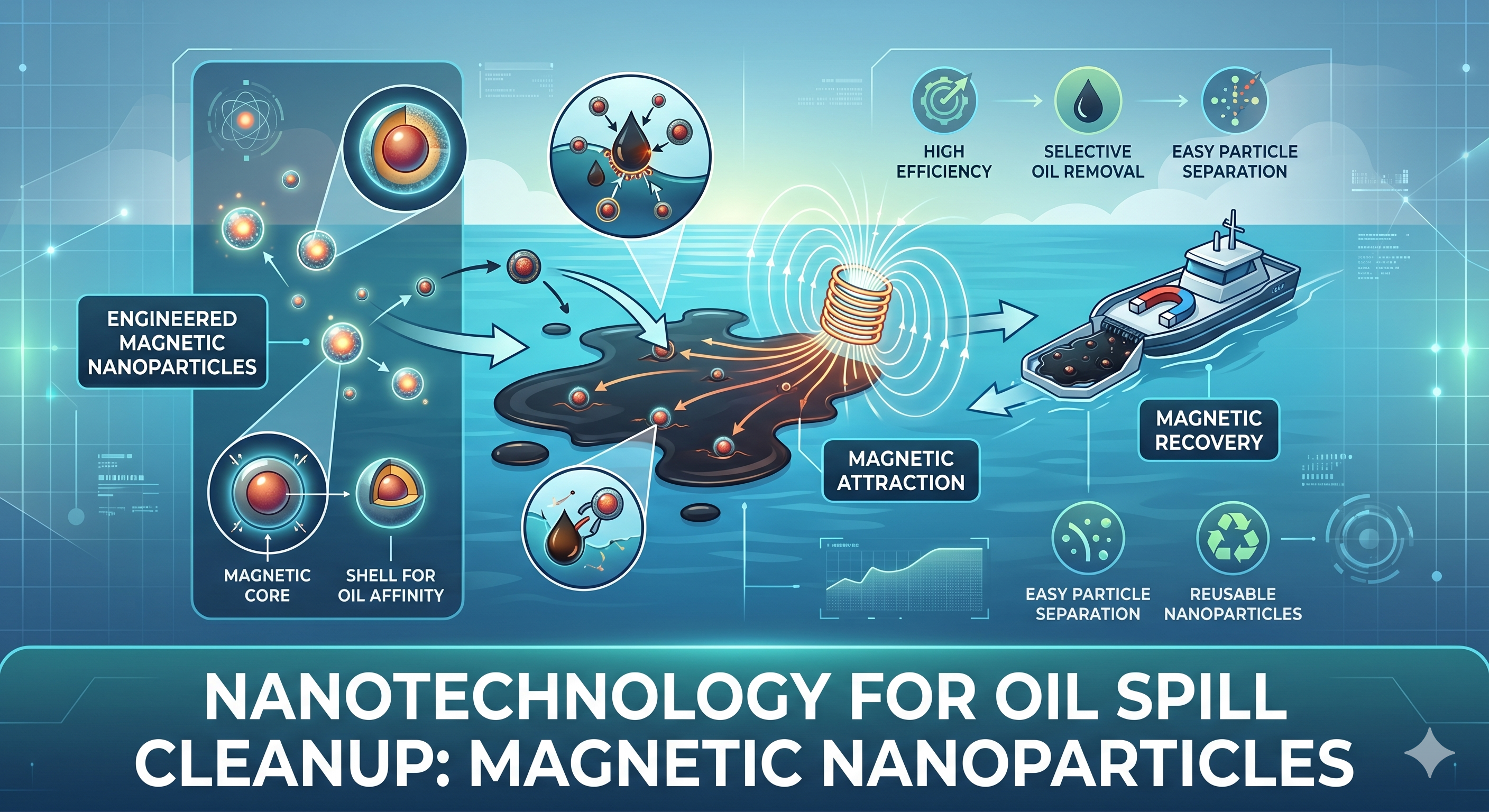
Oil spills are environmental catastrophes of massive proportions. They are not merely localized accidents; they represent the sudden, violent disruption of delicate marine and coastal ecosystems. When a tanker breaches, a pipeline leaks, or an offshore rig fails, millions of gallons of crude oil pour into the ocean. This dark tide smothers wildlife, devastates fisheries, poisons habitats, and poses severe long-term risks to human health in coastal communities.
Traditionally, the battle against oil spills has been fought with methods that are often inefficient, costly, or sometimes, even environmentally harmful in their own right. Chemical dispersants break down oil but can add toxicity to the water. Sorbents can soak up oil but become massive amounts of hazardous waste. Skimmers are slow and fail completely in rough seas.
Today, however, the burgeoning field of nanotechnology offers a revolutionary shield in this ecological war. Among the most promising tools is the use of magnetic nanoparticles (MNPs). This technique combines the astonishing properties of materials at the nanoscale with the oldest force of nature: magnetism. It promises to not only clean up spills more efficiently but also to recover the valuable oil and reuse the cleaning materials, moving environmental remediation toward a circular economy model.
Understanding the Nanoscale Solution
To appreciate how this technology works, we first need to understand what makes these materials special. A nanoparticle is an incredibly small entity, typically between 1 and 100 nanometers in size. To put that into perspective, a human hair is about 80,000 to 100,000 nanometers thick. At this tiny scale, materials behave differently than their larger counterparts. They have an immensely high surface-area-to-volume ratio, meaning almost all their molecules are exposed to the environment, making them extremely reactive.
For oil spill cleanup, scientists utilize particles that can be easily magnetized—most commonly Magnetite ($Fe_3O_4$). However, bare magnetic particles have two fatal flaws for environmental use: they tend to clump together, and they don’t naturally distinguish between oil and water.
The Secret Ingredient: Surface Functionalization
The magic of magnetic nanotechnology lies in how these particles are modified, a process known as surface functionalization. Scientists coat the magnetite core with specialized molecules that make them “smart.”
These coatings are designed to achieve two crucial goals:
-
Superhydrophobicity (Water-Repelling): The coating has a powerful chemical aversion to water molecules, ensuring the particle does not absorb water.
-
Superoleophilicity (Oil-Loving): The coating has a powerful chemical affinity for hydrocarbons (the components of oil), allowing the particle to latch onto oil droplets instantly.
When functionalized, these magnetic nanoparticles act as invisible, magnetic-sensitive nets.
The Cleanup Process: Step-by-Step
A MNP-assisted cleanup operation would ideally follow a sophisticated, yet straightforward, four-step process:
1. Dispersion
The specialized magnetic nanoparticles are dispersed over the affected area of the oil slick. This can be done via specialized ships or even aircraft, similar to how conventional dispersants are applied today. Due to their high reactivity and oleophilic coatings, the nanoparticles immediately seek out and bind with the oil droplets.
2. Attraction and Absorption
The nanoparticles rapidly infiltrate the oil slick, turning the viscous liquid into a slightly thicker but magnet-sensitive substance. The oil essentially becomes “magnetic.” Each oil droplet is now coated or integrated with a multitude of nano-sized magnetic handles.
3. Collection
This is where the technology truly shines. Massive magnetic skimmers or robotic collectors are deployed. These devices generate powerful external magnetic fields. Instead of slowly skimming the surface, these devices actively pull the “magnetic oil” toward them, separating it cleanly from the surrounding water. This collection can occur even in choppy waters where conventional skimmers fail.
4. Recovery and Reuse
Once collected, the mixture is heated or centrifuged to release the nanoparticles from the oil. The valuable crude oil is recovered and can be refined, drastically reducing the economic loss of the spill. Crucially, the nanoparticles can then be collected and reused in another part of the slick, or stored for future emergencies, minimizing waste.
Recent Advancements and Pilot Studies
While “clinical studies” are the benchmark for pharmaceutical development, the equivalent environmental strategy involves rigorous laboratory testing, followed by escalating pilot and field trials. The field of magnetic nanoremediation is currently transitioning from advanced lab settings to larger-scale experimental validations.
Green Synthesis: Making the Cure Sustainable
A major focus of current research is the sustainable production of MNPs. Traditional chemical synthesis methods can be energy-intensive and require hazardous precursors. Recent studies have successfully synthesized magnetite nanoparticles using plant extracts (like green tea or oak leaf), fruit wastes (like pomegranate peel), and even agricultural byproducts. These “green” synthesized MNPs are not only cheaper but also intrinsically more biocompatible, reducing the secondary environmental risk of the nanoproduct itself.
Advanced Hybrid Materials
Scientists are now creating hybrid nanomaterials to enhance performance. Researchers have developed magnetic nanosponges by combining MNPs with porous materials like graphene oxide or carbon nanotubes. These hybrids have an even higher surface area, allowing them to absorb dozens of times their own weight in oil, while still being magnetically retrievable.
Pilot Experiments and Modeling
Several institutions are conducting large-scale laboratory and small-scale pilot tank experiments. These tests simulate ocean conditions, including different salinities, temperatures, and wave actions. Research presented in recent cleaner production journals has demonstrated the creation of magnetic sponges using energy-efficient foaming methods, capable of recovering heavy crude oil from simulated reservoirs with efficiencies exceeding 99% across multiple use cycles. Furthermore, environmental engineers are using complex hydrodynamic modeling to predict how MNP plumes disperse and collect in real-world oceanic currents, which is crucial for designing future deployment strategies.
Advantage–Risk Evaluation
This revolutionary technology must be rigorously evaluated before widespread deployment. The potential benefits are monumental, but the potential risks cannot be ignored.
Advantages: Why this changes everything
-
High Efficiency and Speed: The nanoscale reactivity means they bind with oil instantly, and magnetic collection is far faster than gravity-based skimming, crucial for containing a rapidly spreading spill.
-
Oil Recovery: This is one of the few techniques that recovers the spilled oil in a usable form, turning a waste disaster into a potential resource recovery operation.
-
Material Reusability: The ability to recycle the nanoparticles drastically reduces the overall cost and environmental footprint of the cleanup material itself.
-
Effective in All Conditions: Unlike skimmers, magnetic collection is effective in rough seas and even in icy Arctic conditions.
-
Selective Cleanup: They don’t absorb water, reducing the volume of collected material that needs processing.
Risks and Challenges: Proceeding with Caution
-
Ecotoxicity and Bioaccumulation: The primary concern is the long-term effect of residual nanoparticles that are not collected. How do they affect marine microorganisms, coral reefs, or the wider food chain? While magnetite itself is relatively non-toxic, the long-term biological effects of functionalized nanocoatings need exhaustive study.
-
Large-Scale Production and Cost: While costs are dropping, synthesizing and functionalizing specialized nanoparticles at the metric-ton scale required for a major spill remains expensive.
-
Environmental Fate: What happens to the nanoparticles after the cleanup? Do they degrade? Do they settle on the ocean floor? Extensive environmental fate modeling and monitoring are essential.
-
Regulatory Hurdles: The use of nanomaterials in open environments is a regulatory gray area in many jurisdictions. Comprehensive international frameworks are needed to manage their use.
The Future Outlook
The use of magnetic nanoparticles for oil spill cleanup is not science fiction; it is a burgeoning scientific reality. We are currently in the crucial phase of transition from “lab to ocean.”
The next decade will likely see the deployment of this technology in localized field trials for small-scale coastal spills. As ecotoxicity data becomes more robust and synthesis methods become more sustainable and cost-effective, magnetic nanoremediation could become a staple of standard oil spill response protocols worldwide. The focus will shift from “can we do it?” to “how can we do it responsibly and at scale?”
Conclusion
Oil spills are a grim reminder of our continued dependence on fossil fuels and the fragility of our blue planet. While the ultimate solution is to prevent spills through the transition to renewable energy, we must equip ourselves with the best possible tools to manage the risks that remain. Magnetic nanoparticles offer a potential quantum leap in our ability to defend marine ecosystems, moving beyond simple containment to intelligent recovery and circular environmental protection.