
Recently added item(s)
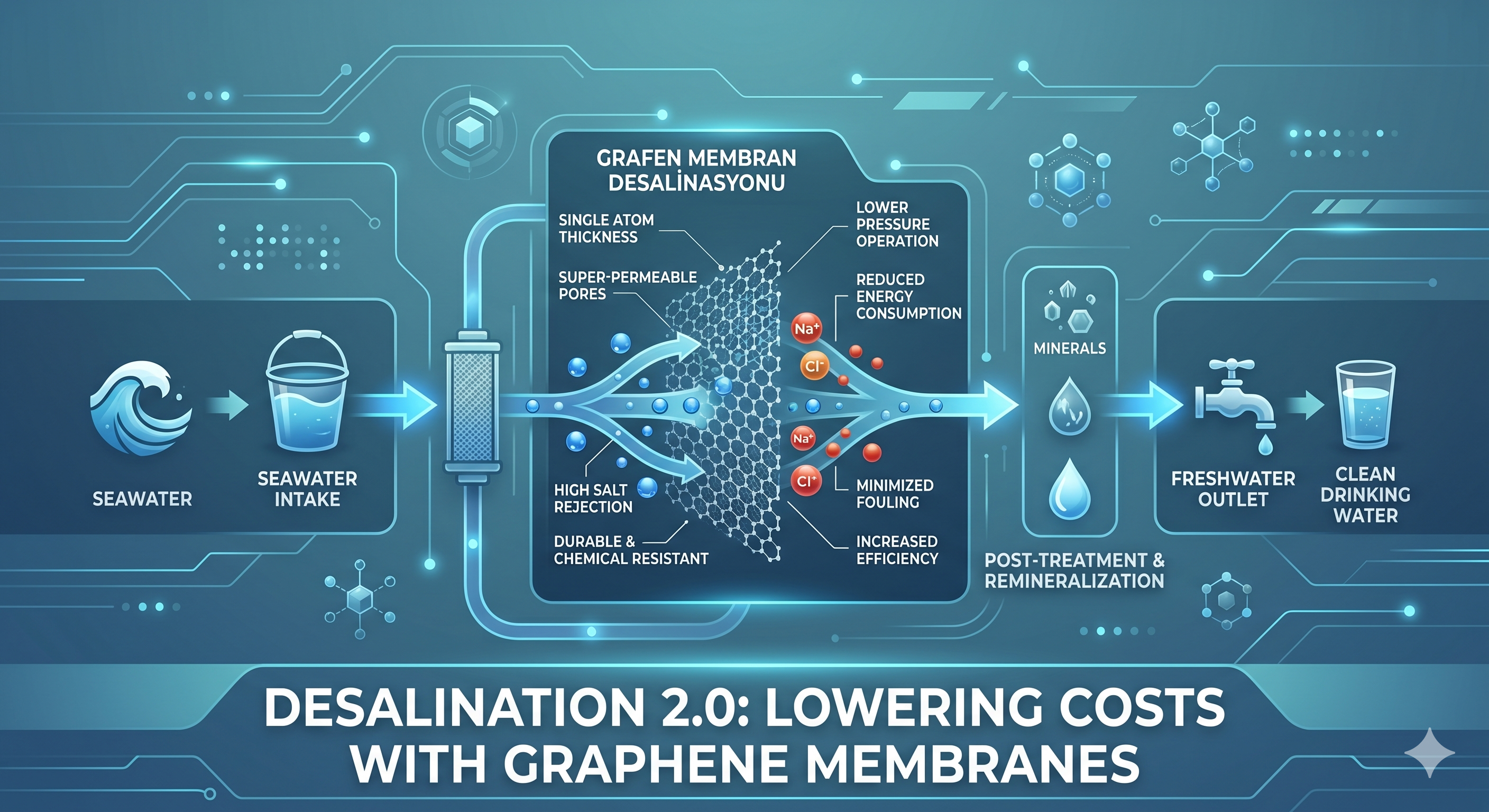
Water is the essence of life, yet the paradox of our planet is that while it is covered in water, fresh, drinkable water is a vanishing resource. Global demand for fresh water is skyrocketing due to population growth, industrialization, and agriculture, while climate change is rapidly shrinking traditional water sources like glaciers and rivers. This has forced the world to turn to the most abundant source of all: the ocean.
Traditional desalination—the process of removing salt from seawater—has been our savior in arid regions, but it comes with a massive catch. It is incredibly energy-intensive and prohibitively expensive for many parts of the world. But we are on the precipice of a revolution: Desalination 2.0, powered by a nanotechnology wonder-material known as graphene. This shift promises to radically lower the cost of water, making the dream of abundant fresh water a global reality.
The Bottleneck of Desalination 1.0: Reverse Osmosis
To appreciate Desalination 2.0, we must first understand the current state of the art, Desalination 1.0.
Today, around 80% of the world’s desalination uses a process called Reverse Osmosis (RO). In RO, massive high-pressure pumps force seawater against a semi-permeable membrane. This membrane acts like a super-fine sieve: it has pores small enough to let water molecules pass through but large enough to block the dissolved salt ions (sodium and chloride).
The membranes used in RO are typically made of synthetic polymers (polyamides). While this technology has matured significantly, it faces two fundamental bottlenecks:
-
High Pressure (Energy) Demand: The polymer membranes are relatively thick and have twisted, tortuous paths for the water to navigate. To achieve the water flux (flow rate) needed for commercial use, immense pressure is required to push the water through these slow, inefficient channels. This energy consumption is the largest single operational cost in a desalination plant.
-
Fouling and Integrity: Over time, these membranes get clogged by organic matter (bacteria), biological growth, and mineral deposits, a problem known as fouling. This decreases efficiency and requires aggressive, expensive chemical cleaning or frequent, costly membrane replacements. Furthermore, polymers degrade under chemical exposure, limiting their lifespan.
Graphene: The Atomistic Filter
The limitations of polymer membranes are constraints of chemistry and physics. To break through them, we need a better material. Enter graphene.
Graphene, discovered in 2004 by scientists at the University of Manchester, is a single layer of carbon atoms arranged in a hexagonal lattice—a two-dimensional material. Despite being the thinnest material known (just one atom thick), it is roughly 200 times stronger than steel, incredibly flexible, and chemically stable.
But why is a one-atom-thick sheet of carbon the key to cheap water? The answer lies in its atomistic thinness and the potential to create atomically precise filters.
1. The Energy Game Changer: Lowering the Pressure Bar
The single greatest cost in desalination is electricity. By replacing thick polymer membranes with one-atom-thick graphene sheets, we can dramatically reduce the friction water experiences as it flows through the filter.
Mathematical modeling and molecular dynamics simulations by research groups at MIT and the University of Manchester have shown that water flux through graphene membranes could be several orders of magnitude higher than through state-of-the-art polymer membranes.
Why does this lower the cost?
-
Less Pressure: Because water flows so easily, the high-pressure pumps that currently consume massive amounts of electricity can be operated at significantly lower pressures while still achieving the same water output.
-
Smaller Plants: Alternatively, at current pressures, a much smaller membrane area (and therefore a smaller, cheaper plant) could produce the same amount of water.
This potential for extreme permeability without sacrificing salt rejection is the “Holy Grail” of desalination engineering.
2. Precise Sieve or Laminar Maze? The Two Main Approaches
Using graphene for desalination isn’t as simple as punching a few holes in a carbon sheet. Scientists are exploring two major architectures:
Approach A: Perforated Pristine Graphene (NP-G)
The idealized, pristine approach involves taking a single large-scale graphene sheet and drilling billions of nano-pores into it. These holes must be exactly 0.7 to 1.0 nanometers wide—large enough to let water (which exists as molecules about 0.3 nm in size) through, but small enough to block sodium ions (which are “hydrated” by a shell of water molecules, making them behave as if they are about 0.9 nm).
This is a precision engineering challenge. Current techniques like ion-beam drilling or laser etching are expensive and cannot yet be scaled up to create membranes for a town’s water supply.
Approach B: Graphene Oxide (GO) Membranes
This is the more practical, scalable approach currently dominating research. Graphene Oxide (GO) is a chemical relative of graphene that is easy to produce in solution, making it ideal for large-scale manufacturing (like printing or coating).
When GO layers are stacked on top of each other like a deck of cards, they create laminar nano-channels. Water doesn’t go through the pores in the graphene sheets; it navigates the space between the sheets. The key to desalination here is controlling the interlayer spacing. Scientists have shown that this spacing can be “tuned” to a precise dimension that allows water to zip along the graphene surface while blocking hydrated salt ions.
Key Research Breakthroughs and “Clinical” Safety Trials
The journey from the “winking” discovery of graphene to industrial desalination is a story of incredible breakthroughs and rigorous validation. (While “clinical” is unusual for water filtration, we will interpret this as pilot trials and toxicity assessments crucial for regulatory approval and human safety).
1. Scaling Up Graphene Oxide Production
One of the most significant research milestones was moving GO from a milligram-scale lab curiosity to kilograms. Research hubs like the University of Manchester’s National Graphene Institute (NGI) have developed processes for exfoliating GO from graphite in large batches, making GO solution a relatively inexpensive material.
2. Fixing the “Swelling” Problem (Molecular Cross-Linking)
The biggest challenge with GO membranes was stability. When GO stacks are placed in water, they naturally absorb water and swell, increasing the interlayer spacing too much and allowing salt through.
Breakthrough research in the mid-2010s demonstrated that this spacing could be precisely controlled using molecular “glue”—chemical cross-linkers that bond the GO layers together at a fixed distance. Research groups have used everything from large organic molecules to simple mineral ions (like calcium or magnesium) to act as atomic spacers, ensuring the GO stack retains its filtering precision even when submerged in the sea.
3. Pilot Plants and Field Trials: Real-World Proof
The first wave of true “field” testing (our “clinical” trials for water infrastructure) is now underway.
Startups (like G2O Water Technologies in the UK) and academic-industrial partnerships have deployed pilot-scale graphene membranes for water purification. These tests are vital for answering key operational questions: How well do they handle fluctuations in salinity? Are they robust? Do they actually repel fouling as predicted?
While true seawater desalination pilot plants (which require extreme salt rejection) are still in the pre-commercial development phase, the initial trials for brackish water (less salty water, easier to filter) show that the permeability benefits are real.
4. Safety: The Ecotoxicity and Cytotoxicity Assessment
Before any technology is approved for human drinking water, it must undergo extensive safety trials. The main safety question for graphene membranes is leaching: will any graphene or GO particles break off and contaminate the drinking water? And if they do, are they toxic to humans?
This is where the closest equivalent to “clinical” studies occurs. In-vitro studies (using isolated cells) and ecotoxicity studies (using aquatic organisms like zebrafish or algae) are essential.
While some studies have flagged potential toxicity for free-floating graphene oxide particles, the situation with embedded membranes is different. Current safety evaluations by environmental agencies show that when GO layers are cross-linked into a robust, solid stack, leaching can be kept well below current detection limits (parts per billion). The regulatory roadmap for graphene membranes is actively being built on the foundation of these negative-for-leaching data.
A Balanced Assessment: Advantages vs. Risks and Bottlenecks
The future of graphene-based desalination is not without friction. A proper evaluation must weigh its immense potential against the significant engineering and economic hurdles.
The Advantages: Desalination’s “Grand Sieve”
The primary advantages can be summarized in three categories:
-
Energy and Operational Cost Reduction: This is the headline benefit. A potential 20–50% reduction in electricity demand would radically change the economics of water security, potentially making desalination affordable in water-stressed, developing economies in the Middle East, North Africa, and Southeast Asia.
-
Anti-Fouling and Improved Durability: Graphene surfaces are atomically smooth and chemically inert. They are predicted to resist fouling from organic matter much better than porous polymers. Moreover, GO membranes are chemically and physically robust, potentially outlasting polymer membranes by years, which would lower the long-term cost of ownership and maintenance.
-
High-Precision Filtration: Unlike polymer membranes that have a broad pore size distribution, the interlayer spacing in GO membranes can be tuned with sub-angstrom precision. This allows for superior selective filtration—not just removing salt, but also rejecting specific complex contaminants like heavy metals, nitrates, boron, and even organic micro-pollutants (like PFAS) that struggle to fit through traditional RO membranes.
The Risks and Bottlenecks: The Scaling Nightmare
Graphene desalination faces the “scaling bottleneck”—a classic challenge in nanotechnology commercialization.
-
Uniformity on a Mile-Scale: It is one thing to make a uniform, flaw-free GO membrane the size of a postage stamp in a lab; it is an entirely different challenge to coat uniform, defect-free stacks onto miles of industrial filter support materials without creating pinholes or variations in thickness. A single significant defect could render an entire industrial module useless for desalination.
-
Manufacturing Cost Competitiveness: Currently, state-of-the-art polyamide (polymer) membranes are incredibly mature and remarkably cheap (about $0.05 per square meter). The cost of production for GO-coated membranes, while dropping, is still significantly higher. Graphene membranes will not win the cost battle on material cost alone; they must win on operational lifecycle savings (energy, longevity).
-
The Stability Dilemma: Can we guarantee that a chemically cross-linked GO membrane, subjected to the brutal physical pressures of seawater desalination (which can exceed 60 bars) for months or years, will maintain its interlayer spacing precision? The long-term physical stability of GO laminates under extreme operational stress remains a critical unanswered question for commercial adoption.
Conclusion: A World of Thirsty Oceans and Hope
Global desalination today produces over 100 million cubic meters of fresh water daily—enough to supply a major portion of the world’s arid regions. However, this output is merely a scratch on the surface of our global need, and its high energy cost is both economically and environmentally unsustainable.
Desalination 2.0, with its promise of a nanotechnology wonder-material, offers a path forward. Graphene membranes are the most plausible hope we have for fundamentally rewriting the energy equation of fresh water.
We are currently in a critical transition phase. We have proven the atomic physics, engineered the molecular structures, and scaled the material. The remaining journey is not about the science of graphene, but about the science of scale and the business of engineering. The upcoming decade, with its full-scale desalination pilot trials and comprehensive safety data, will determine if the atomistic thinness of a graphene sieve will be the key that finally unlocks the limitless potential of our thirsty oceans. Water security is the defining challenge of our century, and Graphene Desalination 2.0 may well be its answer.