
Recently added item(s)
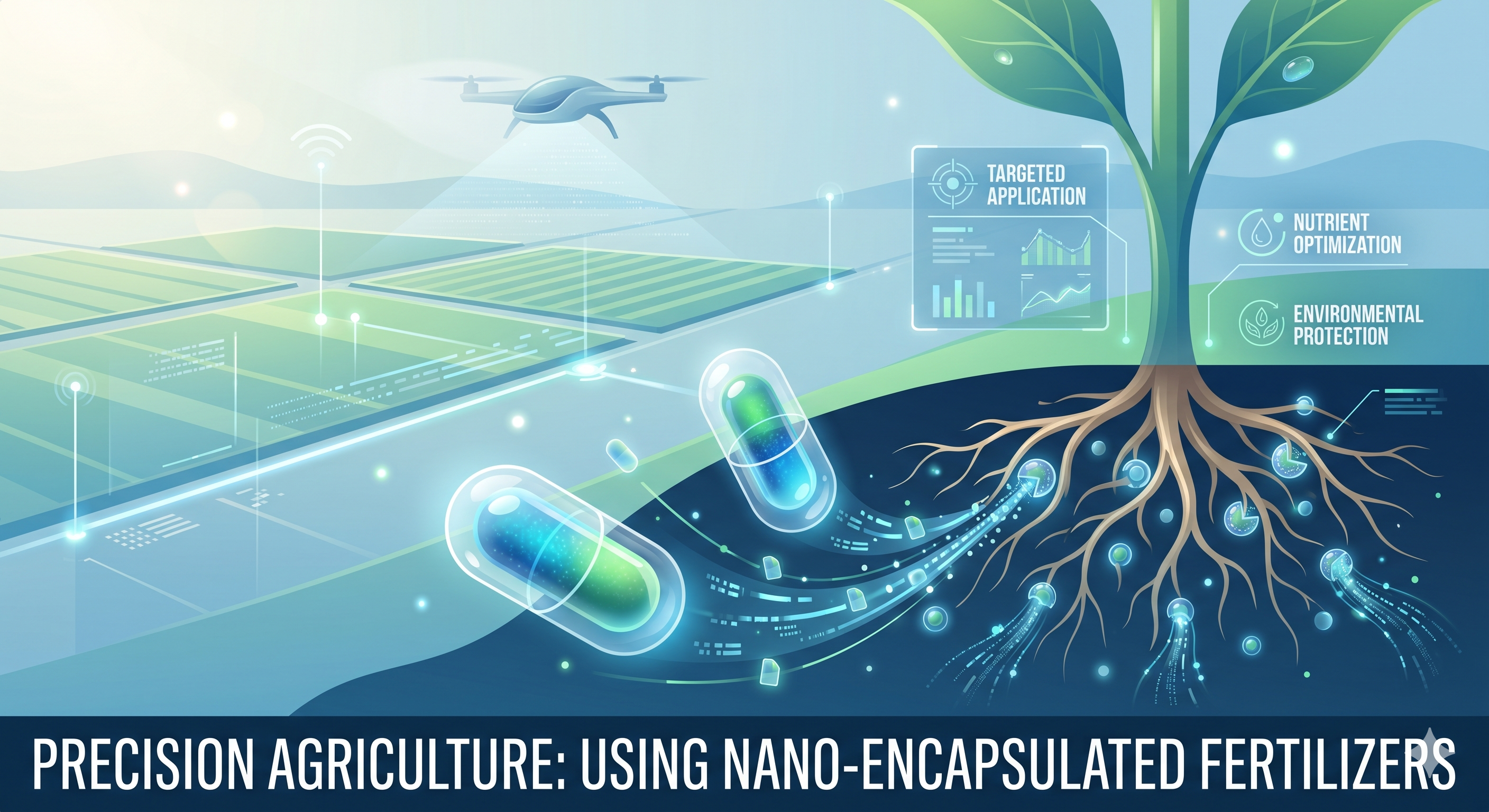
The global agricultural landscape is facing an unprecedented crisis. We are tasked with feeding a population expected to reach nearly 10 billion by 2050, while simultaneously battling shrinking arable land, climate volatility, and the dire environmental consequences of traditional farming practices. Traditional fertilization methods are inherently inefficient; it is estimated that only 30-50% of applied nutrients are actually absorbed by crops. The remainder leaches into groundwater, volatilizes into the atmosphere as greenhouse gases, or becomes locked in the soil, causing eutrophication and ecosystem collapse.
To solve this, agriculture is undergoing a technological revolution, shifting from “broad-spectrum” application to “surgical” precision. This is Precision Agriculture (PA). At the heart of this revolution lies nanotechnology, specifically the development of nano-encapsulated fertilizers. This technology promises to deliver nutrients not just to the field, but directly to the plant’s roots at the exact moment they are needed, maximizing efficiency while minimizing waste.
What is Precision Agriculture?
Precision Agriculture is a management strategy that gathers, processes, and analyzes temporal, spatial, and individual data to improve the resource-use efficiency, productivity, quality, profitability, and sustainability of agricultural production. Instead of treating an entire field the same way, PA uses tools like GPS, satellite imagery, sensors, and drones to observe and respond to variability within the field.
The philosophy of PA is centered on four pillars: applying the Right Source, at the Right Rate, at the Right Time, and in the Right Place. Nano-encapsulated fertilizers represent the pinnacle of the “Right Rate” and “Right Time” pillars.
The Science of Nano-Encapsulation: The Nutrient “Trojan Horse”
Traditional fertilizers are bulk materials—salts or organic matter that dissolve rapidly upon contact with soil moisture. This rapid release often overwhelms the plant’s absorption capacity.
Nano-encapsulated fertilizers utilize nanotechnology to address this rapid release. In simple terms, nutrients (like Nitrogen, Phosphorus, or Potassium) or micronutrients (like Zinc or Iron) are loaded into or coated by an incredibly small shell or matrix. These shells, typically between 1 and 100 nanometers in size (thousands of times thinner than a human hair), act as protective carriers.
These carriers can be designed from various materials:
-
Natural Polymers: Biodegradable materials like chitosan (from shellfish), starch, lignin, or alginate.
-
Synthetic Polymers: Tailored biodegradable plastics designed for specific degradation rates.
-
Inorganic Materials: Like silica or zeolites, which can have porous structures to hold nutrients.
How They Work
Once applied to the soil, the encapsulation protects the nutrients from degradation by soil microbiota, immobilization by soil chemicals, or leaching by rainfall. The release mechanism is the critical innovation. It is usually either:
-
Controlled-Release: The shell degrades slowly over weeks or months, providing a steady “drip-feed” of nutrients that matches the plant’s growth curve.
-
Smart-Release (Triggered): The shell is engineered to release its payload only when triggered by specific environmental stimuli. These triggers include soil moisture levels, pH changes in the rhizosphere (root zone), soil temperature, or even enzymes secreted by the plant’s own roots when they are hungry for nutrients.
Current Frontiers: Recent Research and Agronomic Trials (2023–2026)
While the concept of nanotechnology in agriculture has existed for over a decade, the translation from laboratory to actual field trials (the agrarian equivalent of “clinical studies”) has accelerated significantly between 2023 and the present day (2026). Recent literature reviews and multi-year pilot projects are providing concrete data on their efficacy.
1. Smart-Nitrogen Release for Cereal Crops
Nitrogen efficiency is the biggest challenge in global agriculture. Pilot studies conducted between 2024 and 2026 on wheat and maize crops have utilized smart-release nanourea encapsulated in bio-based polymers. These studies have consistently demonstrated that nano-encapsulated urea can increase Nutrient Use Efficiency (NUE) to over 60%, compared to the 30% baseline of traditional urea. Experimental results showed reduced nitrogen volatilization into the atmosphere as nitrous oxide (a potent greenhouse gas) by up to 50%. Researchers are now focusing on pH-triggered shells that release urea specifically when the root zone becomes slightly acidic, which is a signal of active plant uptake.
2. Phosphorus Immobilization Solutions
Phosphorus often binds rapidly to soil minerals, becoming unavailable to plants. Recent innovative research has focused on coating Phosphorus nanoparticles with biochar or zeolite matrices. Field tests on rice paddies have suggested that these encapsulated forms can maintain Phosphorus bioavailability for twice as long as traditional superphosphate, leading to significantly better root development and increased yields in Phosphorus-deficient soils.
3. Micronutrient Targeted Delivery
Micronutrient deficiencies (Zinc, Iron) affect both plant health and human nutrition. Studies in 2025 on high-value fruit crops utilized lipid-based nano-encapsulation of Zinc. The findings indicated better penetration of the micronutrients through the root cuticle, leading to increased nutritional density in the harvested fruit. Researchers noted that the targeted nature of delivery allowed farmers to use up to 80% less actual Zinc than broad application, massively reducing chemical input costs.
Advantage–Risk Assessment: A Balanced View
The potential of nano-encapsulated fertilizers is immense, but responsible implementation requires a careful assessment of both benefits and potential drawbacks.
Advantages (The Potential)
-
Significantly Higher Yields: By providing nutrients steadily, plants remain healthier and maximize their genetic potential, resulting in yield increases of 10-30% in many studies.
-
Economic Savings for Farmers: While the price per kilogram of nanofertilizer is higher, the quantity required is drastically lower (sometimes up to 70% less urea). This can lead to overall cost savings on fertilizer inputs.
-
Drastic Waste Reduction: Higher NUE means less nitrogen and phosphorus leaching into waterways (reducing algal blooms and fish kills) and fewer greenhouse gas emissions.
-
Stress Tolerance: Steady nutrient availability helps crops better withstand abiotic stresses like drought or salinity, a crucial advantage in the face of climate change.
-
Customization: Formulas can be tailored not just for the crop, but for the specific soil type and climatic conditions of a single farm field.
Risks and Challenges (The Constraints)
-
Nanotoxicity and Ecological Long-Term Impact: The biggest concern is what happens to the engineered nanoparticles once they are “spent.” While many carriers are biodegradable, their environmental fate, impact on essential soil microorganisms, and potential to bioaccumulate up the food chain are not yet fully understood. Long-term (5-10 year) ecological studies are still lacking.
-
High Production Costs and Scalability: Producing nano-encapsulated materials requires sophisticated nanotechnology facilities. Scaling production to meet the global agricultural demand at a price that is competitive with bulk commodities remains a major hurdle.
-
Regulatory Uncertainty: Currently, there is a lack of harmonized global regulations specifically for nanotechnology in agriculture. This makes it difficult to standardize safety testing, labeling, and environmental assessments.
-
Knowledge Barrier: Adopting Precision Agriculture technologies, including nanofertilizers, requires farmers to have access to advanced equipment (sensors, drones) and the technical expertise to interpret the data and apply inputs precisely.
The Future Landscape: Regulatory Evolution and Smart Farming Integration
The future of Precision Agriculture will see nano-encapsulated fertilizers transitioning from niche applications to mainstream adoption, driven by regulatory pressure to reduce chemical inputs and by economic necessity. The concept of “smart” farming will evolve into “autonomous” nutrition management. Sensors will detect nutrient deficiencies in real-time, sending signals to automated drone applicators to apply the exact nano-encapsulated formula needed by that specific hectare.
To ensure safe implementation, governments and international bodies are developing specific regulatory frameworks for nanobiotechnology in food production. These regulations must mandate rigorous safety testing concerning toxicity, environmental fate, and consumer health. Bio-based, completely biodegradable encapsulation materials (like lignin and chitosan) will likely be favored by regulators over synthetic polymers due to their reduced environmental footprint.
Conclusion
Nano-encapsulated fertilizers are not merely an incremental improvement; they are a technological necessity if we are to achieve sustainable global food security. By bridging the gap between nutritional science and precise agricultural management, this technology allows us to produce more food with fewer resources. While we must remain vigilant about the potential long-term ecological risks and invest heavily in eco-toxicological research, the trajectory is clear: the future of agriculture is precise, it is efficient, and it is built upon nanotechnology. The era of dumping bulk chemicals onto fields is ending; the era of surgical plant nutrition has begun.