
Recently added item(s)
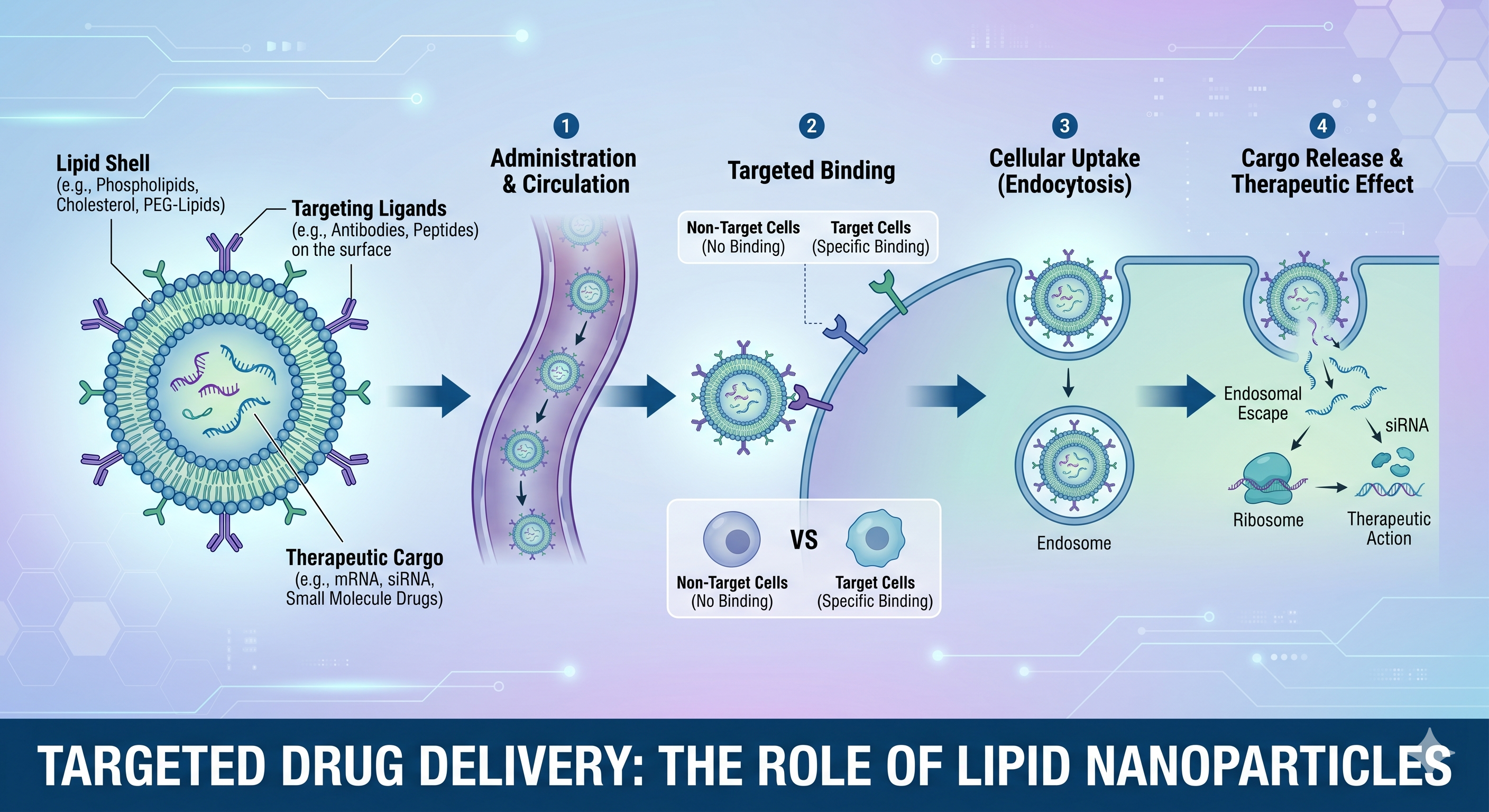
Imagine needing to deliver a fragile, highly valuable package to a specific room inside a massive, heavily guarded fortress. If you simply throw the package over the walls, it will likely break, get intercepted by guards, or land in the wrong courtyard, causing unintended damage.
This is the exact challenge modern medicine faces when treating diseases like cancer or genetic disorders. Traditional drugs often act like that thrown package: they circulate throughout the entire body, harming healthy cells alongside diseased ones, leading to severe side effects.
The solution is Targeted Drug Delivery (TDD)—a “GPS-guided delivery truck” for medicine. At the forefront of this pharmaceutical revolution are Lipid Nanoparticles (LNPs).
LNPs gained global fame as the delivery vehicles for the mRNA COVID-19 vaccines, but their potential goes far beyond pandemics. They are rewriting the rules of how we treat humanity’s most difficult diseases.
What is Targeted Drug Delivery?
Targeted drug delivery is the method of delivering medication to a patient in a manner that increases the concentration of the medication in some parts of the body relative to others.
The goals are simple but profound:
-
Maximize Efficacy: Deliver the drug directly to the site of action (e.g., a tumor).
-
Minimize Toxicity: Prevent the drug from interacting with healthy tissues, thereby reducing side effects.
To achieve this, we need a “carrier”—a vehicle tiny enough to travel through blood vessels but robust enough to protect the delicate pharmaceutical cargo. This is where LNPs enter the scene.
The role of Lipid Nanoparticles (LNPs)
Lipid Nanoparticles are biological delivery vehicles engineered at the nanoscale (usually 10 to 100 nanometers). To put that in perspective, a nanometer is one-billionth of a meter; an LNP is thousands of times smaller than a human hair.
Why are they the preferred vehicle for modern medicine, particularly genetic therapies?
1. The Composition: Bio-mimicry at Its Best
LNPs are primarily made of lipids, which are fats or wax-like substances. Because human cell membranes are also made of a lipid bilayer, LNPs are essentially composed of the “same stuff” as our cells. This similarity allows them to be biocompatible, meaning the body generally accepts them without a massive immune rejection.
An engineered LNP is not just a blob of fat. It is a sophisticated, multi-component sphere:
-
Ionizable Lipids: The “magic ingredient.” They hold a positive charge inside the LNP to bind delicate cargo like mRNA (which is negatively charged). Crucially, they become neutral in blood (pH 7.4), allowing them to circulate safely without sticking to blood vessels.
-
Cholesterol: Provides structural stability and rigidity, preventing the LNP from falling apart prematurely.
-
Helper Lipids (Phospholipids): Aid in forming the LNP structure and help it merge with the target cell membrane.
-
PEGylated Lipids: Fats coated with Polyethylene Glycol (PEG). This creates a “stealth” layer, allowing the LNP to hide from the body’s immune system guards (macrophages) and remain in circulation longer.
2. The Mechanics of Targeting: Finding the Fortress
How do these tiny fat spheres know where to go? LNPs use two types of targeting systems:
A. Passive Targeting
This utilizes the biological characteristics of diseased tissue. Cancerous tumors, for example, have blood vessels that are “leaky” with tiny gaps. Healthy tissue has tight gaps. LNPs are sized perfectly to slip through the leaky tumor vessels and accumulate specifically within the cancer tissue. This is known as the Enhanced Permeability and Retention (EPR) effect.
B. Active Targeting
This is the advanced “GPS” system. Scientists engineer the surface of the LNPs to include “ligands” (like antibodies or peptides) that act as keys. These keys are designed to fit into specific receptors (locks) that are overexpressed on the surface of diseased cells, but rarely on healthy cells. The LNP circulates until it finds the matching cell, sticks to it, and is swallowed by the cell through a process called endocytosis.
Once inside, the LNP releases its cargo (e.g., mRNA), which then tells the cell to produce a therapeutic protein (in vaccines) or shuts down a disease-causing gene (in gene therapy).
Current Research, Applications, and Clinical Studies
The success of the mRNA vaccines was the “proof of concept” that LNPs can be manufactured at a massive scale and used safely in billions of people. This has accelerated research into diverse therapeutic areas.
1. Oncology (Cancer Therapy)
Traditional chemotherapy is devastating to the patient because it kills any rapidly dividing cell, including hair follicles and stomach lining.
Current research is focusing on LNPs carrying highly potent anticancer drugs or RNA interfaces (siRNA) to shut down oncogenes (cancer-causing genes). In clinical trials, active targeting of LNPs is being explored to treat ovarian, lung, and liver cancers by attaching antibodies that recognize tumor-specific markers, delivering the toxicity only to the tumor cells.
2. Genetic Disorders and Gene Editing (CRISPR)
Gene therapy aims to correct disease at the genetic source, but delivering large tools like the CRISPR-Cas9 genetic scissors into cells is extremely difficult. LNPs have emerged as the leading non-viral vector for gene editing. Clinical trials are underway (notably by Intellia Therapeutics and Regeneron) using LNPs to deliver CRISPR components directly to the liver to treat diseases like Transthyretin Amyloidosis (ATTR). Early data shows that a single intravenous dose of LNPs can effectively “knock out” the faulty gene, leading to a massive reduction in the toxic protein that causes the disease.
3. Protein Replacement Therapy
LNPs are being researched to deliver mRNA that instructs the body to make a protein that a patient is naturally missing due to genetic mutations. An active area of research is using LNPs to deliver mRNA coding for clotting factors to treat Hemophilia.
Advantage–Risk Assessment
Targeted drug delivery using LNPs is arguably the future of medicine, but it is a complex technology with specific challenges.
The Advantages
-
High Payload Protection: LNPs act as an impervious armor, protecting fragile cargo like mRNA or proteins from being degraded by enzymes in the bloodstream before they reach the target.
-
Biocompatibility and Low Toxicity: Because they are made of natural fats, they generally have lower toxicity and trigger fewer severe immune responses compared to the viruses traditionally used for gene delivery.
-
Precisely Targeted (High Selectivity): Active and passive targeting minimize off-target effects, significantly reducing damage to healthy tissue and improving the patient’s quality of life.
-
Scalability: Modern manufacturing techniques, like microfluidics, allow for the precise and consistent mass production of LNPs.
The Risks and Challenges
-
The “PEG Dilemma”: While PEG coatings allow LNPs to hide from the immune system, some people have pre-existing antibodies against PEG. This can cause the LNPs to be cleared too quickly or, in rare cases, cause allergic reactions (the major source of the rare reactions seen in mRNA vaccines). Scientists are now researching alternative “stealth” coatings.
-
Liver Accumulation: When injected intravenously, the body naturally sends LNPs (as lipids) to the liver for processing. While this makes LNPs perfect for treating liver diseases, it makes reaching other organs (like the brain or lungs) extremely difficult. Research into “extrahepatic targeting” is one of the biggest challenges in the field today.
-
Stability and Cold Chain: Many LNPs remain unstable at room temperature and require strict cold storage, creating logistical challenges in developing nations or remote areas.
-
Physical Stability: If not engineered correctly, LNPs can aggregate (clump together) in the vial, making them ineffective or dangerous.
Conclusion: The Horizon of Medicine
The field of Targeted Drug Delivery is shifting from science fiction to scientific reality, and Lipid Nanoparticles are the undisputed workhorses of this transition. They have already saved millions of lives through vaccines and are now on the verge of curing genetic diseases that were previously thought untreatable.
As scientists refine the surface engineering of LNPs to reach organs beyond the liver and develop alternatives to PEG, we are moving toward a future of “personalized precision medicine.” In this future, your prescription will not consist of a drug that blankets your entire body, but rather a fleet of incredibly tiny, GPS-guided nanon-carriers designed specifically to fix the disease at its exact cellular source, leaving everything else untouched.