Recently added item(s)
Cancer remains one of humanity’s most daunting health challenges. While standard treatments like chemotherapy, radiation, and surgery have saved countless lives, they often come with significant drawbacks—principally their lack of specificity. Traditional chemotherapy acts like a sledgehammer, damaging healthy dividing cells throughout the body while trying to eliminate cancerous ones. Early diagnosis, too, can be elusive, allowing the disease to progress unseen.
Nanotechnology, the science of manipulating matter at the microscopic scale (on the order of one-billionth of a meter), offers a beacon of hope. At the forefront of this nanomedical revolution are magnetic nanoparticles (MNPs). These tiny marvels, often made from iron oxide cores, are proving to be powerful allies, behaving as microscopic detectives, targetable Trojan horses, and localized furnaces within the human body. They are bridging the gap between diagnostics and therapy, ushering in a new era of personalized cancer management known as “theranostics.”
The Science Behind the Microscopic Detective
What makes magnetic nanoparticles so special? The answer lies in their chemistry and physics. The most clinically relevant MNPs are Superparamagnetic Iron Oxide Nanoparticles, or SPIONs. SPIONs are particularly useful because they exhibit a unique property called superparamagnetism. They are not permanently magnetic like the magnets on your refrigerator; they only become magnetized when exposed to an external magnetic field. When the field is removed, their magnetism disappears. This crucial feature prevents them from clumping together in the bloodstream, which could otherwise cause blockages.
SPIONs are typically structured like a tiny hazelnut. They have a magnetic core (the nut) and a protective, biocompatible coating (the shell). This shell, made of polymers like polyethylene glycol (PEG) or dextran, serves multiple purposes: it prevents oxidation of the core, ensures the particle doesn’t trigger a massive immune response, and acts as a canvas upon which scientists can attach other useful molecules.
Diagnostics: Shining a Light on Hidden Tumors
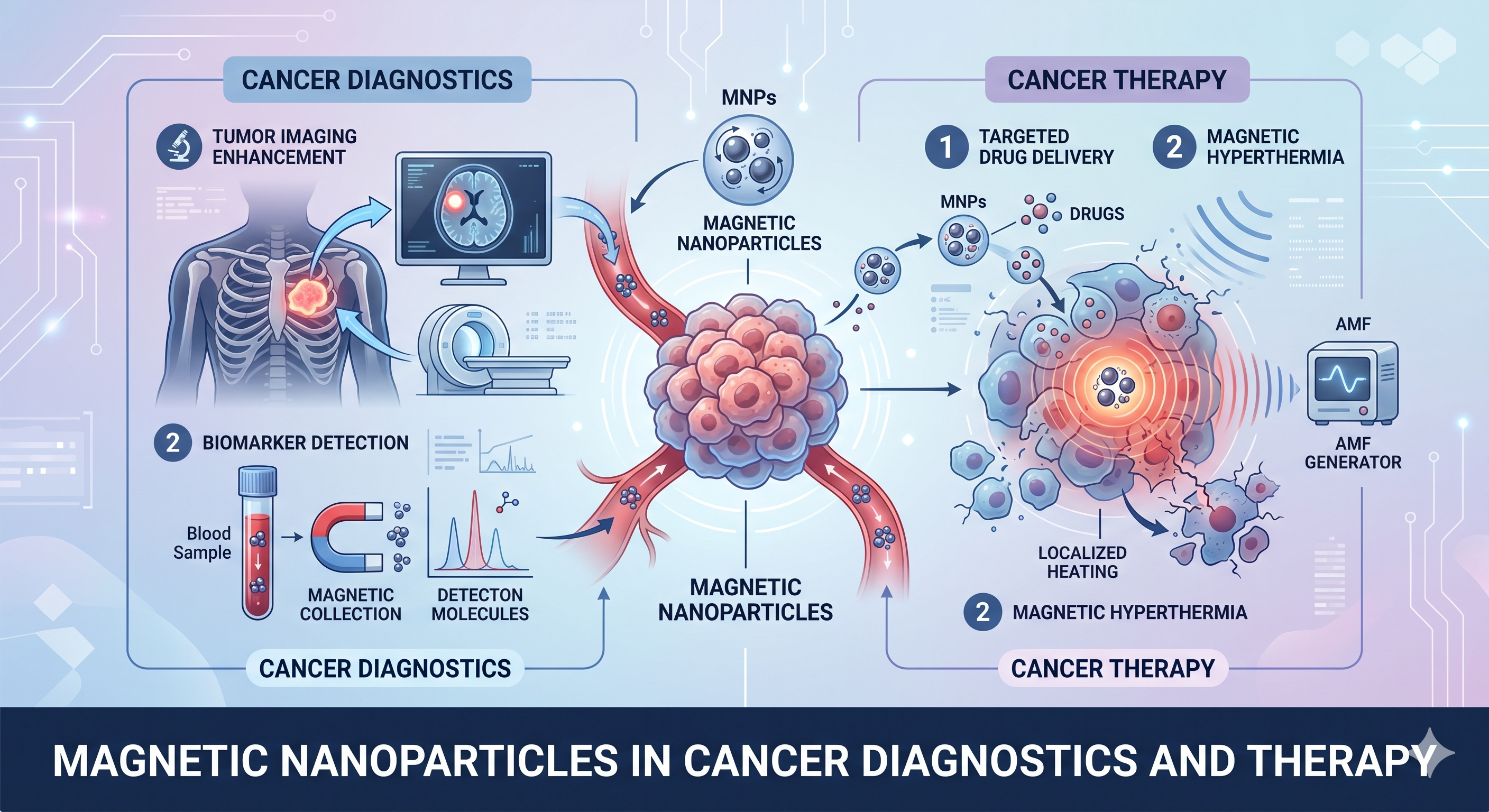
Early detection is paramount in the fight against cancer. Magnetic nanoparticles are drastically improving our ability to visualize and identify tumors at their earliest stages, even when they consist of only a few hundred cells. They achieve this primarily through two methods: Imaging Enhancement and Advanced Biosensors.
Enhancing MRI Resolution
Magnetic Resonance Imaging (MRI) is a staple diagnostic tool that uses powerful magnets and radio waves to create detailed images of soft tissues. However, standard MRI sometimes struggles to distinguish between healthy and diseased tissue, or to detect very small tumors. MNPs serve as exceptional “contrast agents.”
Because SPIONs respond so strongly to magnetic fields, when they accumulate in a specific tissue, they significantly alter the local magnetic microenvironment. This alteration shows up on an MRI scan as a darkening of the image, making SPION-laden tissues stand out with dramatic clarity against the background. Scientists can functionalize the protective shell of the particle with “homing molecules”—such as antibodies or peptides—that bind specifically to receptors overexpressed on cancer cells. Once injected into the bloodstream, these intelligent nano-detectives circulate until they find their target tumor, “lighting it up” (or rather, darkening it) on the scan.
Microscopic Blood Tests
Beyond imaging, MNPs are revolutionizing diagnostic blood tests through advanced biosensors. Early-stage cancers shed tiny proteins, DNA fragments, or even whole cells (circulating tumor cells, or CTCs) into the bloodstream long before symptoms appear. These biomarkers are incredibly rare—like finding a single distinctive grain of sand on a vast beach.
MNPs, coated with antibodies specific to these rare biomarkers, are added to a patient’s blood sample. Because of the particles’ high surface area, they efficiently capture the biomarkers. A magnetic field is then applied, “pulling” the MNPs—now bound to the biomarkers—out of the complex blood mixture for concentrated analysis. This “liquid biopsy” technique allows doctors to detect cancer with unprecedented sensitivity from a simple blood draw, potentially making yearly screenings for multiple cancer types a reality.
Therapy: The Trojan Horse and the Furnace
Once a tumor is detected and localized, magnetic nanoparticles shift from detectives to assassins. They are being utilized in two main therapeutic arms: Targeted Drug Delivery and Magnetic Hyperthermia.
The Targeted Trojan Horse
Traditional chemotherapy is notoriously imprecise. When a drug is injected systemically, it travels throughout the entire body, leading to systemic toxicity—the source of dreaded side effects like hair loss, nausea, and immune suppression. MNPs offer a way to construct a “nano-shuttle” that delivers drugs specifically to the tumor.
Doctors create a conjugate: a magnetic nanoparticle linked to a chemotherapy drug. The SPION’s homing molecules guide it to the tumor. For extra precision, an external magnetic field can be physically applied over the tumor site, acting like a magnet pulling a microscopic iron filing, trapping the SPION shuttles exactly where they are needed.
Furthermore, these shuttles are often engineered with “smart” release mechanisms. The drug is attached to the particle via a chemical linker that is sensitive to the tumor’s microenvironment. For example, tumor interiors are often slightly more acidic or have different enzymes than healthy tissue. When the Trojan horse enters this specific environment, the linker breaks, releasing the toxic payload only inside the cancer cells, leaving healthy neighbors unscathed.
The Localized Furnace (Magnetic Hyperthermia)
Cancer cells have an Achilles’ heel: they are more sensitive to heat than healthy cells. If tumor tissue can be heated to between 41°C and 45°C (106°F to 113°F) for an extended period, the cells begin to break down and die, a process known as hyperthermia. However, heating a tumor deep within the body without cooking the surrounding healthy tissue is incredibly difficult with conventional methods.
This is where magnetic hyperthermia shines. SPIONs are delivered directly into the tumor. Once inside, they are exposed to a rapidly alternating magnetic field (AMF)—similar to the waves in a microwave oven, but much gentler and specifically tuned. The SPION cores respond to this flipping field by rapidly vibrating, turning the magnetic energy into heat.
Each individual nanoparticle acts like a microscopic furnace, cooking the cancer cell from the inside out. Healthy cells, which lack the magnetic particles, remain largely unaffected by the magnetic field. This technique can be used on its own or, more effectively, in combination with chemotherapy or radiation, as heat sensitizes cancer cells, making them more vulnerable to subsequent treatments.
Theranostics: The All-in-One Nano-Platform
The true power of magnetic nanoparticles is realized when diagnostics and therapy are combined into a single platform: Theranostics. The same SPION that is injected to find and map the tumor (Diagnostic branch via MRI contrast) is loaded with a drug (Therapeutic branch via targeted delivery). Once the MRI confirms the SPION shuttle has reached its target, the doctor applies the AMF to trigger hyperthermia and drug release simultaneously. This all-in-one approach allows for real-time monitoring of treatment efficacy, enabling doctors to adjust therapy on the fly and monitor metastasis, all with a single nanomedicine injection.
Current Research Frontiers and Clinical Trials
The path from laboratory breakthrough to bedside clinical application is long and rigorous. SPIONs are currently navigating this complex path. While many applications are in the pre-clinical phase (testing in cells and animals), several notable human clinical trials have been conducted or are underway, primarily focusing on superparamagnetic iron oxide nanoparticles for both diagnostics and therapy.
-
Dendrimer SPION contrast agents are being investigated for improved sentinel lymph node mapping in breast cancer patients, aiming to reduce invasive surgery.
-
Magnetic Hyperthermia is already a clinical reality in limited applications. MagForce AG developed NanoTherm, a fluid containing SPIONs injected directly into tumors. NanoTherm has received regulatory approval in Europe for the treatment of glioblastoma (an aggressive brain tumor) and prostate cancer. Studies have shown that when combined with radiotherapy, NanoTherm hyperthermia can extend survival times significantly for glioblastoma patients.
-
Combination trials are exploring the synergistic effects of SPION-mediated hyperthermia and simultaneously released chemotherapy drugs or immune checkpoint inhibitors, aiming to boost the body’s own immune response to the tumor.
Research is also focusing on developing hybrid nanoparticles—combining the magnetic core with other therapeutic agents like gold (for photothermal therapy) or liposomes (to increase drug loading capacity).
Advantages and Risks Evaluation
While the potential of magnetic nanoparticles in cancer management is immense, a transparent evaluation of their advantages and associated risks is essential.
Advantages
-
High Precision and Targeting: External magnetic field guidance and surface homing molecules drastically reduce off-target effects, lowering systemic toxicity and side effects.
-
Non-Invasive Imaging: Offers real-time, non-invasive imaging of tumors and therapeutic monitoring without harmful ionizing radiation.
-
Controlled Release: Drugs can be released specifically within the tumor environment, increasing the local therapeutic dose while reducing overall body exposure.
-
Lower Toxicity: Iron oxide nanoparticles, particularly SPIONs, are generally considered to have a favorable safety profile compared to metallic metal nanoparticles (like gold or silver) because the body has natural mechanisms for handling and recycling iron.
-
Potential for Personalized Medicine: The multifunctional nature of MNPs allows for tailored Theranostic approaches based on the unique characteristics of a patient’s tumor.
Risks and Challenges
-
Toxicity Concerns: Although SPIONs are relatively safe, long-term accumulation of metal in vital organs like the liver, spleen, and kidneys remains a concern. High doses can induce oxidative stress, which could potentially cause cell damage.
-
Biocompatibility: Coatings are essential, but even coated particles can sometimes be recognized as foreign invaders by the immune system, leading to rapid clearance from the bloodstream before they reach their target.
-
Synthesis and Reproducibility: Synthesizing particles with exact, uniform sizes and surface functionalities in large, reproducible batches required for clinical use is technologically demanding and costly.
-
Efficacy Challenges: Ensuring enough particles reach the tumor center—often characterized by high pressure and poor blood supply—is a significant hurdle.
-
Cost and Regulatory Hurdles: The development and approval process for these sophisticated “nanodrugs” are incredibly expensive and navigating the regulatory landscape is slow.
Conclusion: The Nano-Horizon
Magnetic nanoparticles represent a tectonic shift in the landscape of oncology. They offer a sophisticated, targetable approach that promises to replace sledgehammers with guided nano-missiles. While technological and regulatory challenges remain, the steady progress from lab bench to clinical trials is encouraging. The future landscape of cancer management will undoubtedly include these tiny magnets, behaved microscopic detectives, and localized furnaces, working together to deliver on the promise of effective, personalized, and theranostic cancer care.