
Recently added item(s)
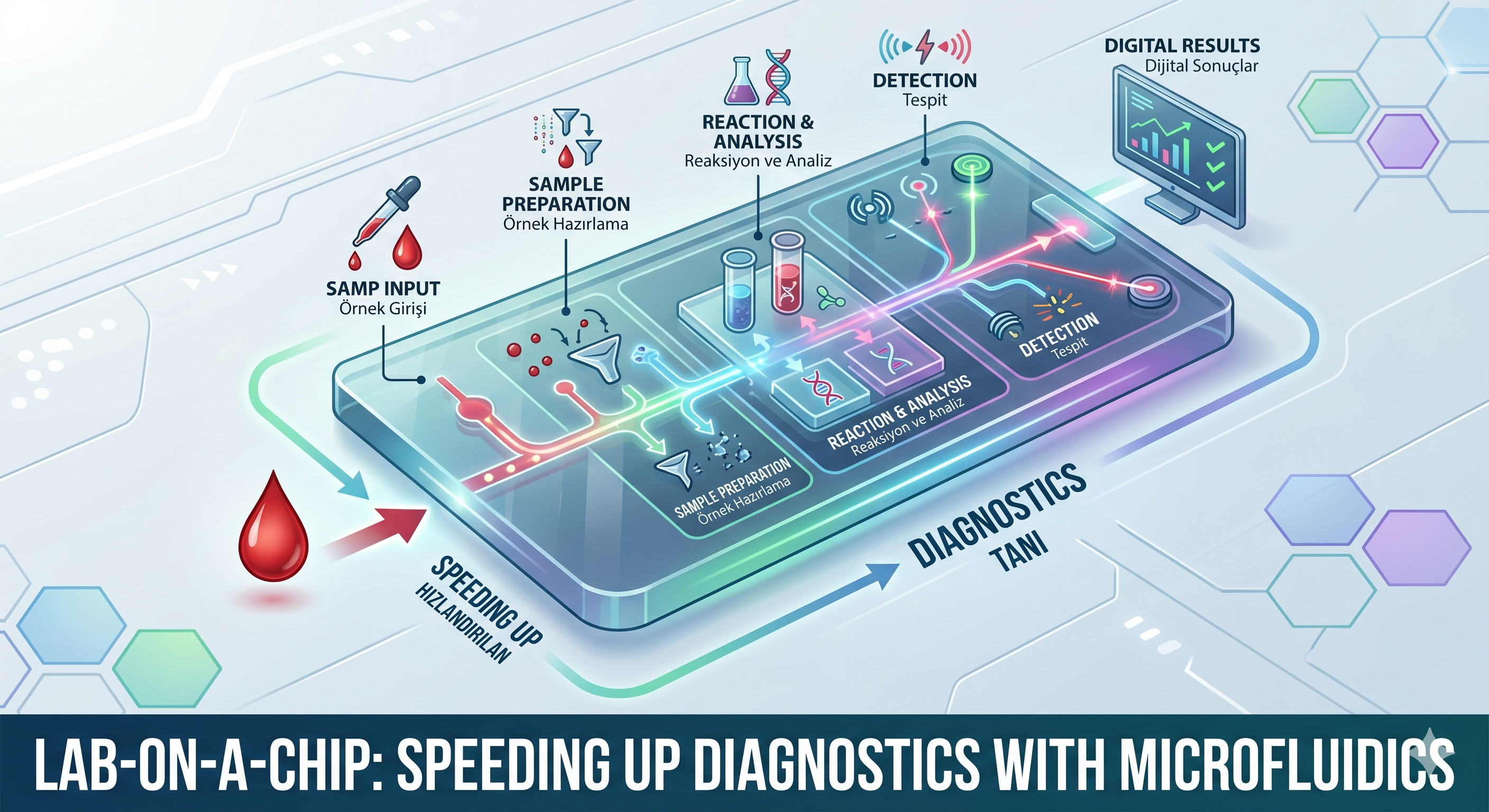
Imagine waiting for a critical medical diagnosis. Currently, this often involves taking a substantial sample of blood or tissue, sending it to a centralized facility miles away, and waiting days—sometimes weeks—for results generated by massive, expensive machinery operated by specialized technicians. During that waiting period, a disease can progress, treatment can be delayed, and anxiety levels can skyrocket.
Now, imagine a different scenario: you are at your doctor’s office, or perhaps even at home. With just a single drop of finger-prick blood placed on a device no larger than a credit card, complex biochemical analysis occurs automatically. Within minutes, highly accurate results appear on a screen, allowing for immediate treatment decisions.
This is not science fiction. This is the promise of Lab-on-a-Chip (LOC) technology, driven by the science of microfluidics. By miniaturizing entire diagnostic laboratories onto a single chip, we are entering a new era of decentralized, rapid, and personalized healthcare.
What is Lab-on-a-Chip and Microfluidics?
To understand Lab-on-a-Chip, we must first understand the force behind it. Microfluidics is the science and technology of manipulating and controlling fluids—usually ranging from microliters ($\mu$L, $10^{-6}$ liters) to picoliters (pL, $10^{-12}$ liters)—inside networks of channels with dimensions on the micrometer scale (thinner than a human hair).
At this minuscule scale, fluids behave differently than they do in a cup or a large test tube. Gravity becomes negligible, while surface tension and capillary forces dominate. Engineers exploit these unique physics to mix, separate, react, and analyze biological samples with extraordinary precision.
A Lab-on-a-Chip device integrates multiple laboratory functions—such as sample preparation (filtering blood cells from plasma), mixing reagents, biochemical reactions (like amplifying DNA), and detection—onto a single miniaturized substrate (made of plastic, glass, or silicon). It is essentially a complete laboratory shrunk down to the size of a computer chip, through which the biological sample flows like electricity flows through circuits.
The Diagnostics Bottleneck and the Speed Solution
The primary driver behind LOC development is speed. Traditional centralized testing is a linear, multi-step process involving logistics, batching samples (waiting for enough samples to run a machine economically), manually intensive preparation, and long reaction times due to the large volumes of fluids required.
Lab-on-a-Chip solves this “diagnostics bottleneck” through several key mechanisms:
1. Rapid Reactions through Miniaturization
In a traditional test tube, chemicals must diffuse across millimeters of distance to interact. At the microscale, these distances are reduced to micrometers. Because the time it takes for a molecule to diffuse increases with the square of the distance, miniaturization leads to exponential increases in reaction speed. What takes an hour in a bulk solution might take only minutes inside a microchannel.
2. Precise Sample Handling and Parallelism
Biomedical researchers can program these chips to perform complex sequences of events automatically, without human error. Furthermore, many microchannels can be etched onto a single chip, allowing for parallelism—running multiple different tests on the same single drop of sample simultaneously.
3. Decentralization: Bringing the Lab to the Patient
Crucially, LOC technology enables Point-of-Care (POC) diagnostics. By removing the need for a central lab and massive infrastructure, these devices can be used in doctor’s offices, ambulances, remote villages in developing nations, or even at home by the patients themselves. Elimination of logistics transport saves the most significant chunk of time in critical diagnoses.
Transforming Major Areas of Medicine: Current Research and Breakthroughs
Active research is expanding LOC capabilities across the medical spectrum. We are moving beyond simple “yes/no” tests to complex, quantitative analyses.
1. Infectious Diseases: Sepsis and Antimicrobial Resistance
Speed is absolute in the treatment of sepsis (blood poisoning). Centralized labs often take 24 to 72 hours to identify the specific pathogen causing the infection, during which doctors must use broad-spectrum antibiotics, contributing to resistance.
Recent research focuses on LOC devices that can isolate pathogens directly from a small blood sample and use on-chip Polymerase Chain Reaction (PCR) to amplify and detect microbial DNA within 1-2 hours.
Furthermore, dynamic microfluidic platforms are being tested to determine Antimicrobial Susceptibility Testing (AST). Instead of waiting for a culture to grow (days), these chips trap single bacterial cells and monitor their response to various antibiotics in real-time under a microscope, providing phenotypic AST results in under four hours.
2. Cancer Diagnostics: The Liquid Biopsy
Traditionally, cancer diagnosis requires an invasive tissue biopsy. LOC devices are revolutionizing the emerging field of “liquid biopsies”—the detection of cancer markers in bodily fluids like blood.
Specifically, researchers use microfluidics to isolate rare Circulating Tumor Cells (CTCs) from whole blood. CTCs are cells that have broken off from a primary tumor and are traveling through the bloodstream to spread cancer (metastasis). Capturing these cells is incredibly difficult, like finding one specific grain of sand in a bucketful. However, microfluidics can sort cells by size, density, or specific surface markers to enrich and capture CTCs.
Current clinical research, such as work conducted at institutions like Massachusetts General Hospital and various university spinoffs, is examining the use of captured CTCs on a chip to sequence their DNA. This allows doctors to profile the cancer’s mutations and track how the cancer is evolving over time in response to therapy, without ever needing surgery.
3. Chronic Disease Management
Managing conditions like heart disease requires regular monitoring. For patients who have had heart failure or are at risk of a heart attack, detecting protein biomarkers like troponin in the blood is crucial. LOC devices are being developed for home use that can provide a quantitative measurement of troponin levels from a single finger-prick within minutes, acting as an early warning system.
Clinical Impact and the Path to the Doctor’s Office
While thousands of Lab-on-a-Chip prototypes exist in academic literature, bringing them to clinical practice is a challenge. However, the success stories are accelerating.
The most famous, although functionally simple, microfluidic application is the home pregnancy test and the lateral flow glucose test for diabetics. However, “true” integrated Lab-on-a-Chip technology made its largest global debut during the COVID-19 pandemic. Microfluidic-based rapid antigen tests and portable PCR devices (like those by Cepheid or LumiraDx) proved that accurate molecular diagnostics could be decentralized at a massive scale.
Currently, late-stage clinical trials are investigating chip-based platforms for:
-
Pre-natal screening from maternal blood (to avoid invasive amniocentesis).
-
Rapid screening for Zika, Ebola, and HIV in resource-limited settings.
-
Determining genetic variants that affect drug metabolism (pharmacogenomics) right before a prescription is written.
The FDA is actively working to establish regulatory frameworks for these innovative platforms, recognizing that the decentralized nature requires unique validation protocols.
Deep Dive: Beyond Diagnostics – Organ-on-a-Chip
The most astonishing emerging research in this field moves beyond measuring disease to modeling it. Microfluidic specialists are creating Organ-on-a-Chip (OOC) devices.
These are not full artificial organs intended for transplant. Instead, they are microfluidic chambers where living human cells—e.g., lung, liver, or heart cells—are grown in sophisticated structural arrangements that mimic the architecture of the actual organ. The microchannels function like blood vessels, delivering nutrients and oxygen, while mechanical forces can be applied (like the stretching of a lung chamber).
By modeling the human “microenvironment” on a chip, these devices provide a quantum leap over standard petri dishes or animal testing for drug development.
Current studies are connecting multiple organs (e.g., gut-on-a-chip connected to liver-on-a-chip connected to kidney-on-a-chip) to observe the “systemic absorption, metabolism, and excretion” of new drugs. This allows pharmaceutical companies to detect toxicities in human cells before clinical trials, potentially shaving years and billions of dollars off drug development while simultaneously speeding up the availability of new treatments to patients.
Evaluating Lab-on-a-Chip: Advantages, Risks, and Reality
A critical assessment is necessary to understand the current state of this field. It is a powerful technology but not a panacea, facing significant hurdles.
The Clear Advantages:
-
Speed: Results in minutes/hours versus days. Immediate Point-of-Care action.
-
Sample Economy: Requires microliters of blood, not entire vials. Vital for neonates or elderly patients.
-
Low Reagent Cost: Small volumes of fluids mean significantly less expensive reagents are used per test.
-
Decentralization: Accessible healthcare in ambulances, pharmacies, developing nations, and rural areas. No massive energy grid required for large machines.
-
Integration and Automation: Entire diagnostics workflow is automated on the chip, reducing human error.
Critical Risks, Reality, and Challenges:
-
Complexity and Manufacturability: Academic prototypes are often handcrafted. Mass-producing microfluidic devices with high precision at a low cost is exceptionally difficult. Materials like PDMS used in research cannot easily be mass-produced, leading to a shift towards thermoplastics like COC (cyclic olefin copolymer), which introduces new engineering challenges.
-
Regulatory Approval: Proving that decentralized tests used by non-experts are as accurate as tests conducted by professionals in a batched lab is a significant regulatory challenge.
-
Data Security and Connected Health: Point-of-Care LOC devices are often connected to smartphone apps for data readout. This opens significant risks regarding patient data privacy and cybersecurity in networked health systems.
-
The “World-to-Chip Interface” and Clogging: While the channels are small, biological fluids are “dirty.” Bubbles or clumping blood cells can easily block a micrometer-scale channel, rendering the entire test useless. Ensuring that the real-world sample (like a messy whole blood drop) can be cleanly delivered into the precise microchannels without user error is the largest technological challenge today.
Conclusion: Decentralization is the Destiny
Lab-on-a-Chip technology, powered by the ingenious science of microfluidics, is fundamental to the inevitable decentralization of healthcare. Just as computing transitioned from centralized mainframes to personal desktops and finally to smartphones in our pockets, diagnostics is making the same journey.
By shrinking biological laboratories to the size of a chip, we are not just speeding up diagnostics; we are shifting the paradigm from a reactive medical system (wait for symptoms, wait for results, then treat) to a proactive, immediate, and ultimately personal health experience. While manufacturing, regulatory, and technical risks remain, the potential to save lives through immediate action is an irresistible driving force. The lab of the future is small, it is fast, and it is coming to you.