
Recently added item(s)
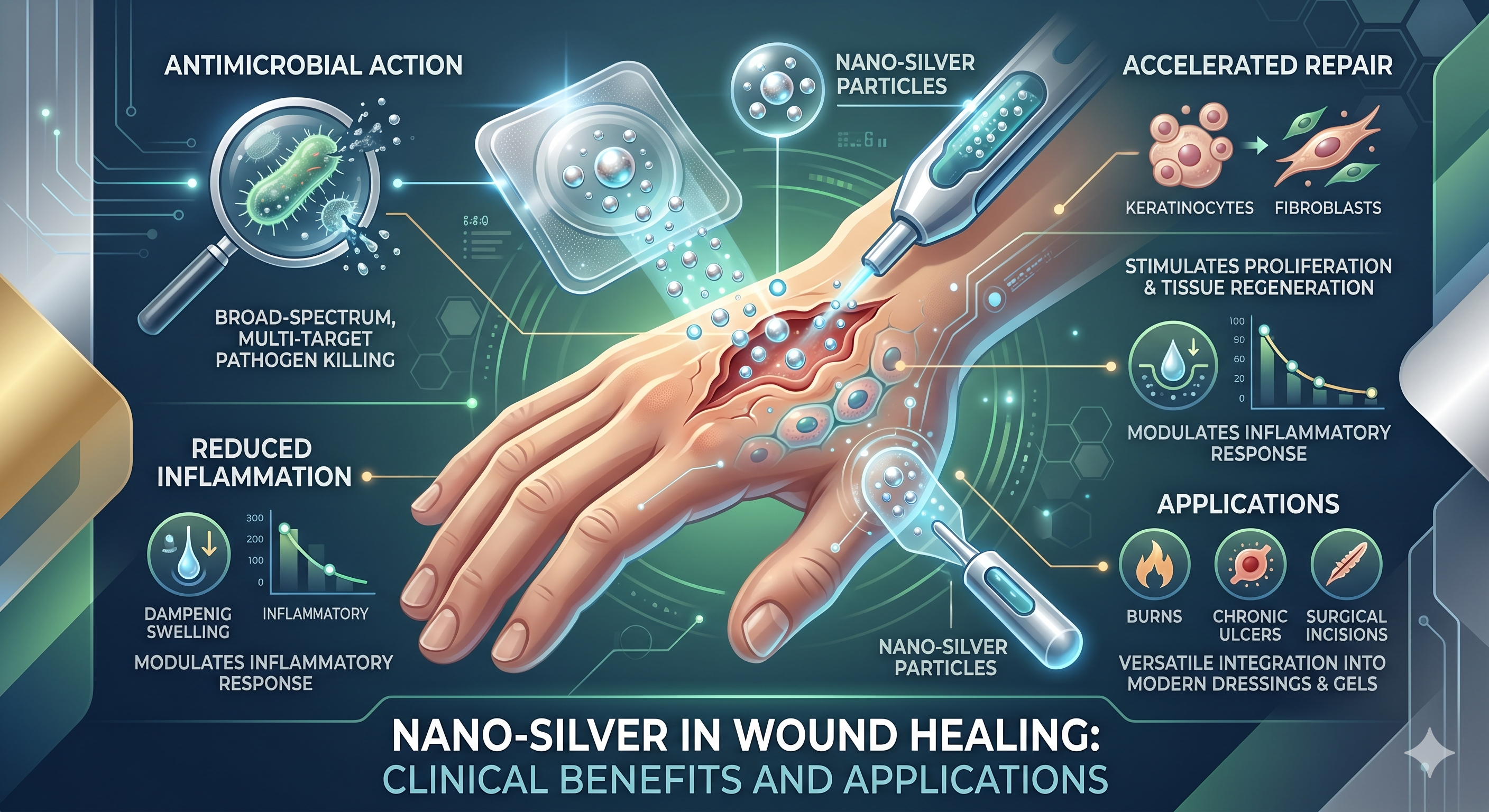
Wound care is a fundamental component of healthcare, yet it presents one of the most persistent challenges for clinicians worldwide. From minor lacerations to complex, non-healing ulcers, the primary threat to proper repair is infection. Bacterial colonisation doesn’t just delay healing; it can lead to devastating systemic complications, amputation, and sepsis. Historically, silver has been a guardian of wound care, revered for centuries for its innate ability to fight microbes.
However, the 21st century has ushered in a revolution in material science: Nanotechnology. By shrinking silver down to the nanoscale, we have unlocked unprecedented healing potential. Silver nanoparticles (AgNPs)—collectively known as nano-silver—are no longer just passive antimicrobial agents. They are active participants in the complex, biological dance of tissue repair. This article explores the scientific mechanisms, modern applications, clinical benefits, and necessary safety considerations of this tiny, but mighty, material.
The Science of Tiny: Understanding Nano-Silver
Before delving into its clinical merits, it is crucial to understand what makes nano-silver unique. Nano-silver consists of particles of silver ranging in size from 1 to 100 nanometers. To put this in perspective, a single human hair is approximately 80,000 to 100,000 nanometers wide.
When a material is reduced to the nanoscale, its biological and chemical properties change dramatically. The defining characteristic of silver nanoparticles is their incredibly high surface-area-to-volume ratio. Compared to a single piece of metallic silver, an equivalent weight of nanoparticles offers a massive surface area exposed to the environment.
This exposed surface area means two key things for wound healing:
-
Sustained Ion Release: AgNPs react readily with moisture (such as wound exudate) to release biologically active silver ions ($Ag^{+}$) in a slow, controlled manner.
-
Enhanced Interaction: The tiny particles can interact directly with the cellular components of both pathogens and host tissue.
Simplified: How Nano-Silver Works Its Magic
The primary biological magic of nano-silver in wounds revolves around its dual role as a pathogen-slayer and a tissue-repair modulator. Here is a simplified breakdown of these complex mechanisms.
1. Broad-Spectrum Assassin
AgNPs are a multi-targeted weapon against bacteria, fungi, and some viruses. Unlike traditional antibiotics, which often attack a single specific target (making it easier for bacteria to develop resistance), silver attacks on multiple fronts. This multi-pronged strategy makes it effective against notoriously resistant strains like Methicillin-resistant Staphylococcus aureus (MRSA).
-
Rupturing the Wall: The tiny particles can physically attach to and penetrate bacterial cell walls, causing leaks and structural collapse.
-
Stealing Electrons: The release of active silver ions damages bacterial enzymes responsible for energy production, essentially starving the cell.
-
Disrupting DNA: Silver ions can bind to bacterial DNA, preventing it from replication and rendering the pathogen unable to reproduce.
-
Reactive Oxygen Species (ROS) Generation: AgNPs can induce the creation of unstable molecules inside the bacteria, causing massive internal oxidative damage, leading to cell death.
2. A Symphony of Repair
Beyond fighting infection, nano-silver actively modulates the wound environment to encourage healing through several pathways:
-
Reducing excessive Inflammation: While initial inflammation is necessary for healing, a chronic, excessive inflammatory state prevents repair. Nano-silver has shown a significant ability to dampen this state, lowering the levels of swelling-promoting molecules (cytokines).
-
Stimulating Cell Proliferation: Silver can act as a gentle signal, encouraging the growth and movement of skin cells (keratinocytes and fibroblasts) needed to close the wound.
-
Promoting Angiogenesis: Studies suggest nano-silver can help stimulate the formation of new blood vessels, bringing vital oxygen and nutrients to the regenerating tissue.
Applications: Where Tiny Particles are Saving Skins
Nano-silver’s versatility has led to its integration into a wide array of modern wound care products. The gold standard application is Nano-crystalline Silver Dressings. Unlike traditional silver sulfadiazine creams, which release a burst of silver that depletes quickly, these dressings incorporate AgNPs into a flexible fabric matrix, ensuring a slow, sustained, and effective release of active silver over several days.
Clinical applications cover a broad spectrum of wound types:
-
Burns: Both acute and deep-degree burns are highly susceptible to infection. Nano-silver dressings are widely used to maintain a sterile wound bed, reduce pain during dressing changes (because they require fewer changes), and prevent massive bacterial invasion.
-
Chronic Wounds: Non-healing wounds, such as diabetic foot ulcers, pressure ulcers (bedsores), and venous stasis ulcers, are major healthcare burdens. They are often trapped in a perpetual inflammatory state with extensive bacterial biofilm. AgNPs help break down these biofilms and jumpstart the stalled healing process.
-
Surgical Wounds: Prophylactic use of nano-silver dressings on surgical incision sites is becoming more common to reduce the risk of surgical site infections (SSIs), particularly in high-risk procedures or immunocompromised patients.
-
Traumatic Wounds: Lacerations, abrasions, and skin graft donor sites benefit from the antimicrobial and pro-healing environment created by nano-silver.
Current Research and Clinical Studies: Evidence from the Field
The shift toward nano-silver is supported by robust, modern clinical evidence. Rather than relying solely on observational data, researchers have conducted rigorous comparative studies to validate its efficacy.
Burn Wound Management Studies
Burn treatment remains one of the most mature fields for nano-silver application. A crucial focus has been comparing modern nanocrystalline silver dressings with standard 1% silver sulfadiazine (SSD) cream. Standard SSD cream requires frequent, sometimes painful, daily dressing changes and has been linked to potential delays in re-epithelialisation in some studies.
Recent systematic reviews and randomised controlled trials (RCTs) have demonstrated that nanocrystalline silver dressings can significantly outperform SSD. In a notable study involving deep second-degree burn wounds, the group treated with nanocrystalline silver dressing combination therapy showed a higher total effective rate (97%) compared to the control group (88%). Key benefits included shorter wound healing time, reduced pigmentation fading time, and significantly lower levels of inflammatory markers ($TNF-\alpha$ and $IL-6$). Clinicians also note that the sustained release aspect reduces the number of painful dressing changes needed, improving the overall patient experience.
Breaking Down Biofilms in Chronic Ulcers
One of the most promising areas of active research is nano-silver’s ability to combat biofilms. Chronic ulcers are almost universally coated in biofilms—slimy, complex bacterial communities that shield them from antibiotics and the host’s immune system. Standard antimicrobial treatments often fail because they cannot penetrate this shield.
In recent trials, nano-silver formulations have shown high efficacy in disrupting these communities. When silver particles are incorporated into a gel formulation or sophisticated fabric dressing, they can penetrate the matrix of the biofilm and kill the bacteria within, transitioning a stalled chronic wound into an actively healing acute state. RCTs for diabetic foot ulcers have shown that the addition of nanocrystalline silver dressings to standard care protocols can result in a higher rate of complete ulcer closure at 12 weeks.
Safety First: Advantage–Risk Evaluation of Nano-Silver
While the clinical merits are extensive, nano-silver is not a risk-free miracle cure. The use of nanomaterials in open wounds requires a balanced, cautious approach. This section outlines the principal benefits compared to the verified risks.
| Advantage | Clinical Merit | Risk/Challenge | Precaution/Mitigation |
| Potent Broad-Spectrum Efficacy | Effectively eliminates multi-drug resistant bacteria (like MRSA) and fungi, preventing life-threatening infections. | Potential Cytotoxicity | High concentrations of silver can harm human keratinocytes and fibroblasts, which are necessary for healing. |
| Sustained Active Release | Dressings provide long-term antimicrobial activity (days) without needing daily changes. | Systemic Absorption & Argyria | Small amounts of silver can enter the bloodstream and accumulate in organs. Prolonged use might pose a very rare risk of argyria (bluish-grey skin staining). |
| Dampening Excess Inflammation | Accelerates the transition to the proliferative phase by reducing chronic inflammation. | Emerging Debate on Resistance | While rare, some studies suggest certain bacterial strains can develop silver resistance mechanisms. |
| Improved Patient Comfort | Requires fewer dressing changes, reducing pain and human resource burden. | Regulatory Unclarity | Regulatory frameworks for nanomaterials are still evolving, leading to varying standards globally. |
Summary of Safety
At therapeutic concentrations, nano-silver is remarkably safe. Its long history in medicine provides a baseline of understanding. The nanoscale innovation primarily serves to optimize the delivery of this historic drug—providing enough silver ions to kill pathogens without overwhelming the human tissue’s ability to repair itself.
Conclusion: The Future of Wound Regeneration
Nano-silver is no longer a peripheral technology; it is a cornerstone of modern wound regeneration science. By fusing an ancient metal with the precision of nanotechnology, we have gained a multifunctional tool that protects, stimulates, and regenerates. Clinical benefits—shorter healing times, reduced infection rates, better management of chronic ulcers, and improved patient quality of life—are backed by compelling evidence.
However, the future demands responsibility. We must treat AgNPs not as simple tools but as active pharmaceutical ingredients. Indigo use must be avoided. Further research is necessary to create truly “smart” dressings that can dynamically respond to changing bacterial levels in a wound bed. As our understanding of ecotoxicology and long-term accumulation grows, we must ensure that the healing of host tissues does not come at an unacceptable cost. Tiny particles are reshaping wound care, but our guidance must be guided by large-scale safety.