
Recently added item(s)
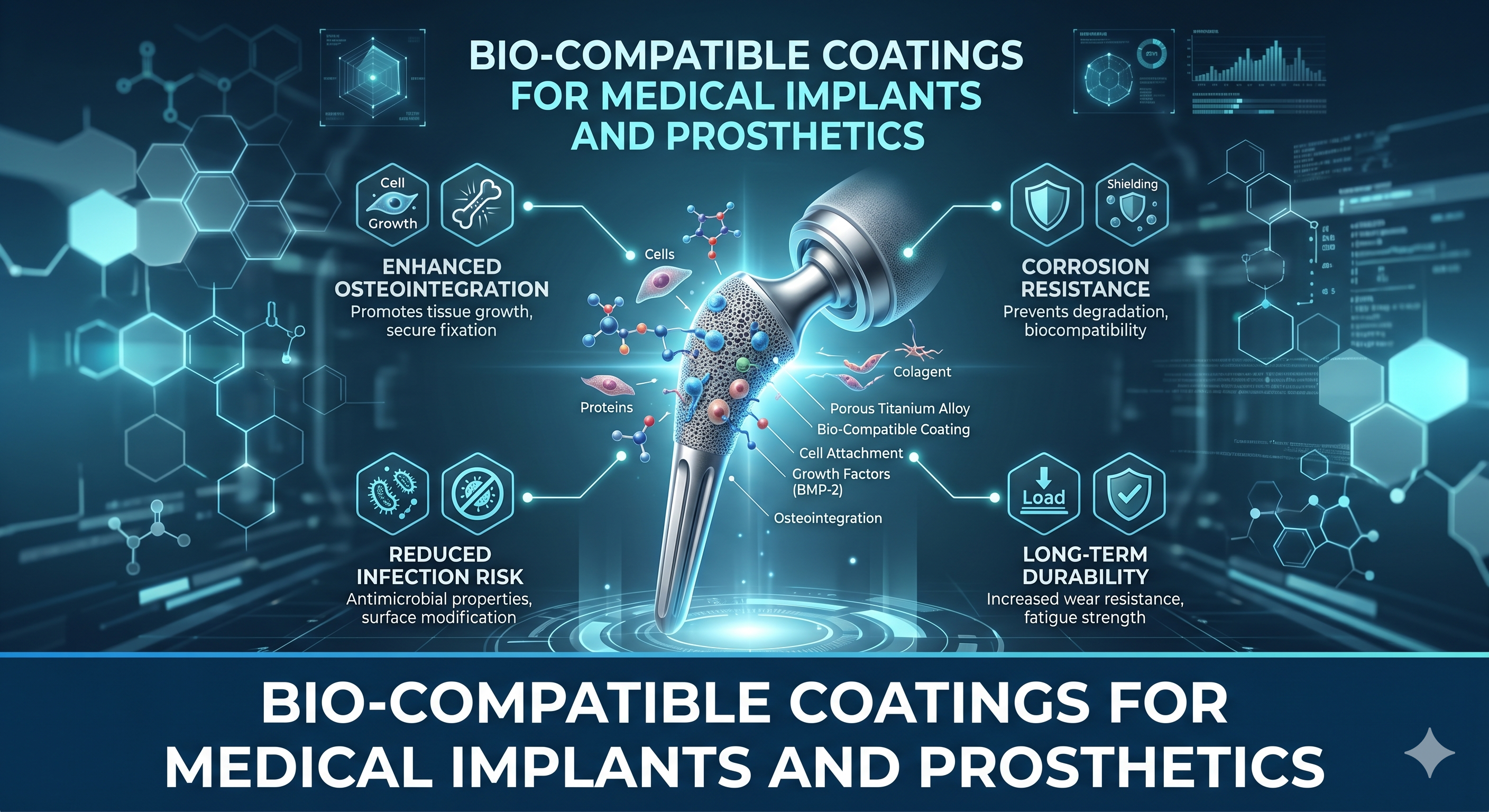
The field of regenerative medicine and orthopedics has undergone a radical transformation over the past few decades. While the primary goal was once simply to replace a damaged joint or missing limb with a mechanical substitute, today’s focus has shifted toward biological integration. The success of a medical implant—whether it is a titanium hip replacement, a dental post, or a neural probe—depends entirely on the “handshake” between the synthetic material and the living tissue.
This handshake is facilitated by Bio-Compatible Coatings. These thin layers of material, often only micrometers or nanometers thick, serve as the translator between the rigid world of metallurgy and the dynamic, fluid world of cellular biology. Without these coatings, the body often views an implant as a foreign invader, leading to inflammation, rejection, or the formation of fibrous scar tissue that prevents the device from functioning correctly.
2. The Science of Osseointegration: Why Surface Engineering Matters
The most critical metric for the success of permanent implants is osseointegration—the structural and functional connection between living bone and the surface of a load-bearing artificial implant. Titanium, the gold standard for many years, is naturally “bio-inert,” meaning it doesn’t harm the body. However, it isn’t necessarily “bio-active.”
Coatings bridge this gap by accelerating healing, promoting faster cell attachment (osteoblasts) to the surface, and reducing “stress shielding” (a phenomenon where bone density decreases because the metal implant carries all the load). By engineering the surface, we can effectively “trick” the body into recognizing the implant as part of the skeletal system.
3. Classification of Modern Bio-Compatible Coatings
Modern science categorizes these coatings based on their chemical composition and their intended biological interaction:
A. Ceramic and Mineral-Based Coatings (Hydroxyapatite)
Hydroxyapatite (HA) is a naturally occurring mineral form of calcium apatite, which makes up about 70% of human bone. By coating a titanium implant with synthetic HA, surgeons can create a surface that is chemically almost identical to bone.
-
Current Trend: Research is moving toward “Carbonated Hydroxyapatite,” which even more closely mimics the natural mineral phases of young, healthy human bone.
B. Polymeric and Soft Coatings
In applications like vascular stents or neural interfaces, a hard ceramic is not ideal. Polymers like PEEK (Polyether ether ketone) or bio-resorbable polymers are used. These coatings often act as “smart reservoirs” that release anti-inflammatory medication or bone-morphogenetic proteins (BMPs) slowly over time to guide the healing process.
C. Metallic and Nanostructured Coatings
With the rise of nanotechnology, researchers are creating “nanoporous” surfaces. These surfaces mimic the natural texture of the extracellular matrix (ECM). Using techniques like Anodic Oxidation, engineers can create “forests” of Titania nanotubes on an implant, providing a scaffold that cells can actually grow into, creating a mechanical lock much stronger than traditional smooth surfaces.
4. Advanced Research Frontiers: Smart and Antimicrobial Surfaces
One of the most significant challenges in modern surgery is the “Race for the Surface.” When an implant is placed, it is a race between human cells and bacteria to colonize the surface. If bacteria win, they form a biofilm—a protective slime layer that makes them nearly immune to antibiotics.
Antibacterial Nanoparticles
Recent clinical studies are exploring the integration of silver (Ag), copper (Cu), and zinc (Zn) nanoparticles into coatings. These metals have natural antimicrobial properties that kill bacteria on contact by disrupting their cell membranes, significantly reducing the risk of post-operative infections.
Biomimetic Peptides
Cutting-edge research in 2025 and beyond is focusing on coating surfaces with specific peptides (short chains of amino acids). These peptides, such as the RGD sequence, specifically signal to the body’s cells to attach and proliferate, essentially “programming” the biological response at the molecular level.
5. Advantage vs. Risk Assessment: A Balanced View
While coatings offer transformative benefits, they are not without risks. A successful clinical application requires a careful balance.
| Feature | Advantage | Potential Risk / Challenge |
| Stability | Faster recovery and better load distribution. | Delamination: The coating may peel off the metal substrate over time. |
| Infection Control | Reduced need for systemic antibiotics. | Toxicity: High concentrations of metal ions (like silver) can be toxic to human cells. |
| Longevity | Prevents corrosion and wear of the base metal. | Wear Debris: Microscopic fragments of coating can cause inflammation (osteolysis). |
| Bio-Activity | Encourages natural tissue growth. | Cost & Regulation: High manufacturing costs and complex FDA/EMA approval processes. |
6. Clinical Applications: Beyond Orthopedics
While hip and knee replacements are the most common users of these technologies, other fields are rapidly adopting bio-compatible coatings:
-
Cardiovascular: Stents coated with drug-eluting polymers prevent “restenosis” (re-narrowing of the artery).
-
Dental: Zirconia coatings on dental posts improve aesthetics and gum tissue attachment.
-
Neural Prosthetics: Coatings that match the mechanical “softness” of brain tissue are being developed for brain-computer interfaces (BCIs), like those used to help paralyzed patients move robotic limbs.
7. The Future: Personalized Bio-Interfaces
We are moving toward a future of “Personalized Coatings.” Using a patient’s own stem cells or specific protein profile, manufacturers could create a custom coating for an implant 3D-printed specifically for that individual. This would virtually eliminate the risk of rejection and allow for implants that last a lifetime, even in younger, more active patients.
8. Conclusion
Bio-compatible coatings are the unsung heroes of modern medicine. They transform lifeless pieces of metal and plastic into integrated parts of the human body. As we continue to refine these materials at the atomic level, the line between man and machine will continue to blur, leading to a future where disability and joint degradation are temporary setbacks rather than lifelong limitations.