
Recently added item(s)
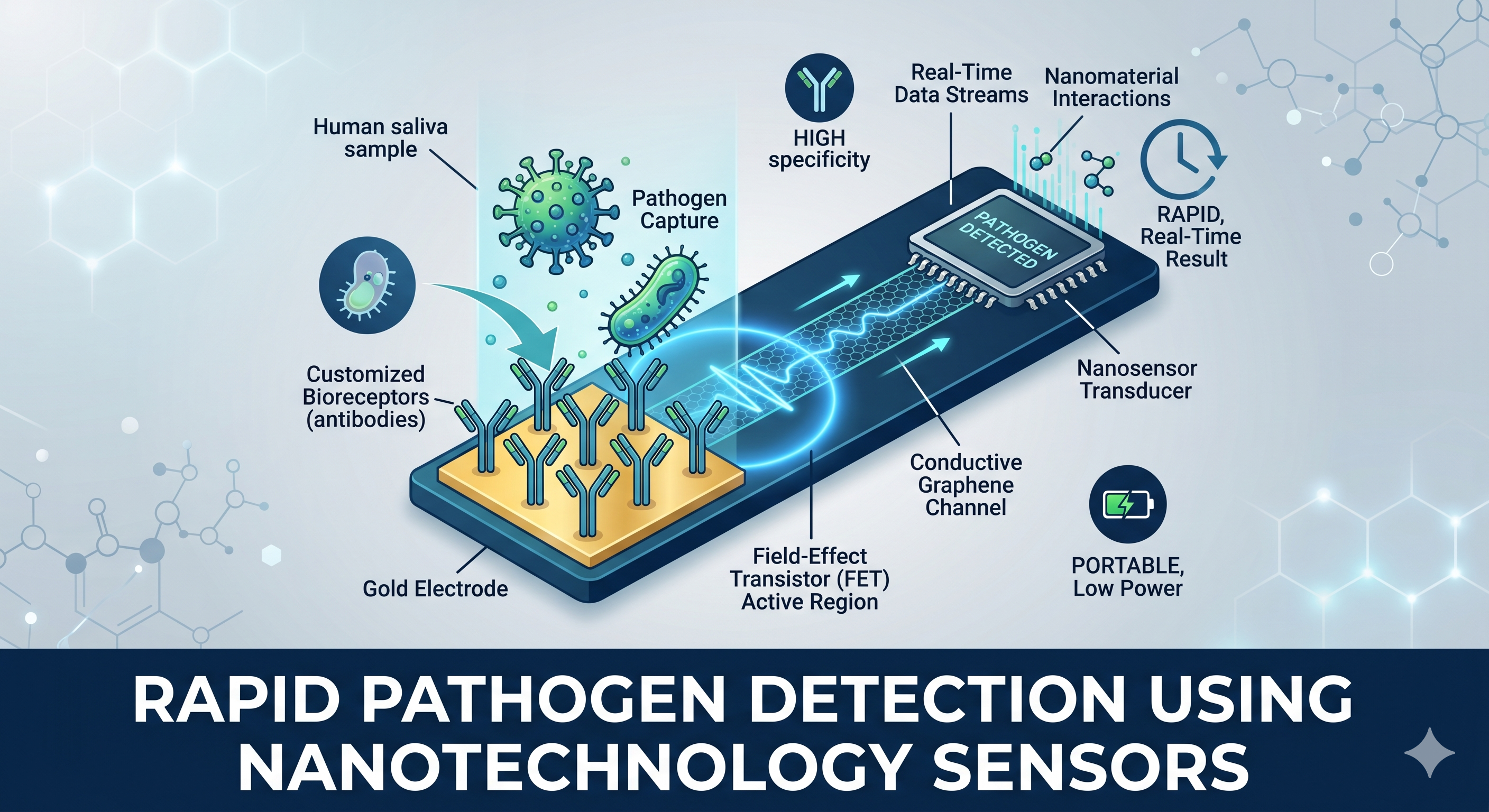
In the battle against infectious diseases, time is the ultimate enemy. Whether it is a seasonal flu outbreak, a localized foodborne illness, or a global pandemic, the ability to identify a pathogen—be it a virus, bacterium, or fungus—in minutes rather than days can save millions of lives.
Traditional diagnostic methods, such as Polymerase Chain Reaction (PCR) or cell cultures, are highly accurate but suffer from significant drawbacks: they are time-consuming, require expensive laboratory infrastructure, and demand highly trained personnel. Nanotechnology is changing this narrative. By manipulating matter at the atomic and molecular scale, scientists are developing sensors that can detect a single pathogen particle in a drop of blood or saliva almost instantaneously.
2. What are Nanotechnology Sensors?
Nanotechnology sensors, or “nanosensors,” are diagnostic tools that utilize the unique physical and chemical properties of nanomaterials (materials with at least one dimension between 1 and 100 nanometers). At this scale, materials behave differently; for example, gold changes color based on the size of its particles, and carbon nanotubes become hyper-sensitive to electrical changes.
In the context of pathogen detection, these sensors act as high-sensitivity transducers. They convert a biological event—such as a virus binding to an antibody—into a measurable signal, such as a change in light, electricity, or mass.
3. Key Nanomaterials Powering Rapid Detection
Several “super-materials” are at the forefront of this diagnostic revolution:
A. Gold Nanoparticles (AuNPs)
Gold nanoparticles are prized for their Surface Plasmon Resonance (SPR). When a specific pathogen binds to these particles, they undergo a visible color change (often from red to blue). this allows for “naked-eye” detection, similar to a pregnancy test, but for complex diseases like Ebola or COVID-19.
B. Carbon Nanotubes (CNTs) and Graphene
These carbon-based materials are excellent electrical conductors. In a Field-Effect Transistor (FET) biosensor, graphene serves as the sensing channel. When a pathogen lands on the graphene surface, it alters the electrical current flowing through the device. Because graphene is only one atom thick, even a minute change is detected, offering unprecedented sensitivity.
C. Quantum Dots (QDs)
Quantum dots are semiconductor nanocrystals that emit bright, stable light when exposed to UV rays. By “tagging” different pathogens with different colored quantum dots, doctors can perform multiplexed detection—identifying multiple different infections (e.g., strep throat and the flu) from a single patient sample simultaneously.
4. How It Works: The “Lock and Key” Mechanism
Nanosensors typically consist of three main components:
-
The Bioreceptor: A molecule (like an antibody, DNA strand, or aptamer) designed to recognize a specific pathogen.
-
The Interface: The nanomaterial (graphene, gold, etc.) where the recognition happens.
-
The Transducer: The component that turns the biological “click” into a digital or visual result.
When a patient sample is applied, the pathogen acts as a “key” that fits perfectly into the bioreceptor “lock.” This interaction triggers the nanomaterial to send a signal, providing a “Yes/No” answer in real-time.
5. Current Research and Clinical Milestones
Research in 2025 and 2026 has pushed these sensors from the laboratory to the clinical “Point-of-Care” (POC).
-
Sepsis Detection: Sepsis is a medical emergency where every hour of delay increases mortality by 8%. New clinical trials are utilizing magnetic nanoparticles to “pull” bacteria out of the blood and identify them using nanosensors within 30 minutes, compared to the standard 24–48 hours.
-
Food Safety: Research is integrating nanosensors into food packaging (“smart labels”). These sensors detect the gases or toxins produced by pathogens like Salmonella or E. coli, changing color to warn consumers before the food is even opened.
-
Wearable Diagnostics: Scientists are developing “diagnostic patches” that monitor sweat for biomarkers of infection. These wearables could provide early warnings of illness before the patient even feels symptomatic.
6. Advantage vs. Risk Assessment
While nanotechnology offers a quantum leap in diagnostics, it must be implemented with caution.
| Advantage | Description | Risk / Challenge | Description |
| Speed | Results in minutes (Real-time). | Stability | Nanomaterials can be sensitive to temperature and humidity changes. |
| Sensitivity | Can detect incredibly low concentrations of pathogens. | False Positives | High sensitivity may lead to detecting “dead” viral fragments that aren’t dangerous. |
| Portability | Handheld devices for use in remote areas or at home. | Manufacturing Cost | Scaling up “lab-on-a-chip” production can be expensive initially. |
| Non-Invasive | Can often use saliva, breath, or urine instead of deep blood draws. | Biocompatibility | If used in vivo, we must ensure nanoparticles don’t accumulate in organs. |
7. The Future: Lab-on-a-Chip (LoC)
The ultimate goal of this field is the Lab-on-a-Chip. This involves shrinking an entire diagnostic laboratory onto a device the size of a credit card. By integrating microfluidics (the movement of tiny amounts of liquid) with nanotechnology sensors, these chips can prepare the sample, detect the pathogen, and send the data to a doctor’s smartphone via Bluetooth.
This technology is particularly vital for developing nations, where access to centralized laboratories is limited. A handheld nanosensor could allow a village healthcare worker to diagnose malaria or tuberculosis instantly, allowing for immediate treatment.
8. Conclusion: Transforming Healthcare Through Tiny Tools
Rapid pathogen detection using nanotechnology sensors represents one of the most significant shifts in medical history. We are moving away from a reactive “wait-and-see” model of medicine toward a proactive, “detect-and-defend” strategy. By harnessing the power of the nanoscale, we are building a world where infectious diseases are identified so quickly that they can be contained before they ever become outbreaks.
As these sensors become more robust, cheaper to produce, and more widely integrated into our daily lives, they will not only save lives but also reduce the economic burden on healthcare systems worldwide. The future of medicine is small, fast, and incredibly powerful.