
Recently added item(s)
1. Introduction: The “Lab-to-Fab” Gap
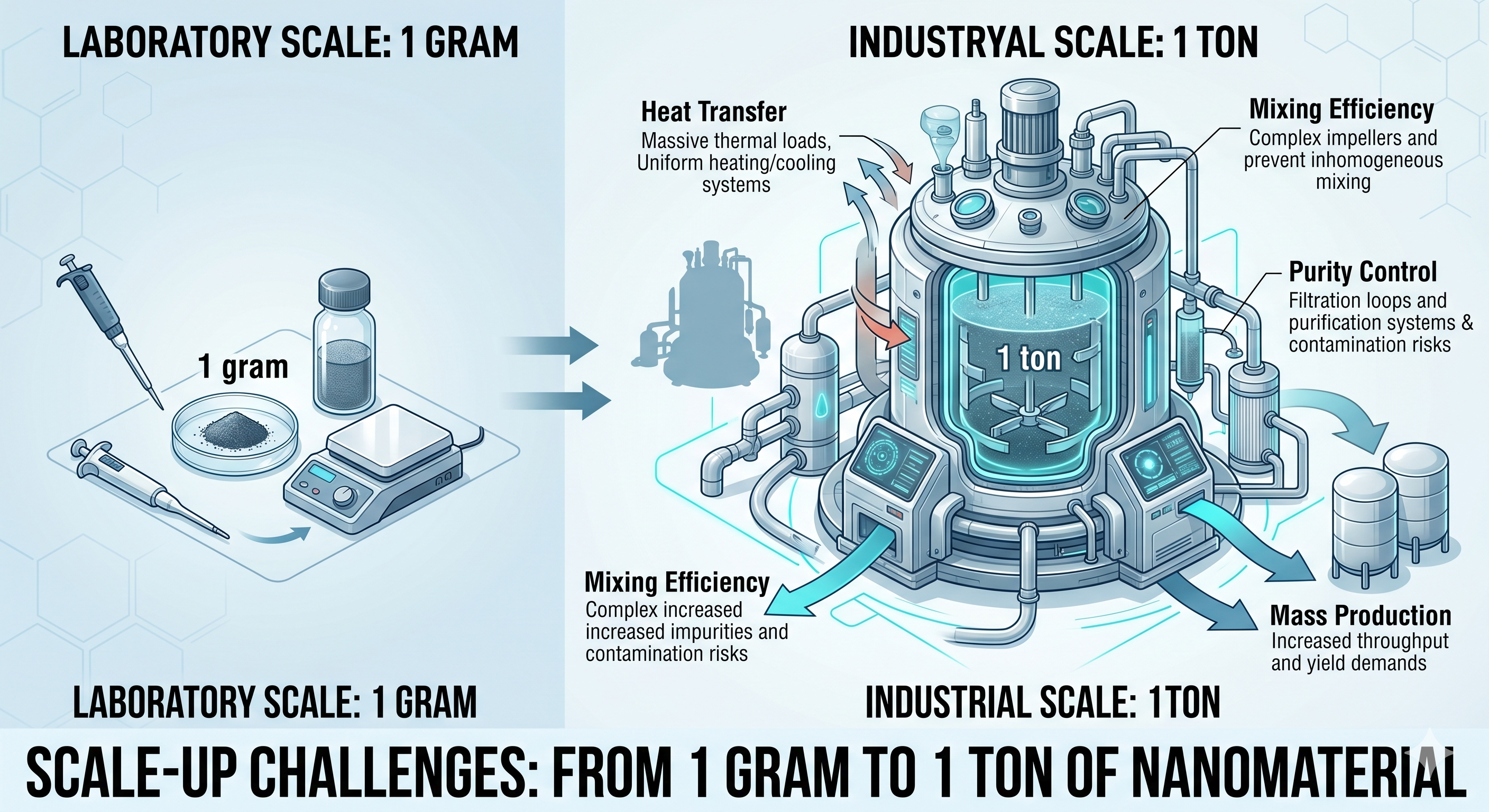
In the history of technology, some of the greatest ideas have never left the laboratory. In the field of nanotechnology, this is often due to the “Scale-Up Challenge.” It is one thing for a PhD student to produce 1 gram of high-quality gold nanoparticles or a few milligrams of carbon nanotubes for a research paper; it is an entirely different feat to produce 1 ton of that same material with the same precision, purity, and cost-effectiveness.
Moving from “milligrams to metric tons” is not just about buying a bigger beaker. At the nanoscale, physical properties are highly sensitive to change. A slight fluctuation in temperature in a 1,000-liter reactor can result in a batch of material that is biologically toxic or functionally useless. This article explores the technical, economic, and safety hurdles of mass-producing the building blocks of the future.
2. The Physics of Scaling: Why “Bigger” Isn’t Just “More”
The primary reason nanotechnology scale-up is difficult lies in Heat and Mass Transfer.
Surface Area vs. Volume
In a small laboratory flask, heat is distributed almost instantly. However, in a massive industrial reactor, the center of the liquid remains cooler than the edges. For nanomaterials, where growth is timed to the millisecond, this temperature gradient causes “polydispersity”—meaning you get a mix of large and small particles instead of a uniform size.
Mixing Efficiency
To create consistent bio-compatible coatings or pathogen sensors, every molecule must experience the same chemical environment. Achieving uniform mixing in a 1-ton batch is an engineering nightmare. Poor mixing leads to “hotspots” where particles clump together (agglomeration), destroying the unique properties that make them useful in healthcare.
3. Top-Down vs. Bottom-Up Scaling Strategies
The method used to create the nanomaterial dictates the scaling strategy:
-
Scaling Ball Milling (Top-Down): Scaling mechanical grinding is relatively straightforward—you use larger mills and more energy. However, as the scale increases, the risk of contamination from the grinding media (steel or ceramic) increases, which is a major concern for medical-grade materials.
-
Scaling Chemical Vapor Deposition (CVD) (Bottom-Up): Scaling CVD requires massive vacuum chambers and precise gas flow controls. While CVD produces the highest quality neural interface materials, it is currently one of the most expensive and energy-intensive methods to scale to “ton” levels.
4. Quality Control and “Batch-to-Batch” Consistency
In pharmaceutical manufacturing, consistency is king. If a lateral flow assay (like a COVID test) is mass-produced using a batch of gold nanoparticles that are slightly too large, the test will yield a false negative.
The Characterization Bottleneck
In a lab, you can spend days using SEM, TEM, and XRD to characterize 1 gram of material. When producing 1 ton, you cannot check every milligram. The industry is currently moving toward “In-line Monitoring”—using lasers and light-scattering sensors directly inside the production pipes to monitor particle size in real-time. This allows manufacturers to stop a faulty batch before 1,000 kilograms are wasted.
5. Economic and Supply Chain Hurdles
The “Death Valley” of nanotechnology is the cost.
-
Precursor Costs: The raw gases and chemicals needed for high-purity nanomanufacturing are often expensive.
-
Energy Consumption: Maintaining high temperatures (up to 1000°C for some nanotubes) in large reactors requires immense amounts of electricity.
-
Regulatory Compliance: As discussed in the Global Regulatory View, moving to large-scale production triggers much stricter safety audits by the FDA and EMA, adding years to the time-to-market.
6. Advantage vs. Risk Assessment of Mass Production
| Feature | Advantage of Scaling | Risk of Scaling |
| Market Accessibility | Drives down the price of life-saving nanomedicines. | Quality Degradation: High risk of losing structural precision at scale. |
| Industrial Integration | Allows nanotechnology to be used in everyday products (paints, filters). | Environmental Impact: Large-scale production generates significant nano-waste. |
| Standardization | Leads to “Golden Standards” for global manufacturing. | Occupational Safety: Managing “ton-scale” amounts of dry nanopowders poses inhalation risks for workers. |
| Economic Growth | Creates a high-tech manufacturing sector and jobs. | Capital Intensity: High initial investment in infrastructure (Clean Rooms). |
7. Current Research: The Rise of Continuous Flow Chemistry
To overcome the “Big Tank” problem, researchers are moving toward Microfluidics and Continuous Flow Manufacturing. Instead of one giant reactor, the material is produced in a continuous stream through small, interconnected tubes.
-
The Benefit: Every drop of the 1-ton total is produced under identical, perfectly controlled conditions.
-
The Progress: Several biotech companies are already using “Flow-CVD” to produce carbon nanotubes with 99.9% purity at an industrial scale, potentially lowering the cost of brain-machine interfaces.
8. Environmental and Safety Standards at Scale
When you produce 1 gram of nanomaterial, the environmental risk is negligible. When you produce 1 ton, you must consider the entire lifecycle.
-
Nano-EHS (Environment, Health, and Safety): Large-scale facilities must implement specialized filtration systems to ensure that nanoparticles do not escape into the local water or air.
-
Workplace Protection: Scaling up requires automated, “closed-loop” systems where workers never come into direct contact with the powders, reducing the risk of respiratory issues.
9. Conclusion: Bridging the Gap
The journey from 1 gram to 1 ton is the final hurdle for the “Nano-Age.” We have already proven that nanotechnology can cure diseases and sense pathogens in the lab. The challenge for the next decade is not discovering new materials, but mastering the engineering required to produce them reliably for the 8 billion people on Earth.
As we transition to continuous flow manufacturing and AI-driven quality control, the cost of these “miracle materials” will drop, making advanced regenerative medicine and high-speed diagnostics accessible to everyone, not just those in the wealthiest nations.