
Recently added item(s)
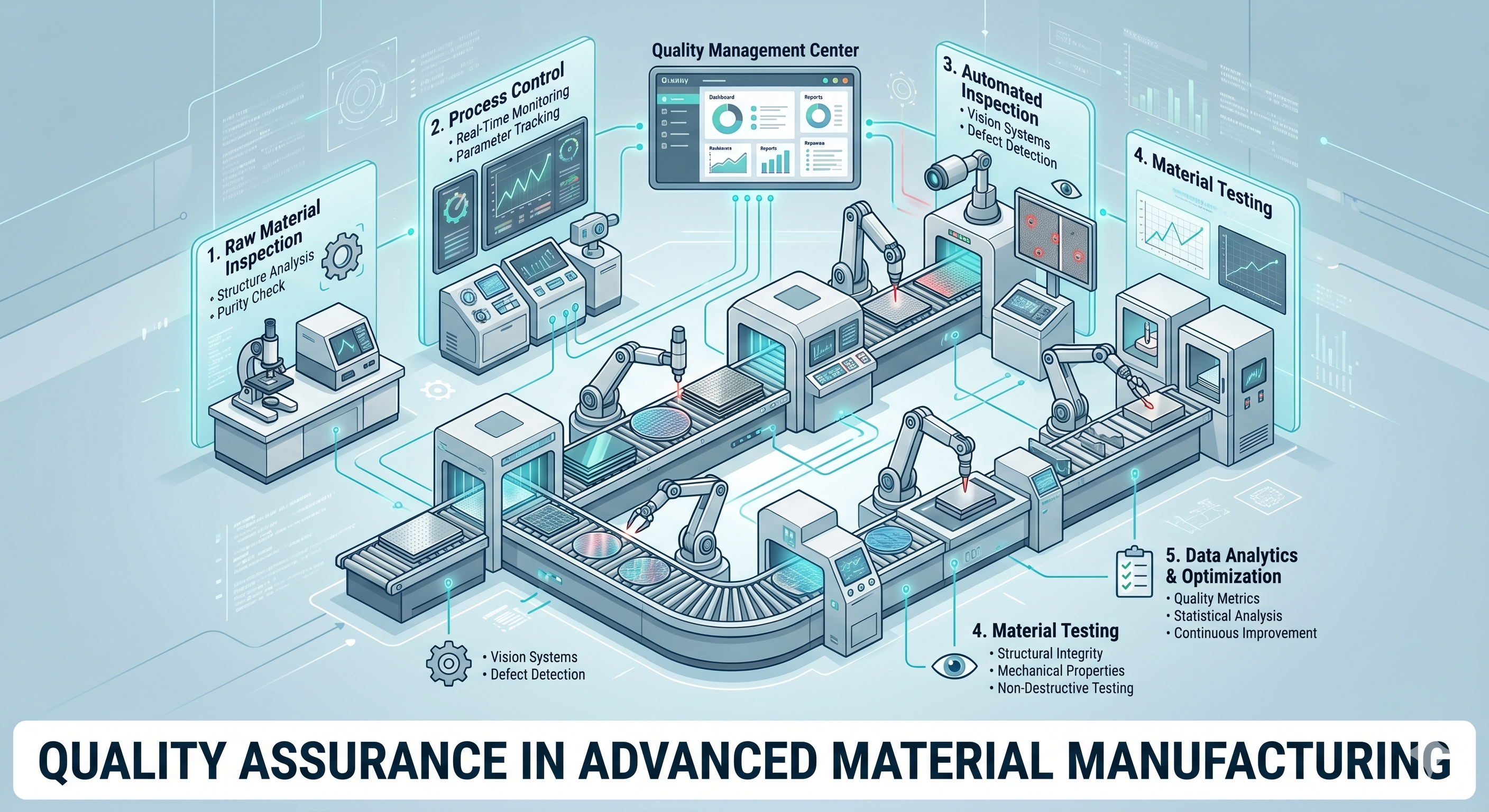
The materials that define our future are no longer just dug from the ground or forged in traditional furnaces. We are entering an era of Advanced Material Manufacturing, where materials like graphene, meta-materials, engineered biomaterials, and customized superalloys are designed atom-by-atom to possess extraordinary properties—unmatched strength, lightness, electrical conductivity, or bio-compatibility. Yet, the bridge between a revolutionary material synthesized in a laboratory and a reliable, life-saving component in an aerospace engine or a patient’s hip implant is paved with a crucial, albeit less glamorous, discipline: Quality Assurance (QA).
Without sophisticated QA, advanced materials remain expensive curiosities, too risky for critical applications. This blog post explores how quality assurance is being reimagined for this new manufacturing paradigm, balancing scientific rigor with industrial scalability, and highlighting the innovations, stakes, and challenges that define this field.
Defining QA vs. QC in the New Era
To appreciate advanced QA, we must first distinguish it from its cousin, Quality Control (QC). Traditionally, QC is reactive; it involves testing a final product to ensure it meets specifications. Quality Assurance, however, is proactive. It encompasses the entire process—from designing the manufacturing method and sourcing raw materials to train operators and defining maintenance schedules.
In advanced material manufacturing, the distinction blurs. “Shift Left” is the mantra: moving QA earlier into the process. Because defects in nanomaterials or complex 3D-printed lattices are often invisible to the naked eye and destructive testing is costly, the only way to guarantee final quality is to assure the process that creates them. In smart factories, continuous sensing means QC is integrated directly into QA workflows.
The Challenges of the Invisible: Why Advanced Materials Demand New QA
Advanced materials introduce unique failure modes that traditional inspection cannot detect.
-
Nanoscale Flaws: For nanomaterials like carbon nanotubes or quantum dots, a defect the size of a single molecule can alter electrical or mechanical properties dramatically across an entire batch. Assuring uniformity requires microscopic precision over macroscopic areas.
-
Structural Complexity: Technologies like Additive Manufacturing (3D printing) allow for intricate internal geometries (like lattices) that cannot be inspected by traditional tools. A void deep within a 3D-printed superalloy turbine blade can cause catastrophic failure under stress.
-
Process Sensitivity: Advanced material properties are often extremely sensitive to subtle environmental variations during manufacturing—such as temperature spikes, humidity, or trace chemical contamination. Controlling these “invisible” parameters is paramount.
Inside the Smart Factory: Emerging QA Technologies
Industry 4.0 is equipping advanced manufacturing with a digital toolkit to tackle these challenges. The goal is the creation of a “digital twin”—a computerized replica of the manufacturing process that predicts and monitors quality in real time.
1. Real-Time Sensing and IIoT
Modern advanced manufacturing machines are teeming with Industrial Internet of Things (IIoT) sensors. For example, in an Additive Manufacturing bed, melt pool monitors use photodiode sensors to measure the temperature and size of the molten metal spot formed by the laser at every millisecond. Deviations are logged instantly, alerting operators to potential flaws as they form.
2. AI and Machine Learning in Defect Detection
Artificial Intelligence (AI) excels at finding patterns in vast datasets. When fed with sensor data, thermal images, or non-destructive testing results, AI models can identify anomalies that human inspectors would miss. AI vision systems are now capable of inspecting material surfaces for micro-cracks or particulate contamination in real time on a production line. Predictive maintenance models, driven by machine learning, can predict when a machine is likely to produce a defective part based on subtle degradation in its sensor readings.
3. Advanced Non-Destructive Testing (NDT)
When final product inspection is necessary, advanced manufacturing relies on sophisticated non-destructive methods.
-
X-ray Computed Tomography (CT): This 3D X-ray technique is the “CAT scan” for materials, providing a detailed map of internal voids, cracks, and density variations in complex 3D-printed components.
-
Terahertz Waves: Emerging for inspecting coatings on complex shapes. Like microwave radiation but higher frequency, terahertz waves can penetrate plastics and composite materials to measure layer thickness and detect hidden defects without damaging the surface—a technique recently adopted by automakers like BMW for paint quality inspection on exterior plastic components.
The Stakes Are Higher: Quality Assurance in Biomedical Materials
While a failure in an aerospace component is catastrophic, a failure in a biomedical material is personal. Quality assurance in the manufacturing of biomedical materials—implants, scaffolds for tissue engineering, and drug delivery systems—is subject to the most stringent regulations, typically Good Manufacturing Practices (GMP).
The stakes include:
-
Bio-compatibility: Assuring a synthetic heart valve or bone graft does not trigger a rejection response in the body.
-
Sterility: Assuring the manufacturing process eliminates all trace microbiological contamination.
-
Structural Integrity: Assuring a customized hip implant can withstand a lifetime of loading without breaking.
GMP requires rigorous documentation, validation of every process step, characterization of cell lines or chemical feedstocks, and extensive stability testing. For manufactured biomedical materials, QA is the primary mechanism that safeguards patient safety, ensuring that personalized solutions deliver their promised therapeutic benefit without unforeseen risks.
Recent Research Breakthroughs in Material QA
Recent studies are pushing the boundaries of material QA from raw feedstock consistency to sustainable manufacturing.
-
Integrated Optimization: Research by ExxonMobil into synthetic graphite initiatives highlights how integrated operations can optimize product feedstocks. By controlling consistency from the outset, manufacturers can ensure that downstream users receive high-quality feedstocks necessary for demanding plastics and material applications.
-
Terahertz Inspection at Scale: The deployment of non-destructive terahertz measurement systems by das-Nano at BMW’s Leipzig plant demonstrates the transition of lab-based NDT into high-volume automotive series production.
-
Sustainable Materials QA: Research at PolyU and other institutes is focusing on the R&D of carbon-neutral manufacturing. This includes developing QA protocols for recycled materials (eco-materials), assuring that recycling processes do not introduce defects or impurities that compromise final material properties.
Advantages of Advanced QA Systems
Investing in sophisticated QA systems is a strategic imperative for high-value manufacturing.
| Advantage | Description |
| Cost Reduction | Early defect detection prevents expensive waste (rework), recalls, returns, and associated reputational damage. |
| Increased Efficiency | Standardized, well-monitored processes reduce variability, minimize machine downtime, and optimize energy and resource use. |
| Improved Customer Satisfaction | Consistent product quality builds customer trust, loyalty, and a strong market reputation. |
| Enhanced Regulatory Compliance | Automated documentation and traceability ensure compliance with industry standards and mandatory safety regulations. |
| Accelerated Innovation | Reliable QA data allows engineers to push the boundaries of design, knowing their manufacturing processes can faithfully reproduce complex geometries and material structures. |
Risks and Evaluation: Balancing Innovation and Control
While the benefits are clear, advanced QA systems carry their own set of risks and implementation challenges.
-
Implementation Cost: High-tech sensors, NDT equipment, and AI software represent significant upfront capital expenditure.
-
Complexity and Dependence: Relying on interconnected digital systems increases vulnerability to cyberattacks or software glitches. A sensor failure could invalidate an entire production batch.
-
Specialized Skillsets: Advanced factories require operators and quality engineers who are not only familiar with materials but also proficient in data analytics, AI, and NDT technologies.
Evaluation: For high-value, critical industries (aerospace, defense, biomedical), the “risk of not having sophisticated QA” (failures, recalls, safety incidents) far outweighs the implementation risks. Advanced QA is not just a regulatory burden; it is an indispensable pillar of modern manufacturing competitiveness and safety.
Summary and Conclusion
Advanced material manufacturing is unlocking revolutionary possibilities, but these materials are only as reliable as the systems that guarantee their quality. Quality Assurance has transcended simple checking; it is now a proactive, digitally integrated, and scientific discipline that assure integrity from the atomic scale to the final component. By leveraging Industry 4.0 innovations—from AI flaw detection to non-destructive imaging—QA is providing the confidence necessary to deploy advanced materials in the most critical of applications, ensuring that the materials of the future deliver their full, safe, and reliable potential.