Recently added item(s)
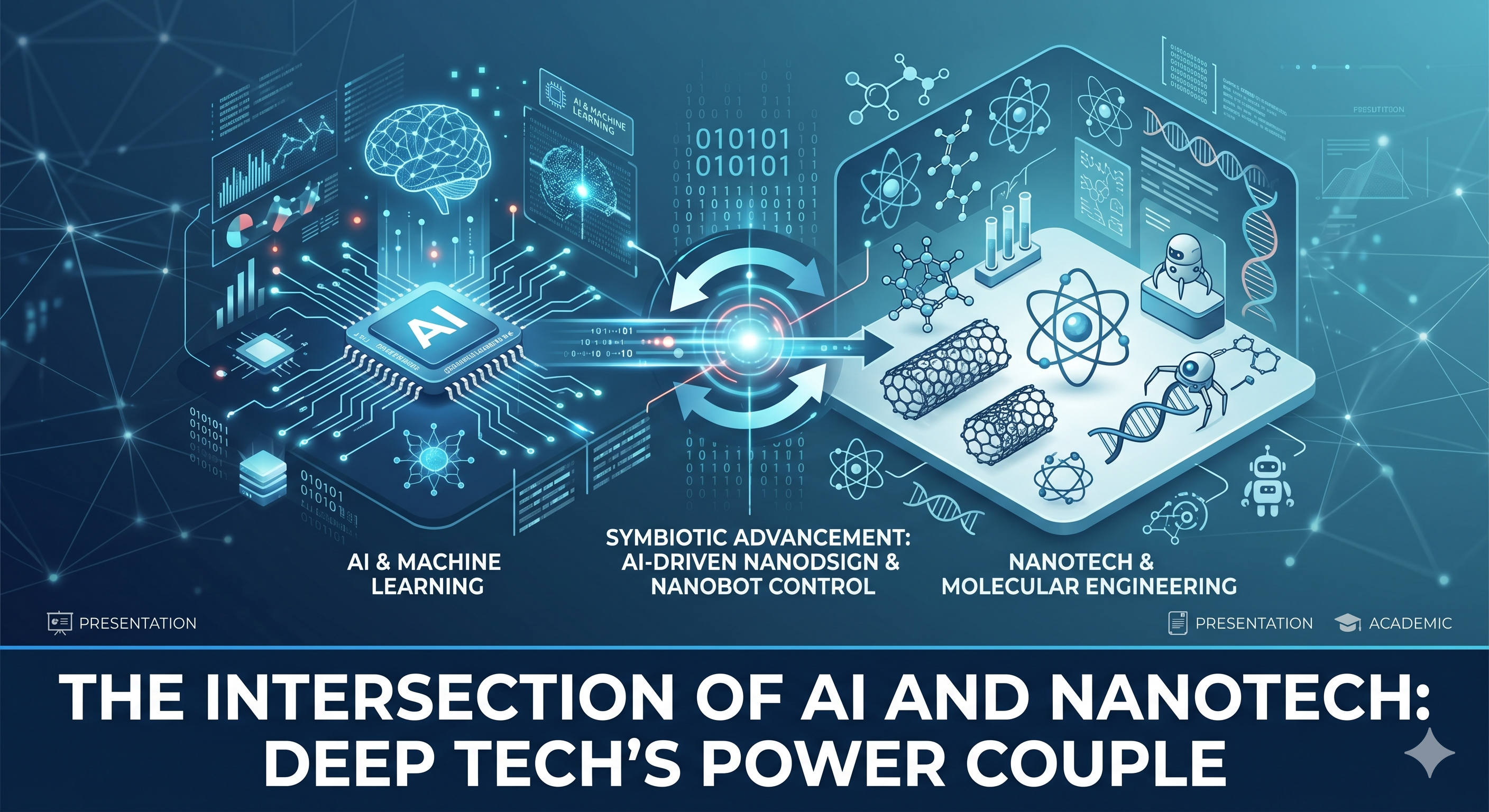
We are standing at the precipice of a technological renaissance, driven not by a single breakthrough, but by the convergence of two foundational fields that were once distinct: Artificial Intelligence (AI) and Nanotechnology. Individually, these are categorized as “Deep Tech”—innovations based on substantial scientific advance and high-tech engineering. Together, they represent something far greater than the sum of their parts. They are a “power couple,” creating a symbiotic feedback loop that is rapidly reshaping the frontiers of medicine, manufacturing, computation, and energy.
While AI focuses on the creation of intelligent agents that can process information and make predictions, nanotechnology operates at the atomic and molecular scale, manipulating matter at dimensions typically below 100 nanometers. By bridging these two domains, we are effectively giving intelligent algorithms the “hands” to manipulate the physical world at the ultimate limits of fabrication, while giving nanomaterials the “brains” to become functional, adaptive, and precise.
The Mutual Acceleration: A Symbiotic Feedback Loop
The intersection is characterized by a reciprocal acceleration. AI is revolutionizing how we design, model, and manufacture nanomaterials. Conversely, nanotechnology is providing the physical hardware required to push AI computational capabilities beyond current limitations.
How AI is Transforming Nanotech Design
For decades, the field of nanotechnology relied heavily on trial-and-error experimentation and simplified mathematical models. Designing functional nanoparticles is incredibly complex because material properties at the nanoscale differ wildly from their bulk counterparts, governed by quantum mechanics rather than classical physics. Predicting how complex groups of atoms interact is computationally expensive and often inaccurate using traditional software.
AI, and specifically Machine Learning (ML), is changing this entirely.
AI models are trained on vast datasets of existing nanomaterial experiments and theoretical simulations. Once trained, these models can rapidly navigate the combinatorial explosion of potential molecular structures. They can predict properties such as optical resonance, electrical conductivity, or biochemical interaction in milliseconds, a task that once took months of labor. This has given rise to the concepts of “Inverse Design”—where scientists define the desired material properties, and the AI suggests the precise molecular structure needed—and the “Materials Genome Initiative” framework.
How Nanotech is Reinventing AI Hardware
Current AI relies on graphics processing units (GPUs) and central processing units (CPUs) based on traditional “von Neumann” architecture, where the memory (data storage) and processor (computing unit) are physically separate. This bottleneck causes massive energy consumption and limits speed, which is a critical constraint as AI models grow in size.
Nanotechnology holds the key to the next generation of computing: Neuromorphic Computing. Instead of relying on silicon transistors acting as binary switches, nanotech allows the creation of electronic devices that mimic the structure of the human brain—synapses and neurons.
A primary example is the Memristor—a portmanteau of memory and resistor. These nanoscale devices can both store information and process it simultaneously within a single physical structure. They can remember the amount of charge that last flowed through them, altering their resistance in a manner analog to biological synaptic weight changes. By integrating arrays of memristors into “crossbar” architectures using nanolithography, researchers are building chips that can execute matrix multiplications (the core operation of neural networks) with a fraction of the energy and at speeds significantly higher than current digital systems.
Transforming Medicine: From Diagnostics to Clinical Breakthroughs
The most impactful application of this synergy is in healthcare, where AI is enhancing the precision and function of nanoscale medical interventions.
AI-Guided Targeted Drug Delivery
A holy grail of medicine is “targeted therapy”—delivering drugs directly to diseased cells (like tumors) while sparing healthy tissue. Nanoparticles are ideal vehicles for this, but designing them to evade the immune system and find their specific target is extremely difficult. The surface of a nanoparticle becomes coated with proteins (a “protein corona”) the moment it enters the body, altering its behavior in unpredictable ways.
In groundbreaking research, AI algorithms are being used to predict the formation of this protein corona. Researchers feed the algorithm data on the chemistry of the nanoparticle, the biological fluid it will enter, and the desired destination. The AI then models the interaction, suggesting specific molecular coatings (functionalization) that will cloak the particle or guide it to the tumor.
Clinical Application Note: This approaches the clinic through platforms using data gathered from lipid nanoparticle (LNP) delivery systems, such as those used in mRNA vaccines, where AI analyzes performance across different genetic profiles to optimize future lipid formulations for cancer treatments or gene editing tools (like CRISPR).
Nanosensors and Predictive Diagnostics
Diagnostics are becoming significantly more sensitive through nanotech. Nanosensors can detect extraordinarily low concentrations of biomarkers (proteins or nucleic acids indicating disease) in “liquid biopsies” like blood or saliva, sometimes at the single-molecule level.
However, a single chip can contain thousands of these nanosensors, generating data streams that are too massive for human interpretation. AI is essential for processing this output. Large language models (LLMs) and advanced regression models analyze patterns in sensor signals, distinguishing true positive signals from background “noise” with unprecedented accuracy.
A critical application of this is the detection of circulating tumor DNA (ctDNA) or exosomes for ultra-early cancer detection. Clinical studies are increasingly validating systems where a nanoscale detection array provides data to an AI model, which then predicts not just the presence of a tumor, but often its tissue of origin and potentially its genetic subtype, before symptoms are present.
Advantage-Risk Assessment of the AI-Nanotech Intersection
The convergence of two powerful “dual-use” technologies amplifies both the potential benefits and the potential risks.
Significant Advantages
-
Accelerated Discovery: The feedback loop reduces the time to invent and manufacture new materials from decades to years or months, accelerating solutions for climate change (optimized solar cells/batteries) and disease.
-
Personalized Medicine: AI creates dynamic, customized nanoscale treatments based on a patient’s unique biomarker profile.
-
Superior Computation: Neuromorphic hardware enables powerful AI to run on edge devices (like smartphones or medical implants) without relying on energy-intensive data centers.
-
Sustainable Green Tech: Nanotech improves battery energy density and catalyst efficiency, designed with AI to minimize material waste and energy input during production.
Risks and Ethical Considerations
-
Nanotoxicity and Environmental Impact: The rapid development of new materials outpaces the ability to assess their toxicity. AI could accidentally design materials that are biologically persistent or highly toxic. The release of free nanoparticles into ecosystems is a significant “nano-junk” concern.
-
Weaponization: This pairing creates risks in bio-weaponization. AI could be used to design nanoscale vectors that can bypass medical countermeasures or deliver toxins with extreme precision.
-
Privacy and Nano-Surveillance: Advances in nanoscale sensing and manufacturing might lead to pervasive, nearly invisible surveillance devices integrated into everyday materials, which AI could use to process massive societal behavioral data without consent.
-
Economic Inequality: Access to advanced Deep Tech is concentrated in a few powerful nations and corporations, potentially worsening global economic and technological disparities.
-
Neural Privacy and Identity: If brain-computer interfaces (BCIs) use advanced nanoprobes to achieve high-fidelity interaction, and AI analyzes those signals, issues of “neural privacy” and the potential to manipulate identity or agency arise.
Conclusion
The intersection of AI and Nanotechnology represents the culmination of Deep Tech, where intelligence meets the building blocks of reality. It is a defining relationship that will determine the trajectory of technological capability in this century. The power couple is delivering personalized cancer treatments, sustainable energy storage, and computing systems that mimic the efficiency of thought.
However, the rapid nature of this convergence necessitates proactive governance. We must develop rigorous, international frameworks for “Safe-by-Design” nanomaterials, ethical guidelines for neuromorphic interfaces, and strong non-proliferation controls on the synthesis capabilities enabled by inverse design. The synergy between AI and Nanotech will continue to accelerate; our responsibility is to ensure that this acceleration carries humanity toward a more resilient, healthier, and equitable future, rather than toward unmanageable complexity or risk.