
Recently added item(s)
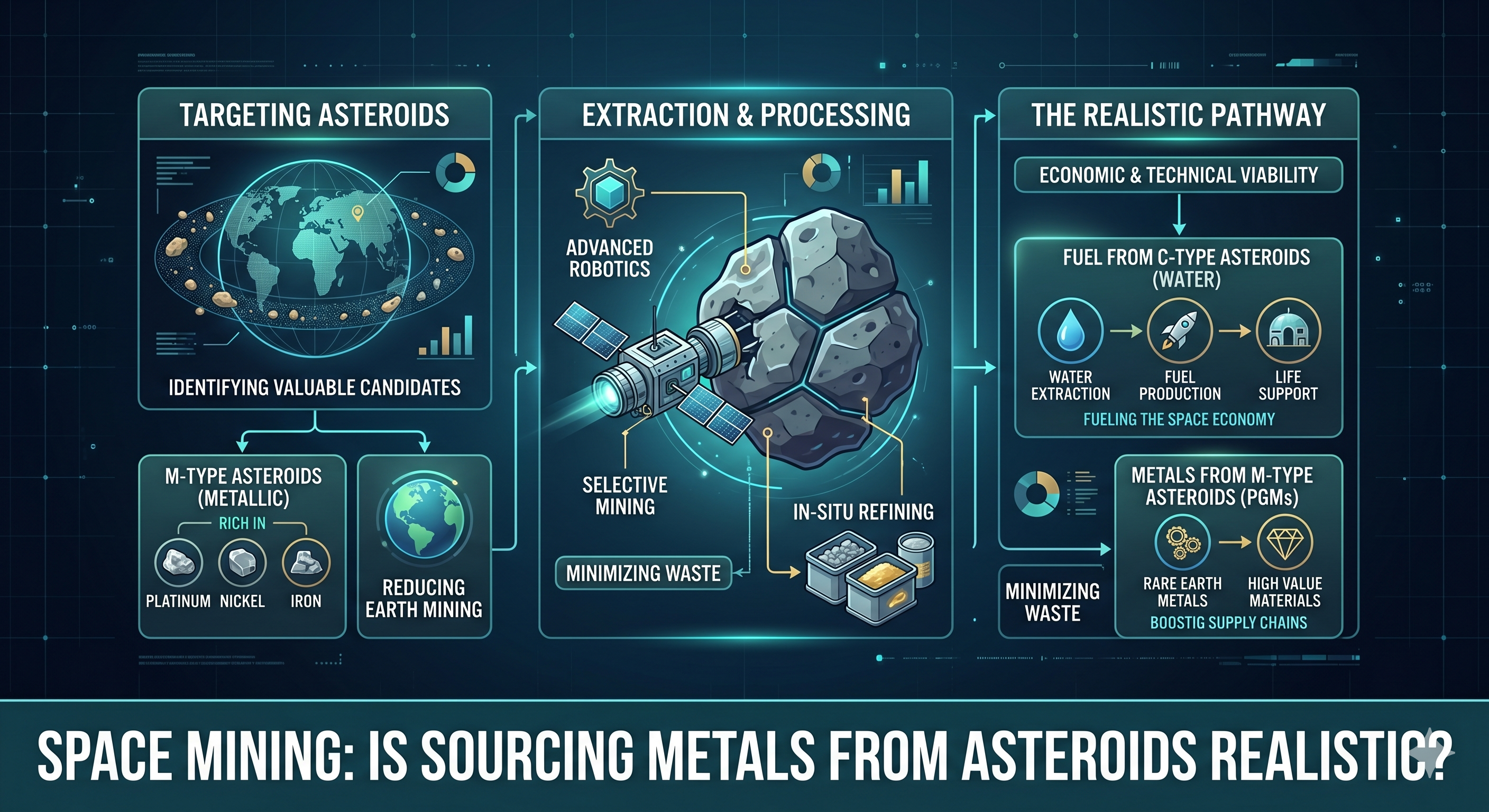
The idea of mining celestial bodies, once relegated to the realm of science fiction, is rapidly descending into the pragmatic world of boardrooms and tech startups. As Earth’s non-renewable resources dwindle and the demand for critical metals for green technologies and electronics skyrockets, we are increasingly turning our gaze upward. Asteroids, the rocky remnants of our solar system’s formation, are not merely drifting hazards; they are flying treasure troves.
But between the intoxicating promise of unparalleled wealth and the reality of deploying robotic extraction infrastructure millions of kilometers away lies a gap filled with extreme technical, economic, and legal challenges. This article provides a scientific yet accessible analysis of space mining, examining its feasibility, current breakthroughs, and the advantage-risk assessment that will determine its future.
The Asteroid Treasure Trove: What is Up There?
Asteroids are not created equal. They are categorized based on their composition, determined through spectrographic analysis from Earth-based telescopes and verified by sample-return missions. For potential miners, three main types are of interest:
1. C-type (Carbonaceous) Asteroids
These are the most common, accounting for about 75% of known asteroids. While they contain some metals, their primary value lies in water ice. Water is the oil of the future space economy. It can be purified for life support or, more crucially, split into hydrogen and oxygen to create rocket propellant. Sourcing fuel in space—In-Situ Resource Utilization (ISRU)—is the key to affordable deep-space exploration.
2. S-type (Silicaceous) Asteroids
Consisting mainly of stony materials and nickel-iron, these account for about 17% of the population. They are potential targets for construction materials for future space habitats.
3. M-type (Metallic) Asteroids
These are the rarest but most enticing targets for wealth generation. They are composed largely of pure nickel-iron, but crucially, they are thought to contain high concentrations of Platinum Group Metals (PGMs) like platinum, palladium, osmium, and iridium. While PGMs exist in Earth’s crust in concentrations of parts per million (ppm), some metallic asteroids might contain them in concentrations 10 to 100 times higher. A single 500-meter metallic asteroid could theoretically contain more platinum than has ever been mined in human history.
Current Research and Technical Demonstrations
While full-scale commercial mining is decades away, the technological groundwork is being laid through government space agency missions and pioneering private ventures. These are the “field trials” or feasibility studies of the space mining world.
1. Sample Return Missions: OSIRIS-REx and Hayabusa2
NASA’s OSIRIS-REx mission to the asteroid Bennu and JAXA’s (Japan) Hayabusa2 mission to Ryugu have been groundbreaking. These missions successfully traveled to Near-Earth Asteroids (NEAs), landed, collected samples, and returned them to Earth.
-
The Scientific Implication: These missions proved we can navigate to, rendezvous with, and precisely interact with small celestial bodies characterized by microgravity. They provided invaluable data on the physical properties of asteroid surfaces (many are “rubble piles” rather than solid rocks). However, OSIRIS-REx returned approximately 120 grams of material—a stark contrast to the millions of tons required for commercial viability.
2. NASA’s Psyche Mission
Launched in 2023, NASA’s Psyche spacecraft is traveling to a unique M-type asteroid also named Psyche, located in the main asteroid belt. This asteroid appears to be the exposed nickel-iron core of a protoplanet. While not a mining mission, Psyche will provide the first-ever close-up study of a metallic world, significantly refining our models of metallic asteroid composition and confirming whether they truly are the “platinum motherships” we suspect.
3. Private Ventures and Technology Testing
Several private companies are entering the fray, focusing initially on prospecting rather than extraction. Companies like AstroForge have launched missions designed to test refine technology in microgravity and prove the feasibility of identifying resource-rich targets. They aim to focus on refining PGMs in space and returning only the high-value product to Earth.
Advantage-Risk Assessment: Weighing the Cosmos
To determine if asteroid mining is truly realistic, we must perform a balanced assessment of its potential benefits against its daunting risks.
Advantages and Potential Benefits
-
Preservation of Earth’s Biosphere: Terrestrial mining is destructive, involving habitat destruction, water contamination, and massive carbon emissions. Shifting the extraction of heavy metals to space could allow Earth’s ecosystems to heal while still meeting civilization’s material needs.
-
Enabling sustainable Space Exploration: The “Tyranny of the Rocket Equation” dictates that lifting fuel from Earth’s deep gravity well is exponentially expensive. Mining water ice from asteroids to create “space gas stations” would radically lower the cost of missions to Mars, the Moon, and beyond, making a sustainable human presence in space possible.
-
Economic Resource Diversification: Sourcing rare metals from space removes Earth’s geopolitical monopolies over critical resources. This could lead to greater global stability and lower prices for high-tech goods like batteries, electronics, and catalytic converters.
-
Scientific Breakthroughs: The technology required for space mining—autonomous robotics, advancedspectroscopy, efficient propulsion—will have countless spin-off applications on Earth, much like the Apollo program did.
Risks and Technical Challenges
-
Extreme Upfront Costs and Long ROI: Space missions are astronomically expensive. Developing, launching, and operating a fleet of robotic miners, plus the infrastructure to return materials, requires billions of dollars in investment with a return-on-investment timeline measured in decades.
-
Technological Complexity in Microgravity: We have millennia of experience mining in 1G (Earth gravity), but almost zero experience in microgravity. Standard mining techniques like drilling, digging, and crushing rely on gravity to hold equipment down or move material. In microgravity, any force applied to the asteroid will push the miner away. Handling floating “rubble pile” material and managing highly abrasive asteroid dust pose extreme engineering challenges.
-
Orbital Mechanics and Travel Time: Asteroids are moving targets. Launch windows to reach Near-Earth Asteroids (NEAs) with low velocity change (Δv) requirements are infrequent. Missions will take years, requiring equipment to operate autonomously with high reliability millions of kilometers from the nearest repair technician.
-
Economic Risks of Market Flooding: If a company successfully returns a massive amount of platinum, the sudden increase in supply could crash the market price of the metal, undermining the economic viability of the entire venture.
-
Murky Legal Framework: The 1967 Outer Space Treaty states that outer space is not subject to national appropriation. While countries like the U.S. and Luxembourg have passed domestic laws allowing private companies to own materials they extract, the international legality is still debated. This legal ambiguity deters large-scale conservative investment.
Conclusion: Is it Realistic?
The verdict on asteroid mining is a nuanced spectrum rather than a simple yes or no.
Is it scientifically possible? Yes. Sample return missions have proven the fundamental steps. Is it technologically ready? No. We lack the robust, reliable extraction and processing technology needed in microgravity. Is it economically viable today? No. The costs are too high, and the return is too distant.
However, the “Tyranny of the Rocket Equation” is being chipped away. Reusable launch vehicles (like SpaceX’s Starship) are radically lowering the cost to access space. Advancements in autonomous robotics and artificial intelligence are solving the “local operator” problem.
Therefore, sourcing metals from asteroids is realistic, but its realism must be viewed on a timeline. In the next 10–15 years, the most realistic goal is the extraction of water ice for ISRU to support a thriving cislunar economy (Moon and Earth orbit). Commercial mining of PGMs for return to Earth is unlikely before the 2040s or 2050s. Space mining is a realistic long-term certainty, but its pioneers must possess patience as vast as the space they seek to exploit.