
Recently added item(s)
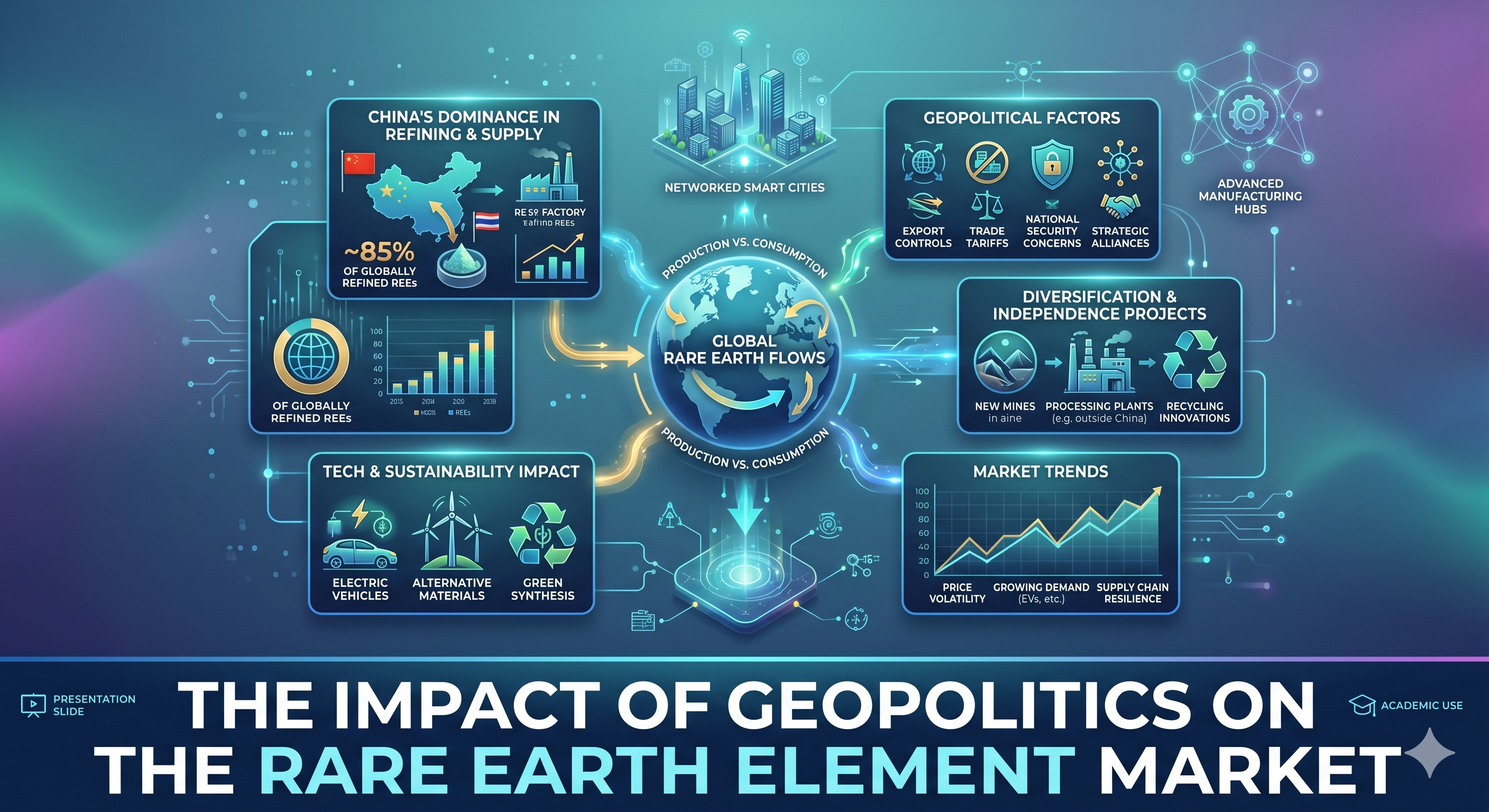
The quiet humming of an electric vehicle (EV), the silent spin of a wind turbine, and the diagnostic precision of an MRI machine all share a single, critical vulnerability. It is not a shortage of labor, money, or ingenuity. It is a group of seventeen elements tucked away in the periodic table: the rare earth elements (REEs).
While their name is a misrepresentation—they are relatively abundant in the Earth’s crust—their extraction and processing are complex, costly, and ecologically devastating. For decades, the global market for these essential materials has operated on a logic of lowest cost, leading to a profound concentration of supply in one nation: China.
Today, that economic logic is colliding violently with geopolitical reality. The rare earth market has become a central battleground in the twenty-first century’s great power competition. The result is a total redefinition of global supply chains, fueled by national security anxieties and a desperate race to secure the future of energy and defense technology.
What Are Rare Earths and Why Do They Matter?
Before diving into the geopolitical intrigue, it is crucial to understand the scientific foundation. Rare earth elements are a set of seventeen chemical elements in the periodic table, specifically the fifteen lanthanides plus scandium and yttrium. They have unique magnetic, luminescent, and electrochemical properties that make them irreplaceable in high-tech applications.
Their primary value is in the creation of powerful permanent magnets, particularly neodymium-iron-boron (NdFeB) magnets. These magnets are the “muscles” behind:
-
Electric Vehicle Motors: Providing the torque needed for acceleration and energy efficiency.
-
Wind Turbine Generators: Converting mechanical energy from wind into electricity, especially in large offshore models.
-
Military Technology: Critical components in missile guidance systems, radar, sonar, drones, and fighter jet motors.
-
Medical Devices: Essential for MRI machines and advanced surgical lasers.
Beyond magnets, REEs are used as catalysts in petroleum refining, as phosphors in screens and LEDs, and as additives to enhance the strength of alloys. They are, in short, the vitamins of modern industry.
The Historical Squeeze: China’s Market Dominance
The story of the current geopolitical crisis begins with China’s visionary economic planning. In the 1980s, Chinese leaders recognized the strategic importance of REEs and instituted policies to encourage their development. China’s advantages were twofold: vast geological reserves (nearly 34% of the global total) and, critically, low labor costs and lax environmental regulations.
This combination allowed Chinese producers to flood the global market with cheap rare earths, effectively driving out Western competitors. Between the 1990s and the early 2010s, global production outside China virtually collapsed. For years, the world enjoyed the benefits of cheap rare earths, untroubled by the emerging vulnerability.
The wake-up call came in 2010. Following a dispute over the Diaoyu/Senkaku Islands, China reportedly restricted rare earth exports to Japan. Although Beijing denied any formal embargo, the message was clear: rare earths were a weapon that could be used to extract political concessions. Prices skyrocketed, and Western governments began to treat the supply chain as a critical national security threat.
The New Great Game: Decoupling and Diversification (2020-2026)
The geopolitical tension has only intensified since 2010, particularly with the escalation of the US-China trade war and the global shift towards green energy. Between 2020 and 2026, the landscape has been defined by urgent efforts to decoupling from Chinese supply and creating independent rare earth capabilities.
Current Research and the New Strategic Frontiers
Geopolitical competition has spurred urgent new academic and government research. According to studies published in 2026 by institutions like the Belfer Center, the Arctic has emerged as a new strategic frontier for REEs. Retreating ice exposes previously inaccessible mineral deposits, making Greenland a focal point of Specspeculation and governance analysis. Academic discourse has dramatically shifted from purely geological exploration to analyses of sovereignty, indigenous self-determination, and the potential for the region to become a sacrifice zone for global decarbonization.
Other research, published in January 2026, highlights that critical minerals, including rare earths, are now balancing strategies for mid-sized and smaller countries across the Eurasian landmass, from Central Asia (like the C5+1 nations: Kazakhstan, Tajikistan, Turkmenistan, and Uzbekistan) to the Afghanistan–Pakistan corridor. Speculative estimates of vast rare earth reserves approaching $1 trillion have circulated in this region, though independent verification remains scarce.
Recent Government Policies and Strategic Alliances
This research is translated into action through aggressive new government policies and international frameworks.
-
The United States: Washington has actively funded midstream processing capabilities. In October 2025, the US and Australia signed a Critical Minerals Framework focused on leveraging Australian mining for midstream capacity. This alliance is crucial; Australia currently hosts 89 active projects, the most outside China, and has scaling midstream capacity, including a $1.25 billion government loan to Iluka Resources for a refinery. Momentum is yielding results: in May 2025, Lynas Rare Earths became the first company outside China to produce commercial quantities of separated dysprosium oxide at its Malaysia facility, using Australian feedstock. Furthermore, starting January 1, 2027, new US defense procurement rules under DFARS will effectively ban Chinese rare earth materials from American weapons systems.
-
Saudi Arabia: The DOD is financing a 49% equity stake in a new rare earths refinery in Saudi Arabia, repositioning the kingdom as a rare earth hub for the Middle East and Africa.
-
Europe: Regulations are similarly encouraging customers to source REEs from suppliers outside China. The focus is on implementing “safe by design” approaches and green synthesis routes to overcome legacy toxicity issues in processing.
The Weaponization of Pricing
China has retaliated with its most effective weapon: a price tag. A May 2026 report reveals that Beijing’s strategy involves price manipulation. Whenever a Western competitor got serious about building independent processing capacity, China would acting to crash prices by flooding the market with cheap material, making the Western project economically unviable. This price manipulation exploits the reality that Western rare earth companies live or die by market pricing, while China controls the market.
Medical Technology: The Affect on Clinical Outcomes
While defense and energy dominate the headlines, the geopolitical squeeze on rare earths has subtle but critical implications for healthcare. Rare earth elements are irreplaceable in medical devices like the Neodymium-iron-boron (NdFeB) permanent magnets used in MRIs, which generate field stability required for diagnostic precision. They are also used in contrast agents (gadolinium chelates) for tissue visualization and selective radiotherapy innovations like yttrium-90 microspheres for cancer treatment.
Supply chain disruptions for high-purity (exceeding 99.9%) rare earths affect the manufacturing of this equipment, which can in turn impact clinical outcomes. Shortages of MRI-grade REEs could delay the diagnosis of neurological conditions and cancer detection protocols. Clinical studies demonstrate that gadolinium-enhanced MRI procedures improve diagnostic accuracy by approximately 34%. Disruptions to the yttrium-90 microsphere supply can affect cancer treatment regimes with otherwise high response rates. Thus, securing the rare earth supply chain is not just an economic or military imperative; it is a healthcare necessity.
Advantage-Risk Assessment of Supply Chain Diversification
The global rush to create non-Chinese rare earth supply chains is a complex endeavor with clear benefits and hidden dangers.
Advantages and Opportunities
-
Enhanced National Security: Diversified supply reduces the risk that great power competitors like China can use rare earths as a geopolitical weapon to delay military modernization or disable energy infrastructure. Mandating domestic, compliant sourcing for defense technology secures essential supply chains.
-
Increased Green Tech Autonomy: Decoupling ensures that national energy transitions—reliant on EVs and wind—are not beholden to foreign political instability. Secure supply allows for continuous green energy deployment to meet climate goals.
-
Economic Resilience: Diversification prevents price gouging and price crashes orchestrated by single dominant actors. Competition from new hubs should establish stable, competitive pricing.
-
Technological Innovation: The urgent search for non-Chinese REE solutions has spurred research into alternative extraction methods (e.g., Arctic exploration, waste recovery), advanced magnet recycling, and yttrium-free superconducting components.
Risks and Challenges
-
Environmental and Environmental Impact: Replicating rare earth extraction and processing outside China risks creating new environmental disaster zones. The multi-stage metallurgical processing required is ecologically devastating. Achieving “Safe by Design” green synthesis is costly and challenging.
-
Economic Viability: Independent Western supply chains cannot easily match the low costs of the integrated Chinese system. New entrants live or die by market pricing, which is subject to Chinese manipulation. Continued price crashes by China can wipe out Western investment.
-
Residual dependencies: Despite diversification, Western companies often remain dependent on Chinese technology and equipment for advanced separation and magnet manufacturing stages.
-
Supply Delays and Shortages: The race for autonomization nearly shutting down automobile supply chains worldwide in 2025 has already caused shortage of essential inputs. New projects cannot rapidly replicate integrated supply chains that take decades to develop.
Conclusion
The impacts of geopolitics on the rare earth element market are profound and permanent. The era of a globalized, lowest-cost rare earth economy is over. It has been replaced by a system of strategic securitization, national mandates, and urgent diversification. The rare earth elements, once an afterthought of industry, have become the minerals that definegreat power competition in the twenty-first century. For Western nations, the hidden war over rare earths is not just about dominant economic pricing or military strategy; it is about securing the essential vitamins required for the future of energy, defense, and advanced healthcare.