
Recently added item(s)
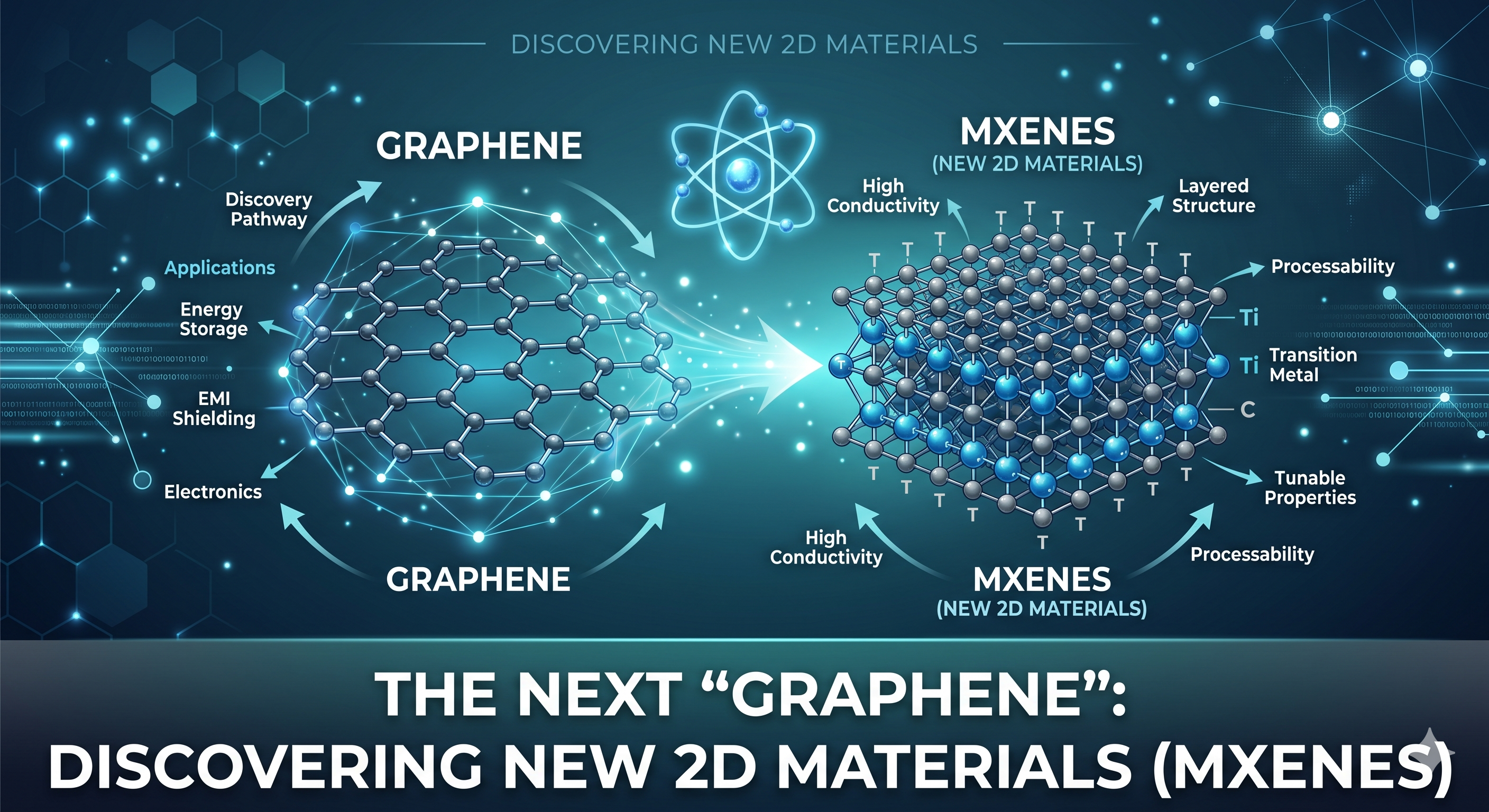
In 2010, the Nobel Prize in Physics was awarded to Andre Geim and Konstantin Novoselov for their groundbreaking experiments with a one-atom-thin sheet of carbon known as graphene. This discovery ignited a global scientific fever. Graphene was lighter than a feather, stronger than steel, a superlative conductor of electricity, and completely flexible. It promised to revolutionize everything from batteries to touchscreens and advanced composites.
Graphene became the undisputed king of nanomaterials.
However, over a decade later, the widespread consumer “graphene revolution” hasn’t quite arrived in the way sci-fi promised. While useful in niche products, manufacturing graphene perfectly at an industrial scale remains prohibitively difficult and expensive. Furthermore, graphene, despite its electrical wizardry, has a limitation: it is atomically flat, chemically inert, and hydrophobic (it hates water).
While scientists were struggling to scale Graphene, a new, massive family of two-dimensional (2D) materials emerged from the labs of Drexel University in 2011, led by Dr. Yury Gogotsi and Dr. Michel Barsoum. They called them MXenes (pronounced Max-eens).
Today, MXenes are hailed not merely as the successor to graphene, but as a superior family of materials for the next generation of electronics, energy storage, health diagnostics, and environmental engineering. They provide the extreme properties of graphene, but with an added, game-changing ability: they can be easily manipulated chemically and possess a natural love for water.
What Exactly Are MXenes? From Parent to Child
To understand MXenes, we must first look at their parents. They are produced from a large family of precursor ceramic materials known as MAX phases.
Think of a MAX phase material like a perfectly stacked club sandwich. The “M” layers (metal) are the bread, the “X” layers (carbon or nitrogen) are the filling, and the “A” layers (an element, usually aluminum or silicon) are the mortar holding the sandwich together.
The MAX phase itself is a 3D bulk material. To create a 2D material, scientists perform selective chemical etching—they essentially throw the sandwich into an acid bath that is designed to dissolve only the aluminum (the A layer) while leaving the titanium and carbon (the M and X layers) intact.
After etching, the stacks are separated (delaminated) into individually dispersed, atomically thin flakes. The resultant material is a 2D transition metal carbide or nitride, hence the name: M_{n+1}X_nT_x. The “T” represents surface groups (hydroxyl, oxygen, or fluorine) left behind by the acid, which are crucial to the material’s unique capabilities.
While graphene is just carbon, MXenes can be made from titanium carbide (Ti_3C_2), molybdenum nitride (Mo_2N), niobium carbide (Nb_2C), and hundreds of other theoretical combinations.
Why Are MXenes the “Next Graphene”?
MXenes combine the high-performance conductive properties of transition metals with the unique physical advantages of nanomaterials. This gives them distinct advantages over graphene:
-
Conductive and Tunable: Like metals, they conduct electricity incredibly well. However, because their chemical composition is varied and their surfaces are active, engineers can tune this conductivity precisely for specific applications.
-
Hydrophilic (Water-Loving): Unlike graphene, which hates water and needs harsh surfactants to disperse, MXenes are naturally hydrophilic due to the “T” groups on their surface. They easily disperse in water or alcohols to form stable, environmentally friendly inks.
-
Chemical Reactivity: Graphene is essentially chemically dead. MXenes have “hands” on their surface, allowing them to stick to and react with other chemicals, proteins, or biological molecules. This makes them significantly better for sensing and drug delivery.
-
Flexible Processability: Because they are hydrophilic, MXene inks can be printed, painted, sprayed, or spin-coated onto almost any surface to create electrodes, sensors, or anti-static coatings. Graphene requires expensive machinery like Chemical Vapor Deposition (CVD).
Key Frontiers: The Science of the Small Changing the Big
The explosive research in MXenes has moved well beyond the theoretical phase. Several sectors are on the verge of massive disruption.
1. Energy Storage: Fast-Charging Batteries and Supercapacitors
The current bottleneck in electric vehicles (EVs) and consumer electronics is the battery. MXenes could solve the fast-charging problem.
Ti_3C_2T_x MXene has demonstrated extremely high volumetric capacitance (the ability to store a charge within a certain volume). In supercapacitors, which charge and discharge instantly but traditionally don’t hold much total power, MXenes are showing performance that approaches batteries in energy density.
Furthermore, they facilitate “pseudocapacitance,” a fast redox reaction at the surface that allows instant power boosts. Imagine charging your smartphone in seconds or an EV in minutes without damaging the battery lifespan. MXenes act as a super-highway for ions during the charging process.
2. Environmental Engineering: Desalination and Wastewater Treatment
Water scarcity is one of the greatest challenges of our age. MXenes are being engineered as ultra-efficient molecular sieves.
Because their spacing between atomic sheets is precisely controlled and their surfaces react with ions, MXene membranes can be used for water desalination and the removal of toxic heavy metals. Current research is focusing on the use of Ti_3C_2T_x to remove hexavalent chromium, lead, and fluoride from drinking water sources, outperforming traditional carbon-based filters.
3. Electronics: EMI Shielding and Antennas
As our world becomes more connected (5G, IoT), the problem of electromagnetic interference (EMI)—the “noise” that disrupts signals—is growing. Our devices need better shielding that is also thin and lightweight.
Graphene is transparent to many radio waves. MXenes are fantastic EMI shielders. Because they are metals with atomically flat structures, they reflect and absorb a massive amount of radiation across the 5G and radar spectrum. A layer of MXene just a few nanometers thick can block 5G signals, making them vital for shielding sensitive medical equipment or autonomous vehicle computer brains.
4. Health and Biomedicine: Diagnostics, Imaging, and Cancer Therapy
The biological potential of MXenes is enormous due to their chemical versatility and interaction with light.
-
Biosensors: Because they are hydrophilic and conductive, MXene flakes can detect tiny shifts in charge when biological molecules attach to their surface. Research is underway to develop ultra-sensitive biosensors for glucose, proteins, and cancer biomarkers (e.g., PSA for prostate cancer) in the bloodstream.
-
Imaging Agents: MXenes show strong absorption of near-infrared light and X-rays, making them promising agents for CT scans and other advanced imaging techniques.
-
Cancer Therapy: Scientists are researching photothermal therapy (PTT) using MXenes. Ti_3C_2T_x MXene sheets accumulate in tumors (due to the leaky nature of tumor vasculature). When near-infrared light is shone on the tumor, the MXene flakes convert that light into precise, intense heat, physically “cooking” the cancer cells from within without harming surrounding healthy tissue. Preclinical studies on mice have shown near-complete elimination of tumors with low overall toxicity.
Path to Human Use: Current Clinical Status
It is critical to manage expectations regarding biomedical applications. While the mouse and cell studies (in vivo and in vitro) are highly promising, there are currently no human clinical trials active for MXenes in any therapeutic application.
We are currently in the robust preclinical phase. Research groups are defining:
-
Toxicity Profiles: Ti_3C_2T_x is generally considered low toxicity compared to other nanomaterials (like some graphene oxides) when tested on human cell lines, but toxicity is heavily dependent on size, surface chemistry, and composition. For example, niobium or molybdenum compositions might have different profiles.
-
Biodistribution: Understanding where MXenes accumulate in the body (liver, spleen, kidneys) and how they are excreted is essential before any human injection can occur.
The transition from lab benches to clinical translation will likely take another 5 to 10 years of intensive biological safety research.
Advantage and Risk Assessment: The Balanced View
No material is a miracle. MXenes offer enormous potential but come with technological hurdles.
| Category | Advantages | Risks & Challenges |
| Synthesis & Scalability | Produced using top-down etching, which is generally more scalable than graphene’s CVD process. Water-processable inks are a major manufacturing advantage. | Etching requires hazardous acids (like hydrofluoric acid or strong fluorine-salt mixtures), creating dangerous waste. Better, safer, electrochemical etching methods are under development. |
| Material Properties | Metallic conductivity + hydrophilic active surfaces + tunable chemistry. Extremely varied family (dozens of M/X combinations). Excellent EMI shielding. | Stability is the major risk: MXenes, particularly titanium carbide, are highly susceptible to oxidation (they “rust”). When exposed to air and water for weeks, the conductive sheets turn into titanium dioxide (an inert white pigment), killing their performance. They need careful storage. |
| Biomedical & Environmental | Active surfaces for drugs/sensors. Photothermal therapy potential. Water-loving filters. | Potential toxicity is still debated. Environmental accumulation of nanoparticles needs assessment. The long-term stability in the body (biodegradability vs. accumulation) is unknown. |
Conclusion: The Outlook for a MXene World
MXenes are not just “another nanomaterial.” They are a transformative family that merges the physics of nanomaterials with the processability of ink and the performance of metals. They are truly the spiritual successor to graphene, addressing its critical manufacturing and chemical limitations.
The future of energy, defense, and diagnostics will likely feature MXenes in the background, whether as shielding on a 5G circuit brain, as a membrane filtering the ocean, or as a targeted heat agent killing a tumor. The primary barrier now is not proof-of-concept, but engineering: finding safer manufacturing methods, mastering their stability against oxidation, and rigorously defining their biological safety. Scientists have cracked the MAX phases; now they must stabilize the MXene revolution.