
Recently added item(s)
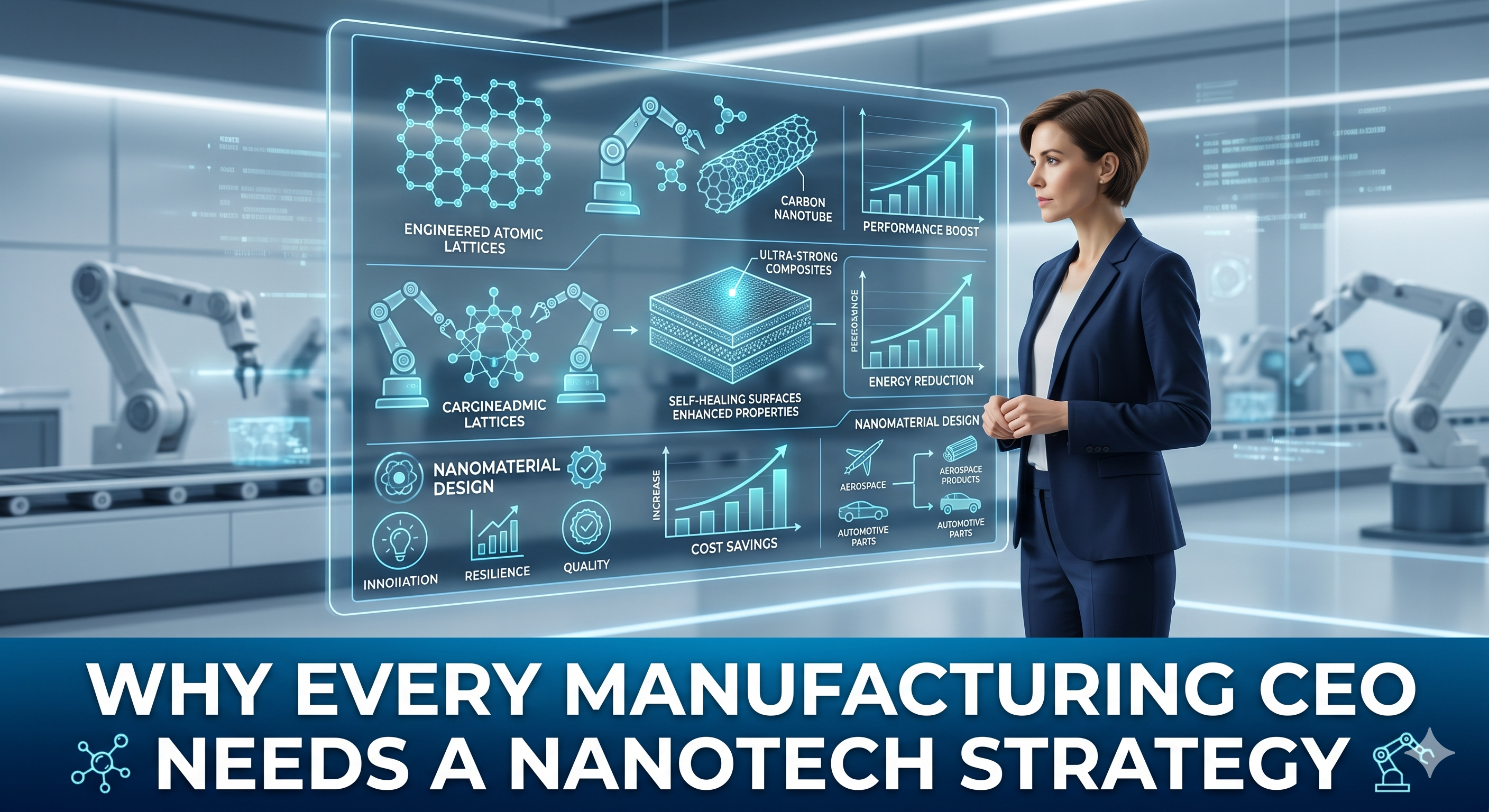
In the landscape of modern industrial competition, CEOs are constantly hunting for the next disruptive technology—the artificial intelligence algorithm, the green energy source, or the automation system that will provide a decisive edge. Yet, many manufacturing leaders are overlooking a profound transformation occurring at the fundamental level of their products: the materials themselves. We are standing on the precipice of the nano-revolution. Nanotechnology is no longer the sole domain of science fiction or academic laboratories; it is actively reshaping material science, supply chains, and consumer expectations. Any manufacturing CEO ignoring this macro-trend is inadvertently ceding future market dominance to competitors willing to engineer from the bottom up. A nanotech strategy is not a futuristic accessory; it is an existential necessity.
Understanding the Nano-Scale: Unlocking Material “Cheat Codes”
To appreciate why nanotechnology is a strategic mandate, a CEO must understand what it actually implies. Nanotechnology involves the manipulation and control of matter at dimensions roughly between 1 and 100 nanometers. A nanometer is one-billionth of a meter. For perspective, a sheet of paper is about 100,000 nanometers thick.
The scientific significance lies not just in the extreme miniaturization, but in the unique properties that matter exhibits at this scale. When materials are engineered on the molecular level, classical physics often gives way to quantum mechanics. Materials can become substantially stronger, lighter, more electrically conductive, or chemically reactive.
It is like unlocking the “cheat codes” of physical matter. For a manufacturer, this means you are no longer constrained by the inherent limitations of standard aluminum, steel, or plastics. You can begin designing materials that possess seemingly contradictory properties: a transparent ceramic, an opaque plastic that conducts electricity, or concrete that heals its own cracks.
Advantage 1: Superior Products and Market Differentiation
The most obvious strategic benefit of nanotechnology is the creation of superior products. Nanomaterials allow manufacturers to enhance performance metrics by orders of magnitude, providing compelling differentiation in a crowded marketplace.
Current Research & Examples:
-
Graphene and Carbon Nanotubes (CNTs): These are perhaps the most famous nanomaterials. Graphene, a single layer of carbon atoms, is exceptionally strong (over 200 times stronger than steel), incredibly conductive, and flexible. Manufacturers are beginning to use graphene and CNTs to create lightweight composites for aerospace, high-performance batteries, and structural components that provide unprecedented strength-to-weight ratios. Recent research from institutions like MIT shows promising techniques for producing graphene at industrial scales suitable for mass-market automotive components.
-
Nano-enhanced Coatings: Manufacturers can apply nanolayers to surfaces to create hydrophobic (water-repelling), oleophobic (oil-repelling), anti-corrosive, or scratch-resistant properties without altering the appearance or bulk dimensions of the product. Automotive CEOs should take note of recent breakthroughs in self-healing clear coats utilizing embedded nanocapsules that rupture and heal scratches upon exposure to UV light.
Advantage 2: Redefining Process Efficiency and Operational Cost
A solid nanotech strategy benefits the bottom line not just through top-line product improvement, but through radical reductions in operational costs. Nanotechnology facilitates the optimization of the manufacturing process itself.
-
Nano-Catalysts: Many manufacturing processes rely on expensive catalysts to accelerate chemical reactions (e.g., in petrochemical or pharmaceutical manufacturing). Nanoscale catalysts provide vastly increased surface area compared to bulk materials, meaning a significantly smaller amount of material can achieve the same, or superior, reaction rates. This reduces raw material costs and can lower the energy required for manufacturing.
-
Additive Manufacturing Improvements: Nanomaterials are revitalizing 3D printing. By integrating nano-additives into polymer filaments or metal powders, manufacturers can print final-use parts that possess the structural integrity required for critical systems. Research is currently underway to create conductive inks utilizing metal nanoparticles, potentially allowing the 3D printing of entire circuit boards or sensor arrays within structural components, merging electronic and mechanical manufacturing into a single step.
Advantage 3: Sustainability and Regulatory Compliance
Pressure from investors, consumers, and regulators regarding environmental, social, and governance (ESG) factors is increasing. Nanotechnology provides a strategic pathway to improve sustainability metrics across the product lifecycle.
-
Energy Management: Nanostructured materials can drastically improve the efficiency of solar panels and the energy density of batteries, assisting manufacturers in reducing their overall carbon footprint. Solid-state battery designs utilizing nano-engineered anodes/cathodes are reaching maturity, promising longer ranges and faster charging times for electric vehicles.
-
Circular Economy: Recent research highlights the use of nanotechnology for the efficient recycling of plastics. Nano-catalysts can break down polymers into their original monomers more effectively than traditional thermal methods, making true circular recycling of complex plastics commercially viable.
The Clinical Perspective: Nanotechnology in Medical Device Manufacturing
While general manufacturing CEOs may focus on material strength or cost, leaders in the medical device sector should pay particular attention to nanotech breakthroughs impacting regulatory pathways and clinical outcomes. This is where “nano strategy” merges with life-saving metrics.
Current Clinical Studies & Impact:
-
Bio-Integration of Implants: Traditional titanium implants, though durable, sometimes fail due to poor osseointegration (bonding with the bone). Nano-coatings are revolutionizing this area. Clinical studies (referenced in databases like PubMed and ClinicalTrials.gov) have demonstrated that orthopedic implants coated with nanostructured calcium phosphate or TiO2 nanotubes mimic the topography of natural bone matrix. This increases the surface area for cell adhesion and accelerates bone bonding, reducing recovery times and minimize implant rejection rates.
-
Anti-microbial Surfaces: Hospital-acquired infections are a critical clinical concern. Medical manufacturers are now implementing nanotechnology to create inherently anti-microbial device surfaces. Studies on Ag-nanoparticles (Silver nanoparticles) integrated into catheters or wound dressings show significant efficacy in killing drug-resistant bacteria (like MRSA) without the systemic risks associated with broad-spectrum antibiotics.
-
Drug Delivery Integration: Advanced clinical trials are exploring “smart” manufacturing where diagnostic nanosensors or drug delivery nanoparticles are integrated into the raw materials of medical devices (e.g., stents that release drug payloads precisely when they detect biological inflammation markers). This moves a manufacturer from producing passive devices to active, intelligent therapy systems.
Advantage-Risk Assessment: A Strategic Balancing Act
A robust CEO strategy must incorporate a balanced assessment. Nanotechnology offers massive advantages but introduces unique, evolving risks.
| Strategic Dimension | Major Advantages | Major Risks & Strategic Hurdles |
| Product Performance | Unprecedented strength, conduction, flexibility, and unique functionalities (e.g., transparency). Compelling differentiation. | Nanotoxicity & Safety: The unique properties of nanomaterials may introduce toxicity issues for workers during manufacturing or consumers upon exposure. FDA and ECHA (Europe) regulations are still catching up. High strategic risk around liability. |
| Operations & Cost | Optimized catalysts reducing raw materials. Stronger additive manufacturing parts. Improved energy efficiency. | High R&D Investment: Developing a viable nanotech strategy requires significant upfront investment in specialized equipment, specialized talent, and lengthy development cycles. ROI is long-term. |
| Sustainability | Better energy density/efficiency. Effective recycling catalysts. | Regulatory Uncertainty: Governments are currently defining standard testing protocols for “nano.” A strategy invested in a specific nanomaterial today may become regulatory non-compliant tomorrow. |
| Supply Chain | Creating new markets. Supply chain resilience through self-healing materials. | Geopolitical Factors: Specific nanomaterials (like pure graphene) require specific precursors or specialized manufacturing processes, introducing new geopolitical or supply chain chokepoints. |
Conclusion: The Strategic Mandate
The time for manufacturing CEOs to debate the theoretical viability of nanotechnology has passed. The nano-revolution is already embedded in high-performance computing, aerospace, and advanced medicine.
A CEO’s nanotech strategy should not be a scientific descriptor; it must be a business blueprint. It requires answering critical strategic questions:
-
Which nanomaterials will define our industry’s next-generation performance metrics?
-
How can nano-enabled processes optimize our current factory floor efficiency?
-
What regulatory pathways and toxicity testing standards must we adopt today to ensure compliant product launches in five years?
-
Are our talent acquisition and partnership strategies aligned with molecular engineering?
Nanotechnology is rewriting the rules of what is physical possible. Manufacturing CEOs who choose to engineer at the atomic level today will define the industrial landscape of tomorrow. Those who wait for the technology to mature fully will find that their market share has dissolved. Don’t just watch the nano-revolution; execute on it.