
Recently added item(s)
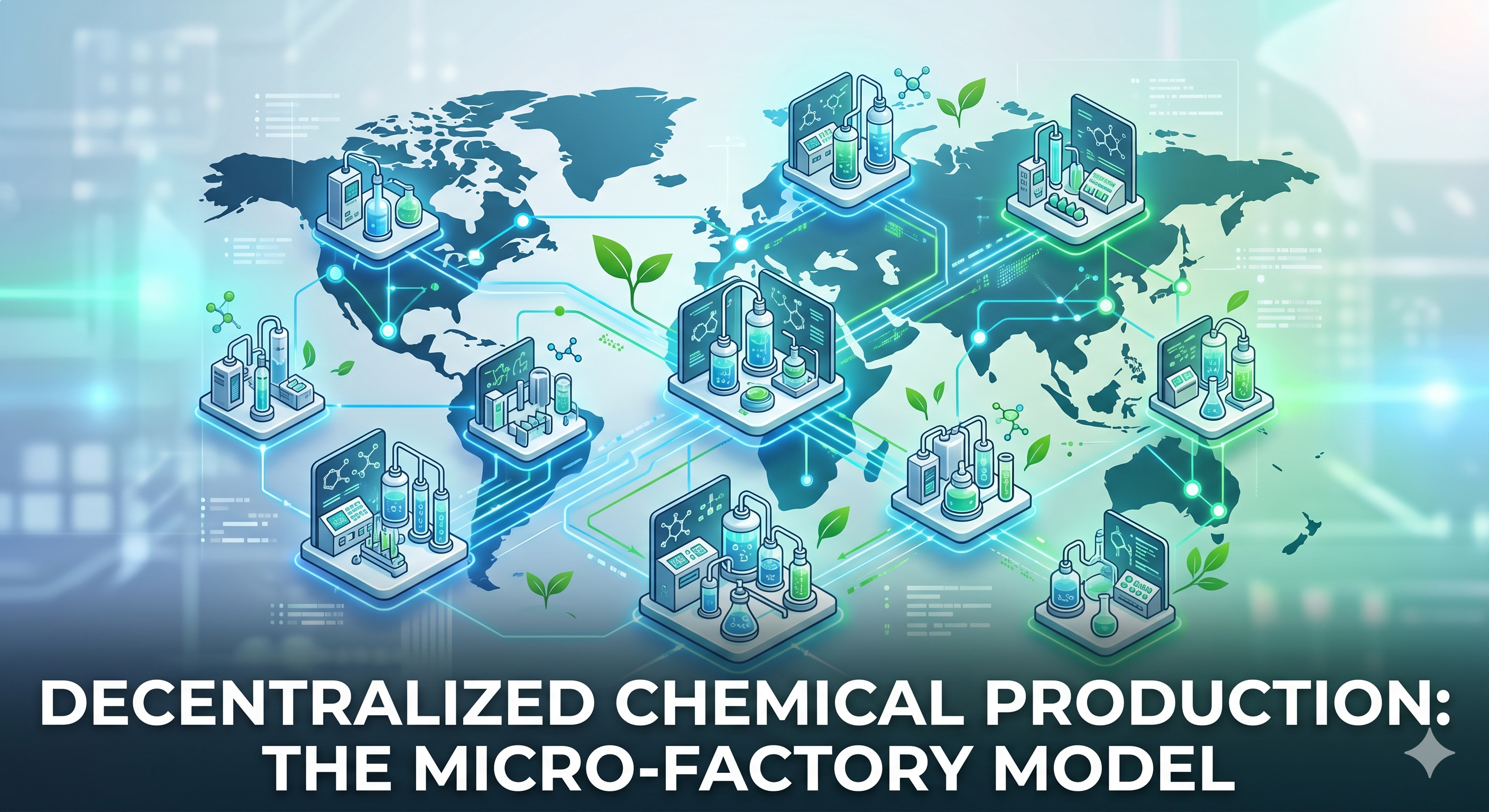
For over a century, the chemical industry has been defined by the “bigger is better” philosophy. Massive, sprawling industrial complexes—often the size of small cities—were built to take advantage of economies of scale. These centralized hubs processed raw materials in gargantuan batches, shipping finished products across oceans and continents. But as the world faces unprecedented supply chain fragility, rising energy costs, and an urgent need for sustainable practices, the “Goliath” model is being challenged.
Enter the Micro-Factory. This is not just a smaller version of a traditional plant; it represents a fundamental paradigm shift toward Decentralized Chemical Production. By moving the point of manufacturing closer to the point of consumption, and utilizing advanced technologies like flow chemistry and AI, we are witnessing a revolution that makes chemical production faster, cleaner, and more resilient.
1. What Exactly is the Micro-Factory Model?
At its core, a micro-factory is a modular, highly automated, and compact production system designed to produce chemicals in smaller quantities but with higher precision and efficiency. Unlike traditional “batch” reactors—which are essentially giant mixing pots—micro-factories often rely on Continuous Flow Chemistry.
In this model, chemical reactions happen inside narrow tubes or channels. Because the surface-area-to-volume ratio is much higher in these small channels than in a 10,000-liter tank, heat transfer is nearly instantaneous, and mixing is perfect. This level of control allows for reactions that would be too dangerous or unstable to perform in a massive factory.
The “LEGO” Approach to Manufacturing
Decentralization relies on modularity. Instead of a fixed infrastructure, micro-factories are often built into shipping containers or standardized skids. If a company needs to increase production, they don’t build a new wing; they simply add another module. This “Plug-and-Play” architecture allows for rapid deployment anywhere in the world—from a hospital pharmacy needing specific drugs to a construction site needing specialized polymers.
2. The Scientific Backbone: Flow Chemistry and Intensification
The transition to decentralized production is powered by Process Intensification (PI). The goal of PI is to make chemical processes significantly smaller, safer, and more energy-efficient.
Microfluidics and Heat Management
In a large batch reactor, maintaining a uniform temperature is a nightmare. The center of the tank might be much hotter than the edges, leading to “side reactions” and impurities. In a micro-factory’s flow reactor, the temperature is controlled at every millimeter. This precision is vital for the synthesis of advanced materials, such as nanoparticles and graphene, where a slight temperature deviation can ruin the entire product’s technical specifications.
Real-time Analytical Technology (PAT)
Because the volume of chemicals at any given moment is small, micro-factories can utilize integrated sensors that monitor the reaction in real-time. Using spectroscopy and AI-driven feedback loops, the system can adjust flow rates or temperatures instantly to maintain 99.9% purity. This eliminates the “batch failure” risk that haunts traditional manufacturing.
3. Advantages: Why the World is Moving Toward Decentralization
A. Supply Chain Resilience
The COVID-19 pandemic and recent geopolitical shifts have exposed the “Single Point of Failure” in centralized manufacturing. If one mega-factory in a specific region shuts down, the global supply of a specific chemical or medicine can vanish. Decentralized micro-factories distribute the risk. If one unit goes down, ten others are still running.
B. Sustainability and “Green Chemistry”
Traditional chemical shipping is a carbon nightmare. Transporting hazardous liquids across the globe involves massive energy use and spill risks. Micro-factories allow for On-Demand Production. You produce exactly what you need, where you need it, using locally sourced raw materials. This reduces waste, minimizes the need for massive storage tanks, and slashes the carbon footprint associated with logistics.
C. Safety and Risk Mitigation
Many chemical reactions are highly exothermic (they release heat). In a massive tank, an out-of-control reaction can lead to an explosion. In a micro-factory, the total amount of “active” material is so small that even if a reaction fails, the energy released is easily contained. This makes it possible to manufacture hazardous chemicals in urban environments safely.
4. Current Research and Technological Frontiers
The field of decentralized chemistry is moving at breakneck speed. Recent studies are focusing on how to make these units even more autonomous and versatile.
AI and “Self-Driving” Labs
Researchers at institutions like MIT and ETH Zurich are developing micro-factories equipped with machine learning algorithms. These systems can “discover” the best way to synthesize a new molecule through trial and error, performing hundreds of micro-reactions per day until the optimal path is found. Once the recipe is perfected, it can be digitally sent to micro-factories worldwide to begin production immediately.
3D Printing of Reactors
Additive manufacturing (3D printing) is allowing scientists to design reactor shapes that were previously impossible to build. By printing reactors in metals like tungsten or high-performance polymers, researchers can create internal geometries that maximize mixing and heat exchange, further shrinking the footprint of the micro-factory.
5. Applications: From Medicine to Nanomaterials
The micro-factory model isn’t just a theory; it’s being applied in high-stakes industries today.
Pharmaceuticals: On-Demand Drug Synthesis
Clinical studies are currently exploring “Pharmacy on Demand” systems. Instead of a hospital waiting for a shipment of a rare or short-supply medication, a bedside micro-factory could synthesize the required dose from basic chemical precursors. This is particularly transformative for personalized medicine, where treatments are tailored to an individual’s genetic profile.
High-Purity Nanotechnology
For companies producing materials like Carbon Nanotubes, MXenes, or specialized metal powders, consistency is the greatest challenge. Micro-factories provide a controlled environment that ensures every gram of nanomaterial has the same physical and chemical properties. This is essential for applications in aerospace, electronics, and energy storage.
6. Risk Assessment: Challenges to Overcome
While the future looks bright, the micro-factory model faces several hurdles that must be addressed for it to become the global standard.
| Aspect | The Micro-Factory Risk | The Potential Mitigation |
| Regulation | Current laws are designed for large plants; certifying thousands of small sites is difficult. | Developing “Digital Twins” and automated compliance reporting. |
| Cybersecurity | Decentralized, connected units are vulnerable to hacking and IP theft. | Implementing blockchain-based encryption and edge computing. |
| Initial Cost | The “CapEx” (capital expenditure) per unit of volume can be higher than massive plants. | Focusing on high-value, specialty chemicals where precision offsets cost. |
| Quality Control | Ensuring every micro-factory produces identical results globally. | Standardized AI-monitored “Golden Batch” protocols. |
7. The Clinical and Industrial Outlook
From a clinical perspective, decentralized production is a lifesaver. During the initial rollout of mRNA vaccines, the bottleneck was often the lack of specialized, high-capacity manufacturing sites. If the world had a network of “Bio-Micro-Factories,” the production of life-saving vaccines could have been localized, ensuring more equitable distribution.
In the industrial sector, the transition is being driven by the “Chemicals as a Service” (CaaS) model. Instead of buying tons of chemicals, companies might lease a micro-factory that sits on their property and produces the chemicals as they are consumed.
8. Conclusion: The Future is Small
The era of the “Chemical Giant” is not over, but its dominance is being challenged by the agility, safety, and sustainability of the Micro-Factory. For entrepreneurs and researchers, this shift offers a unique opportunity to democratize chemical production.
By leveraging the power of decentralized manufacturing, we can build a world where supply chains are unbreakable, chemistry is “green” by design, and innovation is no longer limited by the walls of a massive industrial park. The chemical plant of the future won’t be a skyline of chimneys and cooling towers—it will be a sleek, containerized unit, humming quietly in the back of a laboratory or a local distribution center.