Recently added item(s)
The world is currently standing on the precipice of a computational shift so profound that it dwarfs the transition from the abacus to the microchip. Quantum computing promises to solve problems in minutes that would take today’s most powerful supercomputers millennia. We are talking about simulating complex new drugs, cracking unbreakable encryption, and optimizing global logistics in real-time.
However, there is a catch. While the media often focuses on the “weirdness” of quantum physics—superposition and entanglement—there is a much more grounded, physical hurdle that we must clear before a quantum computer can sit in a data center. That hurdle is material purity.
In the quantum realm, the smallest speck of dust, a single stray magnetic atom, or even an “incorrect” isotope of silicon can cause a multi-million dollar quantum processor to fail. To build the future of computing, we first have to master the art of near-perfect material science.
1. The Qubit’s Greatest Enemy: Decoherence
To understand why high-purity materials are necessary, we have to understand the Qubit. Unlike a classical bit (which is either a 0 or a 1), a qubit exists in a fragile state of “both” until it is measured. This fragility is the source of its power, but it is also its Achilles’ heel.
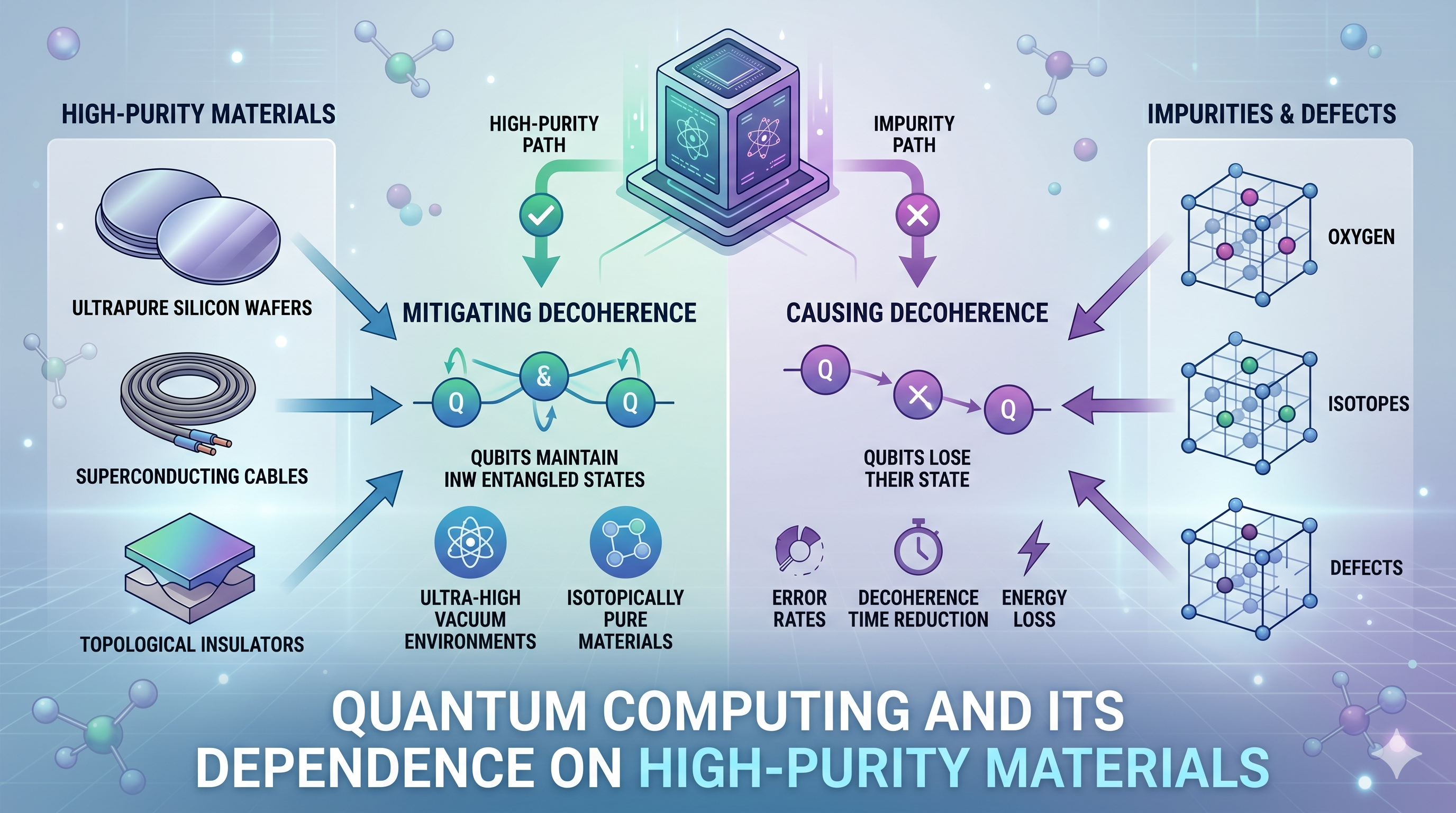
The moment a qubit interacts with its environment—be it heat, vibration, or electromagnetic interference—it loses its quantum state. This is called Decoherence.
Think of a qubit like a spinning coin. If the table it’s spinning on is perfectly smooth and there is no wind, it can spin for a long time. But if there is even a tiny grain of sand on that table, the coin wobbles and falls. In the world of quantum hardware, “purity” is what ensures that the “table” is perfectly smooth.
2. Silicon-28: The Quest for Isotopic Purity
For decades, the tech industry has been built on silicon. It is the most understood material on the planet. Naturally, researchers wanted to build qubits out of silicon to leverage existing manufacturing plants.
However, natural silicon is a “noisy” environment for a qubit. Natural silicon contains about 4.7% of an isotope called Silicon-29. This specific isotope has a “nuclear spin”—it acts like a tiny, uncontrollable magnet. For a qubit trying to maintain a delicate calculation, these billions of tiny magnets in the background create a “magnetic graveyard” that kills the quantum state almost instantly.
The Solution: Isotopic Enrichment
Recent experimental breakthroughs have focused on creating Silicon-28. By using massive centrifuges (similar to those used in the nuclear industry) to remove the Silicon-29, scientists can create a “semiconductor vacuum.” In this ultra-pure environment, qubits have been shown to maintain their coherence for significantly longer periods, moving us from microseconds of stability to seconds—a massive leap in the quantum world.
3. Superconductors and the “Oxygen Problem”
Many of the leading quantum computers, like those from IBM and Google, use Superconducting Qubits. These operate at temperatures colder than outer space to allow electricity to flow without resistance.
The materials used here—typically Niobium, Aluminum, or Tantalum—must be of extreme purity. Even if the metal itself is 99.999% pure, the oxide layer that forms on the surface when the metal touches air can be a disaster.
Research in 2024 and 2025 has highlighted that “surface loss”—the interaction between the qubit and the thin layer of rust or oxidation on the chip—is the primary cause of errors. This has led to a new industrial standard: manufacturing quantum chips in ultra-high vacuum environments where the materials never encounter a single oxygen molecule.
4. The Role of Advanced Nanomaterials: Graphene and Beyond
As we move toward scaling quantum computers, we need materials that can carry signals without generating heat. This is where high-purity Carbon Nanotubes and Graphene enter the fray.
Graphene, a single layer of carbon atoms, is an incredible conductor. Because it is 2D, it allows for a high degree of control over electron movement. In “topological” quantum computing, researchers are using graphene and other 2-dimensional materials (like MXenes) to create “protected” qubits. These qubits are theoretically immune to local noise because their information is stored “globally” across the material’s structure rather than in a single spot.
-
Carbon Nanotube (CNT) Resonators: Highly purified CNTs are being tested as ultra-sensitive bridges for quantum communication.
-
High-Purity Metal Powders: Used in the 3D printing of the specialized dilution refrigerators that house quantum processors, ensuring zero magnetic interference from the housing itself.
5. Experimental Studies and Lab Breakthroughs
While we don’t have “clinical trials” in the medical sense, the physics world uses Benchmarking Trials to test material fidelity.
The “Quiet” Silicon Study
A landmark study recently demonstrated that qubits hosted in isotopically pure Silicon-28 achieved a “gate fidelity” of over 99.9%. This is the “magic number” required for error correction. This study proved that the bottleneck for quantum computing wasn’t the software or the logic—it was the purity of the silicon substrate.
The Tantalum Revolution
For years, Niobium was the standard for superconducting circuits. However, researchers at Princeton recently discovered that switching to high-purity Tantalum could extend qubit lifetimes by a factor of ten. Why? Because Tantalum forms a more stable, less “noisy” oxide layer. This single change in material choice did more for quantum stability than years of code optimization.
6. Advantage–Risk Assessment
Building a global supply chain for high-purity quantum materials is a high-stakes game.
Advantages:
-
Exponential Speed: Once the material purity is solved, we unlock the ability to simulate molecules for green energy and new battery chemistries.
-
Energy Efficiency: Quantum computers, despite their cooling needs, are potentially more energy-efficient than massive “brute force” supercomputer clusters for specific tasks.
-
Sovereignty: Countries that control the production of Silicon-28 or high-purity Tantalum will be the leaders of the next century’s economy.
Risks:
-
Supply Chain Fragility: The “centrifuge” process for Silicon-28 is incredibly slow and expensive. Currently, only a few facilities in the world can produce it.
-
Cost Barrier: High-purity materials can cost 100x to 1000x more than their industrial-grade counterparts. This risks making quantum computing a “billionaire’s club” technology.
-
Environmental Impact: The refining processes for ultra-high purity metals often involve harsh chemicals and high energy consumption, which must be balanced against the “green” promises of quantum discovery.
7. The Roadmap Forward: Materials-First Engineering
We are moving away from an era where we simply “wrote better code” to fix hardware issues. In the quantum age, the hardware is the chemistry.
The next five years will see a massive surge in the demand for Metrological Grade Materials. This includes:
-
Isotopic Separation: Scaling up the production of Silicon-28 and Germanium-72.
-
Surface Engineering: Developing atomic-layer deposition (ALD) techniques to prevent oxidation on superconducting chips.
-
Nanomaterial Integration: Using graphene and hex-Boron Nitride (hBN) as “atomic wrappers” to shield qubits from the outside world.
8. Conclusion
Quantum computing is often discussed as a “software” or “math” problem. But as we peel back the layers of the cryostat, we find that it is, at its heart, a Material Science problem.
The computers of the 2030s will not be built on the same silicon in your current smartphone. They will be built on materials refined to a level of purity that was once thought impossible. For the industries involved in nanomaterials, high-purity metal refining, and isotopic separation, the quantum era isn’t just a distant dream—it is a massive, immediate industrial opportunity. The race to the “Perfect Atom” is on, and the winner will hold the keys to the most powerful technology in human history.