
Recently added item(s)
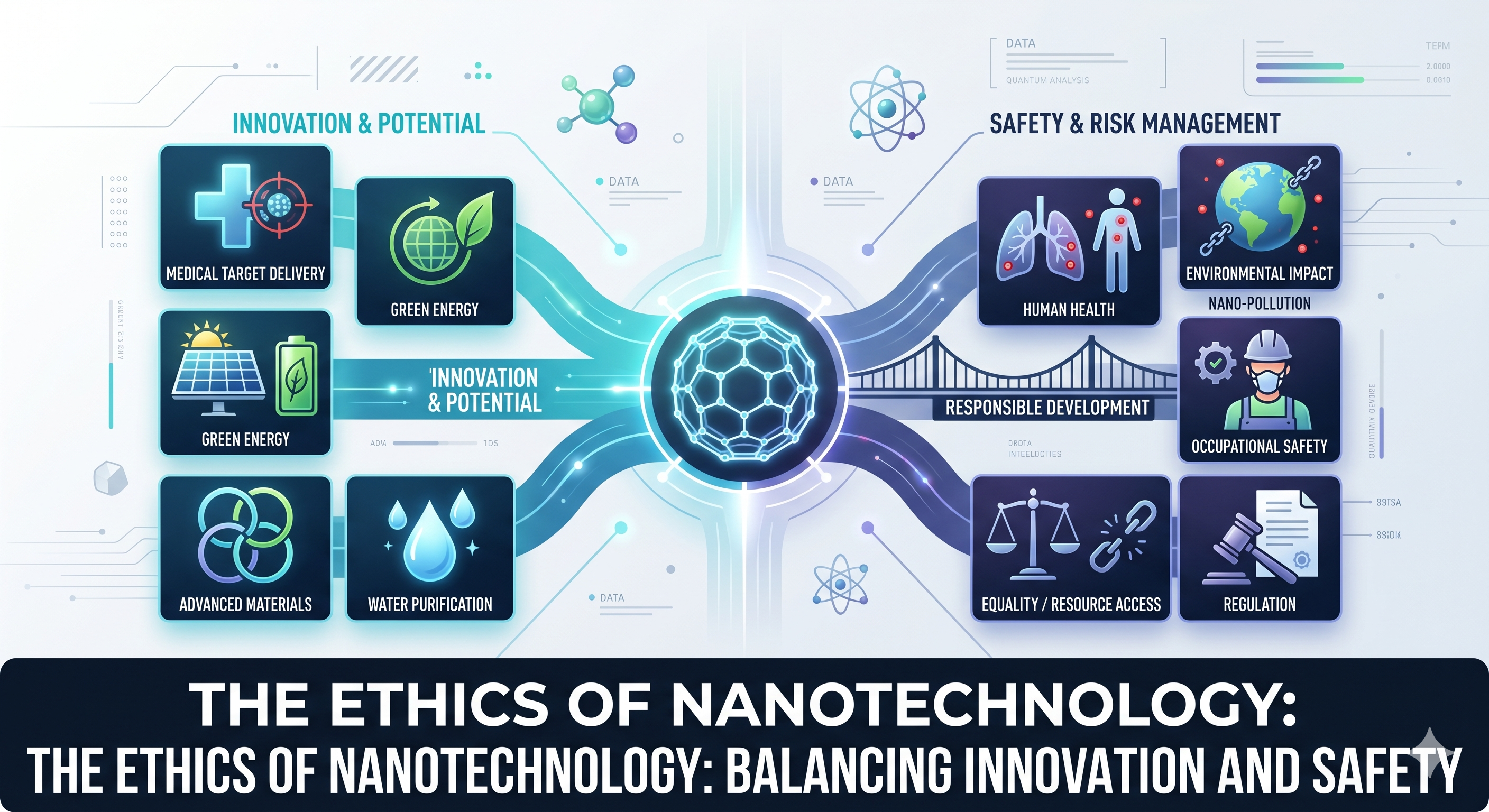
Nanotechnology—the science of the incredibly small—is no longer a futuristic concept found only in science fiction novels. Today, it is an industrial reality. From the graphene in our high-performance batteries to the lipid nanoparticles delivering life-saving mRNA vaccines, we are effectively redesigning the world at the atomic level.
However, as we gain the power to manipulate matter at the scale of a billionth of a meter, we encounter a profound ethical crossroad. How do we embrace the revolutionary potential of these “miracle materials” without compromising human health or the planetary ecosystem? The ethics of nanotechnology is not about stopping progress; it is about ensuring that innovation is tethered to responsibility.
1. The Unique Nature of the Nano-Scale
To understand the ethical challenges, we must first understand why “nano” is different. When materials are shrunk to the nanoscale (1 to 100 nanometers), they stop behaving like the bulk materials we know. Gold, which is inert in large quantities, can become chemically reactive. Materials that were opaque become transparent.
This change in behavior is driven by a massive increase in Surface-Area-to-Volume Ratio. A gram of nanoparticles has thousands of times more surface area than a gram of the same material in bulk form. While this makes them incredibly efficient for industrial catalysis and medicine, it also makes them potentially more toxic. The very properties that make nanotechnology an “innovation engine” are the same properties that necessitate a new ethical framework for safety.
2. Environmental Ethics: The Risk of “Nano-Pollution”
One of the most pressing ethical concerns involves Nano-Ecotoxicology. Because nanoparticles are so small, they can bypass traditional filtration systems in wastewater treatment plants.
The Case of Silver Nanoparticles (AgNPs)
Silver nanoparticles are widely used in textiles and consumer products for their antibacterial properties. However, current research shows that when these particles enter the water supply through laundry or industrial waste, they don’t just kill “bad” bacteria. They can disrupt the microbial balance in soil and water, affecting the nitrogen cycle and potentially entering the food chain.
The ethical dilemma here is one of Long-term Impact vs. Short-term Utility. We benefit from odor-free socks today, but we risk permanent changes to aquatic ecosystems tomorrow. Responsible innovation requires us to develop “Green Nanotechnology”—creating particles that are designed to degrade into harmless components once their job is done.
3. Human Health: Nano-Toxicology and Occupational Safety
For the scientists and factory workers handling raw nanomaterials like Carbon Nanotubes (CNTs) or metal powders, the risks are more immediate.
Inhalation and Translocation
Research has shown that certain high-aspect-ratio carbon nanotubes can behave similarly to asbestos if inhaled, causing inflammation or lesions in the lungs. Furthermore, nanoparticles are small enough to cross the blood-brain barrier or move from the lungs into the bloodstream (translocation).
Ethically, this places a massive burden on Occupational Safety. It is not enough to follow “standard” chemical protocols. Companies must implement advanced HEPA filtration, closed-loop manufacturing systems, and rigorous health monitoring. The ethical imperative is to ensure that the workers building the future aren’t the ones paying for it with their health.
4. Clinical Breakthroughs: The Ethics of Nanomedicine
In the medical field, nanotechnology is a beacon of hope. Nanomedicine allows us to deliver chemotherapy drugs directly to a tumor, sparing the rest of the body from toxic side effects.
Clinical Studies and Trial Design
Recent clinical trials involving “Targeted Nano-carriers” have shown remarkable success in reducing the “off-target” toxicity of drugs. However, this introduces new ethical hurdles:
-
Consent: Can a patient truly give informed consent when the delivery mechanism is a complex autonomous particle they cannot see or fully comprehend?
-
Long-term Retention: Some inorganic nanoparticles (like gold or iron oxide) can remain in the liver or spleen for years. We do not yet have decades of data on the long-term effects of “bio-accumulation” within human organs.
The ethical path forward in nanomedicine is Precautionary Transparency—being honest about what we don’t yet know while pursuing the undeniable benefits of targeted therapy.
5. The “Nano-Divide”: Global Justice and Equality
Technology has a history of widening the gap between the “haves” and the “have-nots.” Nanotechnology risks creating a Nano-Divide.
If nanotech leads to vastly superior water purification, cheaper energy, and personalized medicine, will these benefits be shared globally? Or will the high cost of intellectual property and specialized manufacturing facilities keep these tools in the hands of the wealthiest nations?
An ethical approach to nanotechnology must include International Collaboration. We must ensure that nanotech is used to solve global challenges—like clean water in developing regions—rather than just serving as a luxury for high-end markets.
6. Advantage–Risk Evaluation: A Balanced View
To move forward, we must weigh the revolutionary advantages against the manageable risks.
| Category | Advantage (The Innovation) | Risk (The Safety Concern) |
| Medicine | Targeted drug delivery, early cancer detection, and regenerative tissue engineering. | Potential for long-term bio-accumulation and unknown cellular interactions. |
| Energy | Ultra-efficient solar panels, lighter batteries, and hydrogen storage. | High energy cost of producing nanomaterials and end-of-life recycling issues. |
| Environment | “Nano-Remediation” to clean up oil spills and heavy metals from soil. | Unintended disruption of beneficial microbes and ecosystem “leakage.” |
| Industry | Materials that are 100x stronger than steel but 6x lighter. | Respiratory risks for workers and difficulty in monitoring “invisible” spills. |
7. The Regulatory Landscape: Governance in a Fast-Moving World
Regulation is often the “slowest” part of the tech cycle. By the time a government passes a law, the technology has often moved on.
The Shift to “Proactive Regulation”
Regulatory bodies like the FDA (USA) and the EMA (Europe) are shifting toward a Case-by-Case Assessment model for nanotechnology. Instead of trying to regulate “all nanoparticles,” they are looking at the specific chemical composition, size, and intended use of each product.
Ethically, this is the correct approach. A nanoparticle used in a solar panel does not require the same scrutiny as one injected into a human vein. However, we need a globalized set of standards to ensure that a product deemed “unsafe” in one country isn’t simply sold in another with looser regulations.
8. Conclusion: Toward Responsible Nanotechnology
The ethics of nanotechnology boils down to a single principle: Sustainability by Design. We should not build materials and then “figure out” how to make them safe later. Safety and ethics must be baked into the molecular structure from the very beginning.
For entrepreneurs, researchers, and consumers, the goal is to foster an environment where we ask “Should we?” just as often as we ask “Can we?” Nanotechnology holds the key to solving some of humanity’s greatest challenges—from climate change to incurable diseases. By balancing our drive for innovation with a deep, scientific commitment to safety, we can ensure that the “Nano-Revolution” is a victory for all of humanity.
The future is small, but our responsibility toward it is immense.