
Recently added item(s)
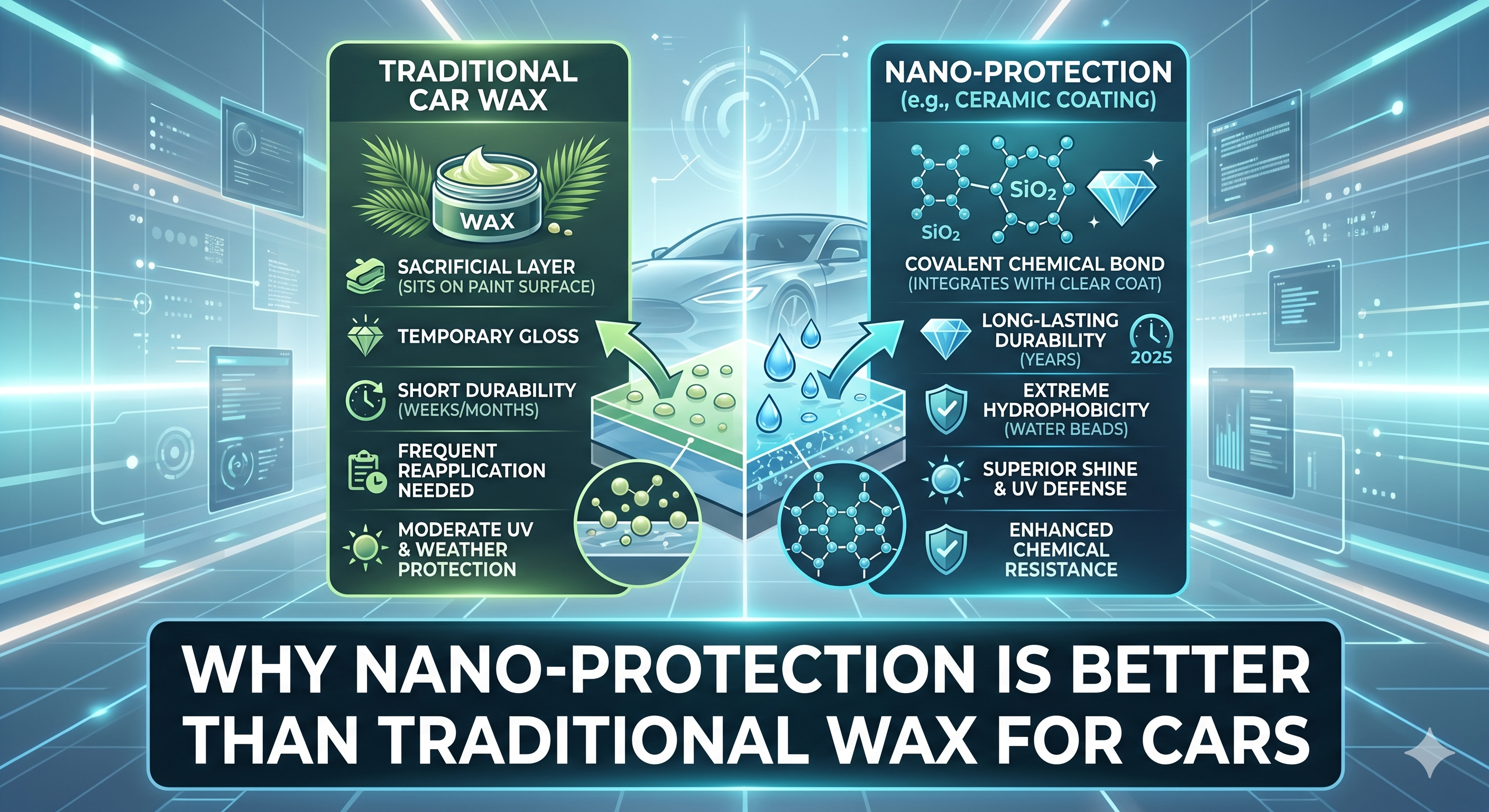
For decades, the ritual of car care culminated in a single, satisfying act: waxing. Drivers spent Sunday afternoons applying paste, waiting for the haze, and buffing it to a high, “wet-look” shine. It was the gold standard of paint protection. Today, a shift has occurred in the automotive detailing industry. Traditional carnauba wax is no longer the reigning champion. It has been dethroned by nanotechnology.
While both products enhance a car’s appearance, the differences between nano-protection (often called ceramic coatings or nano-coatings) and traditional wax are dramatic, rooted in fundamental chemistry, and backed by material science. To understand why nanotechnology offers superior protection, we must look beyond the surface shine and examine how these materials interact with a vehicle’s paint at the molecular level.
This article provides a detailed, scientific yet accessible examination of why nano-protection is the better choice for long-term automotive preservation.
1. The Chemistry of Traditional Wax: A Sacrifice at the Surface
Traditional car wax is primarily composed of natural waxes, most famously carnauba wax harvested from Brazilian palm leaves, or synthetic polymers. Carnauba is renowned for its warmth and depth of shine, particularly on dark paint colors.
However, from a material science perspective, traditional wax has a fundamental flaw: it is a non-bonding sacrificial layer.
How Traditional Wax Works:
When you apply paste or liquid wax to a car, you are essentially spreading a pliable, water-resistant substance on top of the paint’s clear coat. The wax fills microscopic imperfections in the paint surface, creating a smoother plane that reflects light more uniformly, resulting in that coveted shine.
Because it does not chemically bond to the paint, it begins to degrade immediately upon exposure to the elements. Detergents, environmental heat, friction from washing, and UV radiation all break down the wax layer quickly.
Key Limitation: Traditional wax typically lasts only 4 to 8 weeks. It requires frequent reapplication to maintain its protective benefits. It is a “soft” form of protection, providing only minor defense against environmental hazards.
2. The Science of Nano-Protection: Creating an Inseparable Bond
Nano-protection coatings represent a revolutionary leap from organic chemistry to inorganic material science. Unlike wax, nano-coatings do not merely sit on the paint; they transform the surface.
How Nano-Protection Works:
Nano-coatings are liquid polymers primarily composed of Silicon Dioxide ($SiO_2$), Graphene, or Titanium Dioxide ($TiO_2$). The “nano” prefix refers to the microscopic size of the particles—roughly 1 to 100 nanometers.
When applied to a car’s surface, these particles fill the most minute pores of the clear coat and, more importantly, create a strong covalent bond with the vehicle’s paint. Through a cross-linking curing process, the coating chemically meshes with the factory clear coat, effectively creating an inseparable, ultra-hard, transparent layer on top of the car.
The Resulting Properties:
-
Chemical Permanence: Because it is chemically bonded, it cannot be washed off.
-
Hardness: Nano-coatings are much harder than wax. Many coatings are rated 9H on the Pencil Hardness scale, whereas traditional wax cannot be rated on this scale.
-
Thinness: The resulting layer is extremely thin (typically 1 to 3 microns), preserving the paint’s clarity while providing robust defense.
3. Water Performance: The Extreme Hydrophobic Effect
One of the most noticeable and functionally superior aspects of nano-protection is its extreme hydrophobicity. Traditional wax provides good water sheeting (creating larger, flatter beads), but nanotechnology achieves a “self-cleaning” effect.
The Water Contact Angle:
Scientific measurement of hydrophobicity uses the “water contact angle.” The higher the angle, the more water repels the surface.
-
Traditional Wax Angle: Typically ranges from 90 to 105 degrees. Beads are visible, but they often struggle to move.
-
Nano-Protection Angle: Can exceed 110 or even 120 degrees (super-hydrophobic).
At these extreme angles, water cannot flatten out. It maintains a spherical shape and rolling force. Because the surface energy of the coating is so low, water simply rolls off the vehicle, even at low speeds.
The Functional Benefit: As water rolls off, it collects surface dirt, dust, and light contaminants, actively rinsing them away. This means the car stays cleaner longer and maintenance washes are significantly easier.
4. The Defensive Shield: Beyond Basic UV Protection
Traditional wax offers standard defense against UV fading, but it is weak against chemical and environmental etchings. Nano-protection offers a multi-faceted defensive shield.
Resistance to Chemical Attack:
Your car’s paint faces constant attack from acidic contaminants: bird droppings, bug guts, acid rain, and road salt.
-
Wax Limitation: Acids break down wax rapidly and etch directly into the clear coat beneath.
-
Nano Superiority: A true $SiO_2$ or Graphene coating is highly resistant to chemical attack within a broad pH range (typically pH 2 to pH 12). While acids might eventually damage the coating itself if left on for days, they cannot easily penetrate it to reach the clear coat. This buys you precious time to clean the car.
Superior UV Defense:
Nano-coatings incorporate advanced UV inhibitors. Because the coating is a semi-permanent ceramic, these inhibitors provide far more consistent and long-lasting protection against paint oxidation and clear coat failure than the temporary layer of wax.
5. Recent Research and Innovations in Automotive Coatings
Nanotechnology is a rapidly evolving field. Automotive coatings have advanced significantly in the past five years.
The Rise of Graphene:
While Silicon Dioxide ($SiO_2$) coatings remain the standard, the inclusion of Graphene (a one-atom-thick sheet of carbon) has emerged as a key innovation. Material science research indicates that graphene-based coatings offer several key advantages over pure silica coatings:
-
Improved Sheeting Speed: Faster water evacuation.
-
Reduced Water Spotting: Because of its conductivity, some graphene coatings appear to reduce the mineral bonding that causes water spots.
-
Enhanced Elasticity: While harder, graphene can also be slightly more flexible, reducing micro-cracking over years of heat cycles.
Future Development: Self-Healing and Zero-VOC Formulations
Academic and industrial laboratories are currently focusing on two major frontiers in automotive coatings:
-
Elastomeric Self-Healing Coatings: These coatings use polymers that, when exposed to heat (sunlight or hot water), actively flow back into minor swirl marks, effectively healing them without polishing. While commercially available, they are still evolving.
-
Sustainability: Research published in the past two years (e.g., in the MDPI Journal of Coatings) highlights a push toward zero-VOC (Volatile Organic Compound) formulations to reduce environmental impact and improve safety for professional installers, without sacrificing longevity.
6. Advantage–Risk Assessment: A Balanced View
While nano-protection is scientifically superior, a true professional assessment must consider both the benefits and the potential drawbacks.
The Advantages:
-
Longevity: Lasts 2 to 5 years (some professional coatings claim longer), compared to weeks for wax.
-
Hydrophobicity: Unmatched self-cleaning properties and easier washing.
-
Hardness & Minor Abrasion Resistance: Provides robustness against minor swirl marks during washing (though not scratch-proof).
-
Chemical Resistance: Robust defense against acids, salt, and environmental contaminants.
-
Enhanced Aesthetics: Crisp, glossy, mirror-like clarity.
The Risks and Drawbacks:
-
High Initial Cost: Professional application can range from $800 to $2,500. Even DIY ceramic coating kits cost more than standard wax.
-
Complex Application Process: Achieving the necessary chemical bond requires an immaculate paint surface. This often necessitates intensive decontamination and paint correction (polishing out existing scratches) before application. Failure in prep work locks defects under the coating.
-
Time Commitment: Requires several hours of preparation and 12–24 hours of curing time during which the car cannot get wet. Wax is apply-and-go.
-
Difficulty of Removal: Because it chemically bonds, a cured ceramic coating cannot be washed off with soap or standard chemicals. It must be mechanically polished off using abrasives.
-
Potential for High Spots: If the product is applied unevenly or left too long before buffing, it cures as a visible smudge (a “high spot”) that can only be fixed by polishing. DIYers often struggle with this.
-
Creating False Confidence: Many car owners assume “ceramic” means “bulletproof.” It is not scratch-proof, not rock chip-proof, and still requires proper maintenance washing to prevent dulling or water spotting.
7. A Note on Clinical Applications and Academic Sources
The term “clinical trials” is rarely applied to automotive care; however, “laboratory testing” is rigorous.
-
Academic Validity: The effectiveness of Silicon Dioxide and Graphene as anti-corrosion barriers is well-established in corrosion science literature. Published studies from entities like the NACE International (National Association of Corrosion Engineers) have validated the bonding strength and chemical resistance of these nano-ceramic structures in various industrial applications.
-
Standardized Testing: Detailing labs use standardized tests, such as ASTM salt spray testing, to measure anti-corrosion life, and Mohs hardness scales or pencil hardness testers to measure surface robustness. These scientific metrics consistently confirm that nano-protection outperforms wax by several orders of magnitude in key defensive categories.
Conclusion: Investment vs. Routine Maintenance
Traditional carnauba wax is not a bad product; it is a ritualistic product that offers temporary beauty and basic water resistance. It appeals to the automotive enthusiast who enjoys the frequent, low-upfront-cost act of detailing their own car.
However, for those seeking the highest level of preservation for their vehicle’s paint, material science offers only one champion. Nano-protection is scientifically better because it transforms the surface of the vehicle at the atomic level, creating a hard, hydrophobic, and semi-permanent defensive shield that traditional sacrificial waxes cannot replicate. It is an investment in long-term protection, reduced maintenance effort, and preserved resale value. In the battle for automotive paint survival, nanotechnology wins.