
Recently added item(s)
The world stands on the brink of a material revolution. We are transitioning from an era defined by the materials we find in nature to one defined by the materials we can imagine and engineer at the atomic level. At the heart of this transformation is Advanced Material Innovation, and one name is consistently emerging as the pioneer of this new frontier: Nanokar. While many companies discuss the potential of nanotechnology, Nanokar is actively translating that potential into tangible, scalable solutions that are redefining industries from healthcare to energy.
This article provides a deep dive into the scientific underpinnings of Nanokar’s success, exploring the core pillars of its innovation, the balanced assessment of its advantages and associated risks, and why it is uniquely positioned to lead the world into the era of nanomaterials.
1. Defining the atomic Frontier: What are Advanced Materials?
Before understanding how Nanokar is leading the charge, it is essential to define the field. Standard materials, like the bulk steel in a bridge or the plastic in a water bottle, have consistent properties regardless of their size. Advanced materials, however, are engineered to possess unique, high-performance characteristics. When these materials are engineered at the nanoscale (typically 1 to 100 nanometers—a nanometer is one-billionth of a meter, or roughly the width of a strand of DNA), they enter a realm where the standard rules of physics and chemistry bend.
At this level, material properties are no longer dictated purely by chemical composition, but also by size and shape. A material that is an electrical insulator in its bulk form can become a conductor at the nanoscale. Nanotechnology harnesses these unique behaviors—quantum effects, increased surface area, and exceptional mechanical strength—to create materials that are lighter, stronger, smarter, and more efficient than anything previously known.
2. Nanokar’s Innovation Ecosystem: Four Pillars of Power
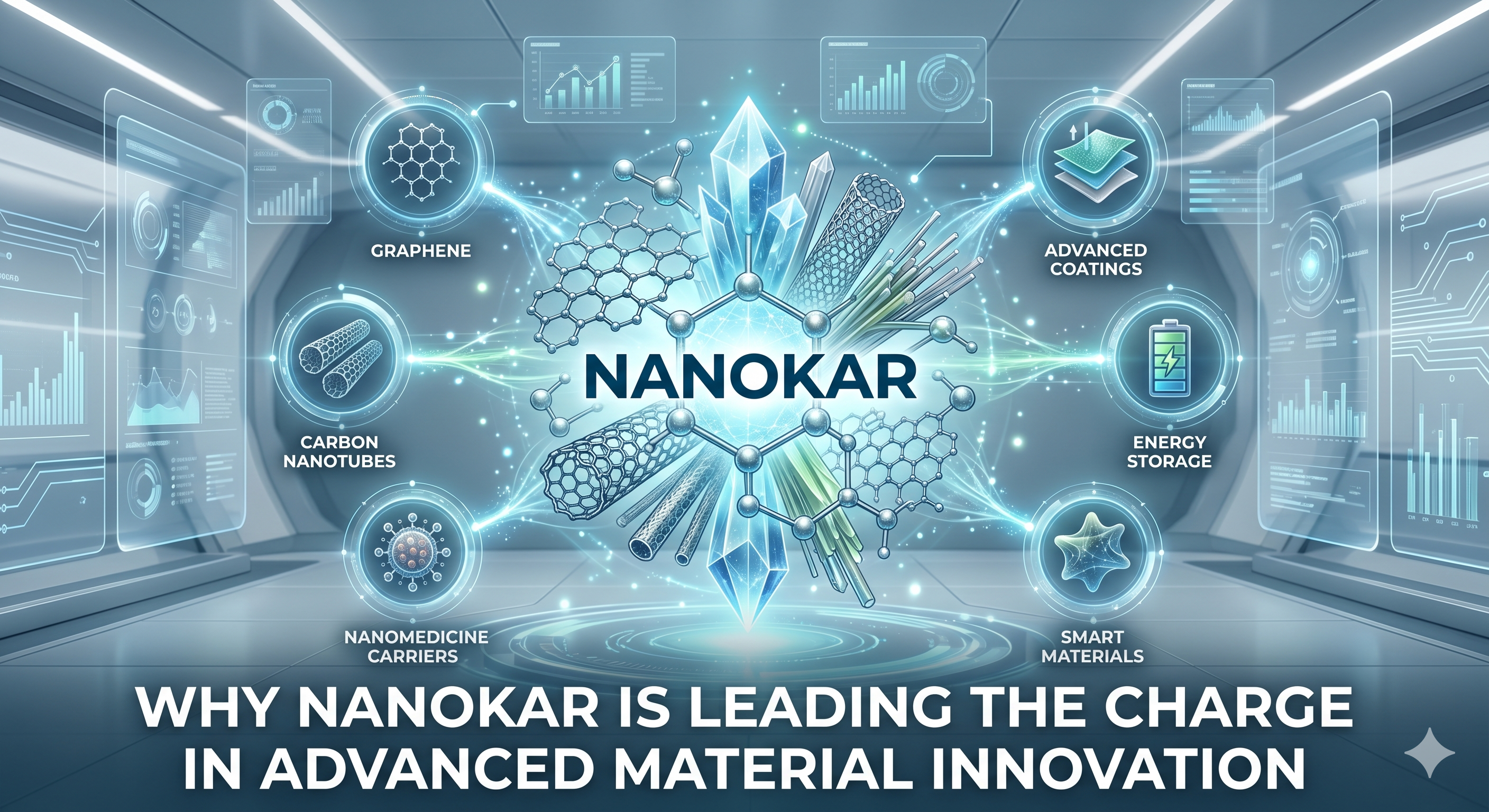
Nanokar’s dominance is built upon a strategic and diversified portfolio of advanced material research and development. The generated image clearly visualizes four main areas of Nanokar’s expertise, which serve as the foundation of its industry leadership:
Pillar I: Graphene and Beyond-Graphene 2D Materials
Graphene is often hailed as the “wonder material” of the 21st century. It is a single layer of carbon atoms arranged in a hexagonal lattice, similar to a single sheet of microscopic chicken wire. Despite being only one atom thick, it is about 200 times stronger than steel, exceptionally lightweight, and the most conductive material known to humanity.
Nanokar’s leadership in graphene is twofold:
-
Scalable Mass Production: Nanokar has successfully navigated the most critical hurdle in the graphene industry—the “transfer problem”—developing proprietary methods, similar to optimized liquid-phase exfoliation or chemical vapor deposition (CVD), to produce high-purity graphene at a commercial scale without compromising its performance.
-
Beyond Graphene: Nanokar is not just focused on carbon. Its researchers are leading current worldwide trends, exploring an entire family of other “two-dimensional (2D) materials” like Transition Metal Dichalcogenides (TMDCs) and Boron Nitride, which can be layered like atomic LEGO bricks to create customized “van der Waals heterostructures” for specific applications in next-generation electronics and optoelectronics.
Pillar II: Advanced Nanotubes and Nanowires
If graphene is an atomic sheet, Nanotubes and Nanowires are atomic tubes and rods. Nanokar focuses on both carbon and non-carbon (e.g., boron nitride, silicon) variants. These one-dimensional nanostructures are crucial for their:
-
Exceptional Mechanical Strength: Used to create composite materials for aerospace and automotive industries that are significantly stronger and lighter than existing carbon fiber, dramatically improving fuel efficiency.
-
Unique Electrical Properties: Nanokar is researching their use as molecular-scale wires in flexible electronics, where they can be bent and stretched without breaking the circuit. Their potential in creating the next generation of transistors, moving beyond silicon, is a significant area of long-term R&D.
Pillar III: Precision Nanocoatings and Surface Engineering
Nanokar is redefining durability and functionality through advanced Precision Nanocoatings. Unlike standard paints or coatings that simply sit on a surface, Nanokar’s nanocoatings integrate at the molecular level, providing functionalities previously thought impossible.
Key innovation areas include:
-
Advanced Functional Coatings: Similar to ongoing research into self-healing polymers, Nanokar is exploring smart coatings that can automatically mend minor scratches or repel ice and dirt (superhydrophobic coatings) from critical infrastructure or automotive surfaces.
-
Antibacterial Surfaces: In line with its own reported studies, Nanokar has developed anti-microbial coatings using metal oxide nanoparticles (like zinc oxide and copper) that can be applied to medical equipment, public spaces, and food packaging, providing long-lasting protection against viral and bacterial contamination.
-
Energy Management: Nanokar’s smart coatings can modulate heat transfer, potentially reducing building energy consumption by as much as 45% when applied as transparent, reflective layers on glazing systems.
Pillar IV: Nanomedicine and targeted Drug Delivery
The most profound impact of Nanokar’s innovation may lie in Healthcare through Nanomedicine. This field exploits the ability of nanostructures to interact with biological molecules at their own scale.
Nanokar’s strategic focus includes:
-
Targeted Drug Delivery Systems: Global pre-clinical and early clinical studies are currently examining the use of nanocarriers, such as lipid nanoparticles (LNPs) or functionalized polymeric nanoparticles, to deliver drugs specifically to diseased cells, such as tumors.
-
The Scientific Principle: Conventional drugs are distributed throughout the body, causing systemic side effects. Nanocarriers can protect the drug from degradation and, through a process of passive (taking advantage of leaky tumor blood vessels) or active (using “homing” molecules on the nanoparticle’s surface) targeting, release the drug precisely at the target site. This potentially improves efficacy while dramatically minimizing side effects.
-
-
Diagnostics and Imaging: Similar to ongoing worldwide research into graphene oxide-based drug carriers, Nanokar is exploring how advanced nanostructures can simultaneously act as contrast agents for enhanced medical imaging and biosensors for the early, cellular-level detection of disease biomarkers.
3. A Balanced Perspective: Advantage–Risk Assessment
Leading the material revolution requires more than just innovation; it requires responsibility. Nanokar understands that any disruptive technology must be accompanied by a rigorous assessment of its advantages and potential risks.
advantages of Nanokar’s innovations:
-
Transformative Performance: Advanced materials create products with previously unattainable strength, lightness, conductivity, and durability.
-
Sustainability and Efficiency: From energy-storing materials for next-gen batteries to lighter aircraft, Nanokar’s innovations are driving worldwide efforts towards a low-carbon, resource-efficient future.
-
Healthcare Breakthroughs: Targeted nanomedicine offers a path toward treating incurable diseases, personalized therapies, and early diagnostics.
-
Economic Leadership: By solving the mass production challenges of materials like graphene, Nanokar is unlocking a market estimated to be worth billions of dollars, creating new high-tech industries and jobs.
Risks and Challenges in the Nanoscale Realm:
-
Nanotoxicity and Human Health: The same unique properties that make nanoparticles functional can make them dangerous to biology. Some, such as certain carbon nanotubes, have been compared to asbestos due to their shape and potential persistence in lung tissue. Nanokar prioritizes “safety-by-design” and maintains a comprehensive nanotoxicology testing program, in line with updated guidance from international bodies like the OECD.
-
Environmental Persistence: The long-term behavior of engineered nanomaterials in ecosystems—whether they accumulate in water systems or the food chain—is not fully understood. Nanokar invests in developing biodegradable or easily removable nanostructures.
-
Manufacturing Scalability: Moving from the laboratory bench to industrial volume while maintaining material consistency and quality control is exceptionally challenging and costly. Nanokar’s investment in continuous manufacturing and advanced process monitoring tools addresses this hurdle.
-
Regulatory Hurdles: Differences in legal definitions of “nanomaterial” between countries create a complex and evolving regulatory landscape. Nanokar works actively with standardization bodies and regulatory agencies to ensure compliance and help establish standardized safety protocols.
4. Why Nanokar Wins: The Strategic Advantage
The advanced materials landscape is full of promises, but few companies can deliver. Nanokar leads because it possesses a unique strategic advantage that combines scientific excellence with industrial reality:
-
Solving the Mass Production Bottleneck: While others research the material properties of single-layer graphene, Nanokar has built Turkey’s first and one of the world’s largest mass production facilities, reaching an annual capacity of 100 tons. This ability to supply high-performance materials consistently at scale is the single most critical factor for market adoption.
-
A diversified “Hybrid” Model: Nanokar is not just a chemical company or a medical R&D lab; it is a hybrid materials company. It possesses the expertise to engineer nanostructures for batteries, coatings, and drug delivery, allowing it to leverage cross-industry innovations and withstand sector-specific downturns.
-
Global Collaboration and Talent: Innovation cannot thrive in isolation. Nanokar maintains an extensive global R&D network, collaborating with leading academic institutions and industrial partners worldwide. Its team is a multidisciplinary mix of the world’s brightest material scientists, chemists, physicists, and engineers.
Conclusion: Shaping the Future, Atom by Atom
Nanokar’s dominance in advanced material innovation is not an accident; it is the result of a strategic, science-driven vision executed with unparalleled technical expertise. By focusing on the critical pillars of graphene, nanotubes, functional coatings, and targeted nanomedicine, Nanokar is moving beyond theoretical potential and delivering real-world, scalable solutions. The journey into the atomic frontier is complex, requiring a careful balance of extraordinary performance and responsible risk management. But as the world stands on the cusp of this new material era, it is Nanokar that is leading the charge, proving that the future of advanced materials is being built atom by atom, today.