
Recently added item(s)
Plastics, or polymers, have revolutionized modern life. They are in our cars, our electronics, our homes, and even our clothes. However, this ubiquity comes with a hidden danger: most synthetic polymers are highly flammable. When they ignite, they burn rapidly, release immense heat, and produce thick, toxic smoke, which is often the primary cause of casualties in fires.
For decades, the construction and electronics industries relied heavily on halogenated flame retardants to mitigate this risk. While effective, these chemical additives are now strictly regulated or banned globally due to their persistence in the environment and their tendency to release highly poisonous dioxins upon combustion. The search for eco-friendly, non-toxic alternatives has led material scientists from the micro-world to the nano-world.
One element is leading this nanotechnology charge: Nano Magnesium Oxide (MgO). Far from being just a lab curiosity, nano MgO is transforming fire safety by upgrading plastics into smart, self-extinguishing materials.
The Nanoscale Advantage: Why Bigger isn’t Better
Magnesium Oxide is a well-known white mineral powder. In its bulk (micro-sized) form, it has been used as a filler in polymers for years. However, its effectiveness as a flame retardant was limited because huge amounts (often exceeding 50% by weight of the plastic) were needed to achieve significant fire resistance. Such high loading made the resulting plastic brittle, heavy, and difficult to manufacture.
Nano Magnesium Oxide changes everything due to nanotechnology. At the nanoscale—where particles measure between 1 and 100 nanometers—a material’s properties change dramatically. To put this in perspective, a single strand of human hair is roughly 80,000 to 100,000 nanometers wide.
What makes nano MgO special is its Specific Surface Area (SSA). A single gram of nano MgO powder can have a surface area equivalent to several hundred square meters. This massive surface area means a tiny amount of powder has a enormous amount of contact area to interact chemically and physically with the burning polymer matrix.
Under the Hood: The Scientific Mechanism of Fire Retardancy
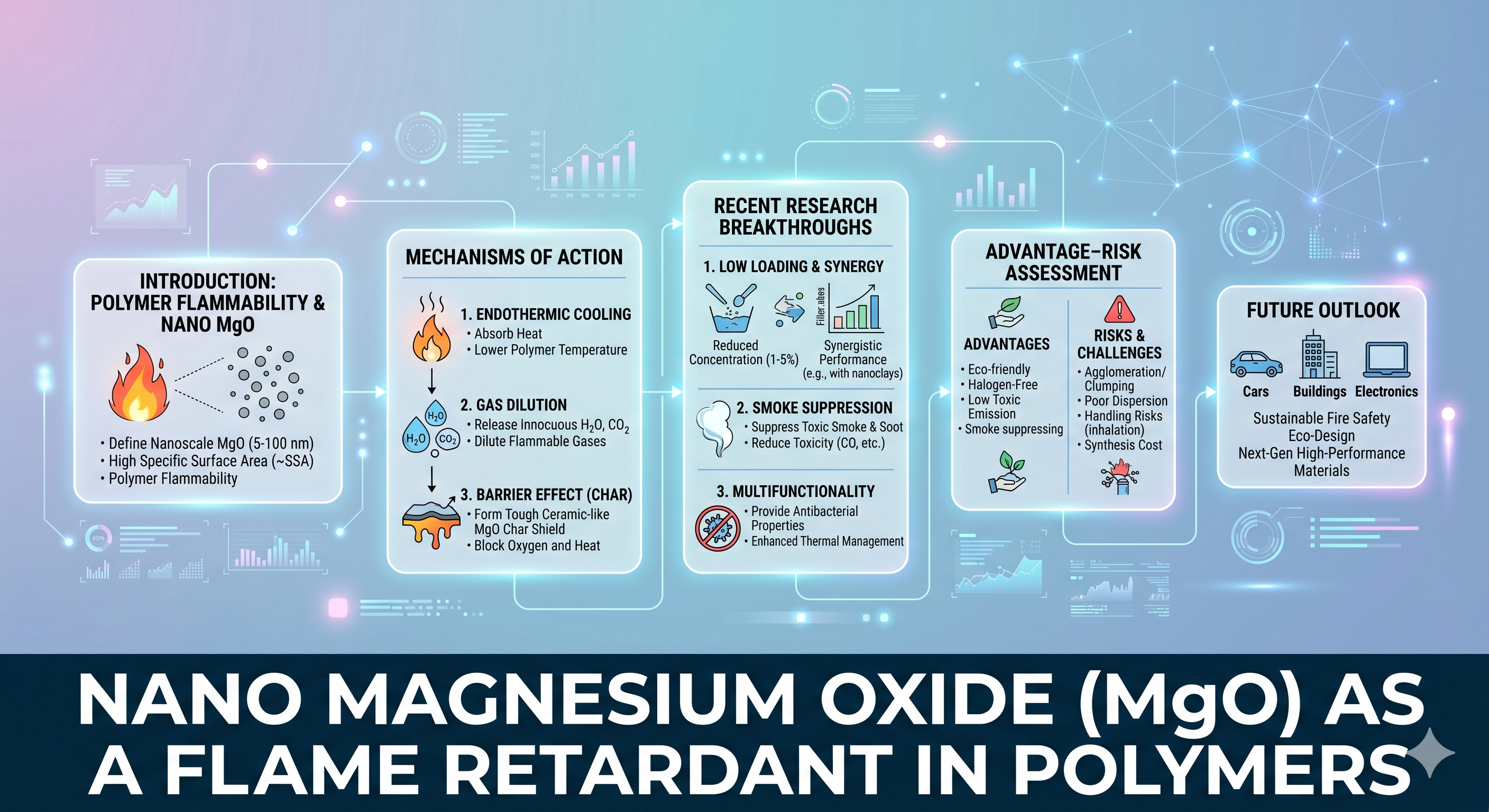
When a plastic enhanced with nano MgO is exposed to a flame, a multi-stage chemical battle begins. Unlike chemical retardants that interfere with the flame’s gas-phase chemistry, nano MgO works through safer, physical-chemical mechanisms in both the condensed (solid/liquid plastic) and gas phases.
1. Gas-Phase Combat: Cooling and Dilution
The fundamental mechanism of nano MgO (often derived from magnesium hydroxide, Mg(OH)₂) is endothermic decomposition. This means when it is heated, it absorbs a tremendous amount of energy to break down. This chemical breakdown has a dual action:
-
Isı Soğurma (Heat Absorption): As it decomposes, it sucks heat away from the burning front, cooling the surface of the plastic and potentially stopping it from reaching its ignition temperature.
-
Oksijen Seyreltme (Oxygen Dilution): During decomposition, it releases innocuous water vapor (and potentially CO₂, if carbonates are present). This steam creates a localized barrier around the flame, diluting the oxygen concentration needed for combustion.
2. Condensed-Phase Combat: The Shield Effect
The most crucial role played by nano MgO is the formation of a ceramic-like char layer. The byproduct of decomposition is pure Magnesium Oxide ceramic. Due to the high specific surface area of the nanoparticles, this MgO catalyzes the polymer matrix to decompose smoothly into a carbonaceous char.
This char layer acts as a physical shield (barrier effect). It is thermally stable, meaning it doesn’t easily burn or break. It creates a firewall that performs two essential functions simultaneously:
-
It blocks the underlying, unburned plastic from oxygen and heat.
-
It prevents flammable gases generated by the melting plastic from escaping to the surface to feed the flame.
Applied Studies: Recent Research Frontiers and Fire Safety Breakthroughs
While the theoretical mechanisms are sound, the core of nano MgO innovation lies in recent applied research aimed at optimizing its performance in industrial scenarios. Construction and electronics are key markets.
Breakthrough in Low Loading and Performance Synergy
A defining center of current applied studies is optimizing the amount of nano MgO required. Material scientists are focusing on synergistic flame retardant systems, where nano MgO is paired with other additives, such as graphene or layered silicates (clays). Research demonstrates that adding just 1–3% nano MgO to a plastic matrix, combined with other eco-friendly agents, can achieve performance levels that previously required 30% of bulk metal hydroxides. This preserves the lightweight nature of the polymer.
Smoke Toxicity Suppression (Key Life Safety Benchmark)
The gas phase suppressive capabilities are incredibly important. Thick, toxic smoke containing carbon monoxide (CO) and hydrogen cyanide is the biggest threat to life in a fire. Current applied studies utilize advanced smoke density chambers to measure toxicity. Nano MgO is remarkably effective at smoke suppression because its alkaline surface catalyzes the decomposition products, reducing the formation of soot particles and adsorbing toxic gas molecules, leading to cleaner, more translucent smoke and potentially saving lives.
Multifunctionality: Antibacterial Firewalls
Emerging applied studies are transforming nano MgO into a multifunctional additive. Research shows that nano MgO can provide antibacterial properties alongside flame retardancy. This makes it ideal for plastics used in hospital wall coatings, medical devices, or food packaging, where fire safety and hygiene are both critical benchmarks.
Advantage–Risk Assessment: A Realistic Blueprint
A formal evaluation of nano MgO’s technological benefits versus its practical challenges is essential for industrial adoption.
The Clear Advantages
-
Eco-Friendly and Halogen-Free: Non-toxic, releases only water vapor and ceramic MgO upon decomposition. No dioxin risk.
-
Multifunctionality: Can improve tensile strength (sometimes), thermal conductivity, and provide smoke suppression and antibacterial effects.
-
Lower Loading Requirements: Nanoscale specific surface area means less powder is needed than bulk metal hydroxides.
The Technological Risks and Challenges
-
Aglomerasyon ve Topaklanma (Aggregation Issues): The greatest challenge in nano-engineering. Because they have such high surface area, nano MgO particles tend to stick together, forming large clumps (aggregation). Clumped nanoparticles behave like bulky micro-sized particles, destroying the effect. Achieving uniform dispersiyon within the polymer matrix is the biggest technical challenge and requires specialized mixing techniques or chemical dispersants.
-
Long-Term Environmental Fate: While the decomposition products (water, MgO) are safe, the long-term ecological impact of free nanoparticles themselves (if they leach from products over decades) is not fully understood and requires ongoing ecotoxicological risk research.
-
Occupational Safety: Working with dry, super-fine nanoparticle powder presents serious inhalation risks for workers during the manufacturing process. It requires advanced containment and H&S protocols, such as gloveboxes or the use of pre-dispersed nano MgO masterbatches.
-
Cost: High synthesis and processing complexity means nano MgO is currently significantly more expensive than traditional bulk metal hydroxides.
Future Horizons: The Smart Firewall Within
The potential for nano MgO is boundless. Current research is aiming to perfect the synthesis methods to create custom nano MgO shapes (e.g., plates, rods, or flakes) that might offer even better barrier properties at lower concentrations. Furthermore, the focus is also on perfect encapsulation methods that will make nano MgO safer to handle during processing, accelerating its industrial application in next-generation high-performance plastics for the built environment.
Conclusion
Nano Magnesium Oxide is moving from laboratory curiosity to the indispensable workhorse of sustainable fire safety in plastics. By mastering the immense capabilities of nanotechnology, scientists are upgrading synthetic polymers with smart, intrinsic firewall properties. While the industry must carefully navigate the technical challenges of cost and dispersion and enforce strict H&S protocols for handling nanoparticles, the rewards—faster self-extinction, eco-friendliness, and critically, suppressed smoke toxicity—make nano MgO the undeniable key to building a safer, stronger future at the nanoscale.