
Recently added item(s)
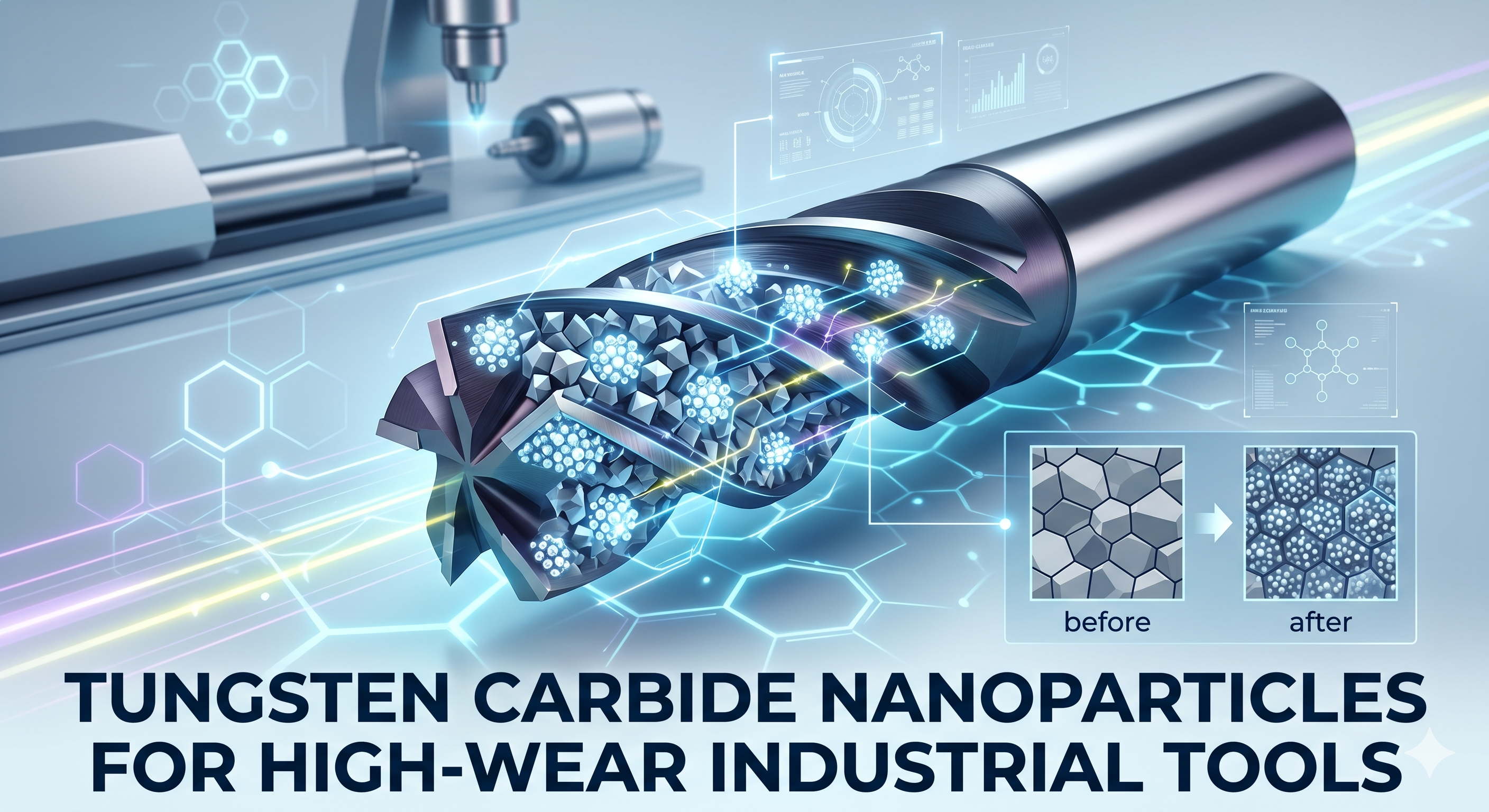
In the relentless world of heavy industry, the battle against friction, heat, and time is never-ending. Whether it is deep-earth mining, aerospace engineering, or precision automotive machining, the tools used to shape, cut, and drill our modern world take an unimaginable beating. For decades, the undisputed champion of these extreme environments has been tungsten carbide. Known for its incredible hardness and durability, it has been the backbone of high-wear industrial tools. However, as our engineering ambitions have grown, so too have the demands we place on our materials. Enter the microscopic revolution: Tungsten Carbide (WC) nanoparticles.
By shrinking the building blocks of this already formidable material down to the nanometer scale—thousands of times thinner than a single human hair—scientists and engineers are unlocking a new frontier in material science. This blog post explores the fascinating world of tungsten carbide nanoparticles, delving into how they work, the latest field studies, and the delicate balance between their immense industrial advantages and the risks associated with their production.
The Magic of Tungsten Carbide: A Brief Primer
Before we dive into the nanoscale, it is essential to understand why tungsten carbide is so highly regarded in the first place. Tungsten carbide is a chemical compound containing equal parts of tungsten and carbon atoms. In its most common industrial form, it is manufactured as a “cemented carbide.” This means the hard tungsten carbide grains are bound together by a softer, ductile metal—usually cobalt.
Think of it like a brick wall: the tungsten carbide acts as the incredibly hard, crush-resistant bricks, while the cobalt acts as the mortar, providing the flexibility needed to prevent the wall from shattering under sudden impacts. This combination gives traditional cemented tungsten carbide an excellent balance of hardness (resistance to wear and scratching) and toughness (resistance to cracking or breaking). It is twice as stiff as steel and is surpassed in hardness only by a few materials on Earth, such as diamonds and cubic boron nitride.
Yet, traditional tungsten carbide has its limits. When cutting through aerospace-grade titanium or drilling through solid granite miles beneath the earth’s surface, the intense heat and mechanical stress can cause even the best tools to degrade, dull, and fail. This forces industries into costly downtimes for tool replacements and maintenance.
Why Go Nano? The Science of the Small
So, why take an already excellent material and make it microscopic? The answer lies in the strange and wonderful physics of nanomaterials. When you reduce the grain size of a material to the nanoscale (typically less than 100 nanometers), its physical and chemical properties begin to change dramatically.
In traditional materials science, there is a frustrating, golden rule: hardness and toughness are almost always mutually exclusive. If you make a metal harder, it becomes more brittle (like glass). If you make it tougher and more resistant to shattering, it becomes softer (like copper).
Nanotechnology effectively breaks this rule through a phenomenon known as the Hall-Petch effect. By reducing the size of the tungsten carbide grains, the material creates vastly more “grain boundaries.” These boundaries act as microscopic roadblocks. When a tool is subjected to immense stress, tiny microscopic cracks try to form and spread. In traditional, large-grained materials, these cracks can travel easily, leading to tool failure. In nanostructured tungsten carbide, the immense number of grain boundaries stops these cracks dead in their tracks.
The result? A material that is not only significantly harder and more wear-resistant than conventional tungsten carbide but also tougher and more resistant to catastrophic shattering. Furthermore, the massive surface-area-to-volume ratio of nanoparticles allows for better bonding with the cobalt matrix, resulting in a more uniform, flawless composite material.
Current Research and Industrial Field Studies
While the phrase “clinical trials” is usually reserved for medicine, the industrial equivalent—rigorous field studies and applied research—is currently booming in the realm of nano-tungsten carbide. Engineers are taking these materials out of the laboratory and putting them to the test in the harshest environments conceivable.
1. Breakthroughs in Aerospace Machining One of the most intense areas of research is the machining of superalloys, such as Inconel and aerospace-grade titanium. These metals are notoriously difficult to cut because they generate massive amounts of heat, which traditionally melts or degrades cutting tools. Recent industrial studies have tested nano-grain tungsten carbide cutting inserts against conventional ones. The results have been staggering. Tools made with WC nanoparticles maintained their sharp cutting edges up to three times longer than standard tools. The nanostructure provides superior thermal stability, meaning the tool does not soften even when glowing red hot from friction.
2. Deep Drilling and Mining In the oil, gas, and mining sectors, drill bits must endure extreme abrasive wear and high-impact shocks. Applied research in geothermal drilling—where rocks are exceptionally hard and hot—has demonstrated that nano-enhanced cemented carbide buttons on drill bits show drastically reduced wear. The increased toughness provided by the nanoparticles prevents the bit from chipping when it strikes unexpected hard rock veins, while the increased hardness prevents the abrasive sand and stone from wearing down the cutting surface.
3. The Sintering Challenge: Spark Plasma Sintering (SPS) A major focus of current scientific research is how to make these tools. The traditional method of baking the powders into a solid tool (sintering) takes a long time and uses high heat. The problem is that when you heat nanoparticles, they naturally want to melt together and grow into large particles, entirely defeating the purpose of using nano-powders in the first place. Current research has heavily focused on advanced manufacturing techniques like Spark Plasma Sintering (SPS). SPS uses pulses of electrical current to heat and compress the powder in a matter of minutes rather than hours, locking the tungsten carbide in its nano-state before the grains have a chance to grow.
Advantage and Risk Assessment
As with any highly advanced technology, the integration of tungsten carbide nanoparticles into industrial manufacturing brings a complex matrix of benefits and challenges. A thorough evaluation is necessary to understand the future viability of this technology.
The Advantages
-
Unprecedented Lifespan: The most immediate benefit is the drastic increase in the operational lifespan of high-wear tools. A tool that lasts two or three times longer translates directly to massive financial savings for heavy industries.
-
Reduced Machine Downtime: In large-scale manufacturing and drilling, the cost of the tool is often negligible compared to the cost of stopping the machine to replace the tool. Nano-enhanced tools mean fewer interruptions, leading to higher overall productivity.
-
Enhanced Precision and Surface Finish: Because nano-WC tools wear down much slower, they maintain their precise geometric shape for longer. In the manufacturing of critical automotive or aerospace parts, this means the final products have a smoother, more accurate surface finish, reducing the need for secondary polishing or grinding.
-
Energy Efficiency: A sharper tool requires less mechanical force to cut through metal or rock. This leads to reduced energy consumption by the heavy machinery powering the tools, contributing to a lower carbon footprint for industrial operations.
The Risks and Limitations
-
Occupational Health and Nanotoxicity: The most significant risk associated with nanoparticles is the health of the workers who manufacture the tools. Because nanoparticles are incredibly small, they can easily become airborne during the powder-mixing phases. If inhaled, these particles can bypass the body’s natural respiratory defenses and enter the deepest parts of the lungs, potentially crossing into the bloodstream. Strict, medical-grade ventilation and personal protective equipment (PPE) are required to mitigate respiratory and cellular toxicity risks.
-
Agglomeration: Nanoparticles have highly active surfaces and tend to clump together (agglomerate) due to attractive forces. If the particles clump up during the manufacturing process, it creates weak spots in the final tool, leading to unexpected failures. Achieving a perfectly even dispersion of nanoparticles requires highly sophisticated and expensive mixing technology.
-
Prohibitive Manufacturing Costs: Creating high-quality tungsten carbide nanoparticles is energy-intensive and chemically complex. Furthermore, the specialized equipment required to sinter them without losing the nanostructure (like the aforementioned Spark Plasma Sintering machines) requires millions of dollars in capital investment. Currently, these tools are highly expensive to produce, meaning their use is restricted to industries where the high cost is justified by the extreme demands.
Future Ideas and Innovations
Looking forward, the potential applications for tungsten carbide nanoparticles are expanding beyond just making better solid tools.
Nano-Coatings: Instead of making the entire tool out of expensive nano-tungsten carbide, researchers are developing ways to use nanoparticles in thin-film coatings. By applying a microscopic layer of nano-WC to a cheaper, standard steel tool, industries could achieve near-nano performance at a fraction of the cost.
3D Printing of Hard Metals: Additive manufacturing (3D printing) is revolutionizing how we create metal parts. Combining 3D printing technology with tungsten carbide nanoparticle binders could allow engineers to print custom-shaped, highly complex cutting tools on demand—geometries that are currently impossible to create using traditional molding and grinding methods.
Eco-Friendly Synthesis: A major idea currently being explored is the sustainable production of these nanoparticles. Scientists are looking into recycling old, broken standard tungsten carbide tools, breaking them down chemically, and reforming them into high-value nanoparticles, creating a closed-loop, sustainable supply chain for one of the world’s most critical industrial materials.
Conclusion
Tungsten carbide nanoparticles represent a monumental leap forward in materials engineering. By understanding and manipulating matter at the atomic level, scientists have managed to solve the age-old compromise between hardness and toughness. While the challenges of high manufacturing costs and stringent safety requirements during production remain significant, the successful field studies in aerospace, mining, and precision machining prove that the benefits far outweigh the hurdles.
As manufacturing techniques become more refined and cost-effective, we can expect nano-enhanced tungsten carbide to become the new standard in high-wear industrial tools. It is a perfect example of how the smallest, invisible tweaks at the microscopic scale can drive the largest, heaviest industries on Earth forward into the future.