
Recently added item(s)
Every time you turn the key in your car’s ignition, a miniature symphony of controlled explosions begins under the hood. While these explosions give us the power to traverse continents, they also produce a toxic cocktail of gases: carbon monoxide, nitrogen oxides, and unburned hydrocarbons. Fortunately, before these harmful pollutants can escape the tailpipe and choke our atmosphere, they are forced through a metallic honeycomb hidden beneath the car—the catalytic converter.
While precious metals like platinum and palladium usually steal the spotlight in discussions about these emission-control devices, there is an unsung hero working silently in the background: Cerium Oxide (CeO2), commonly known as ceria.
This post delves deep into the fascinating, microscopic world of cerium oxide in automotive catalytic converters. We will explore the science behind how it breathes life into our emission control systems, look at the latest field studies pushing the boundaries of nanotechnology, and weigh the undeniable environmental advantages against the genuine risks of utilizing rare earth materials.
The Anatomy of a Clean Exhaust
To understand the magic of cerium oxide, we first need to understand the battlefield where it operates. A standard Three-Way Catalytic Converter (TWC) is designed to tackle three main villains simultaneously:
-
Carbon Monoxide (CO): A deadly, odorless gas.
-
Hydrocarbons (HC): Unburned fuel that contributes to smog.
-
Nitrogen Oxides (NOx): Gases that cause acid rain and respiratory issues.
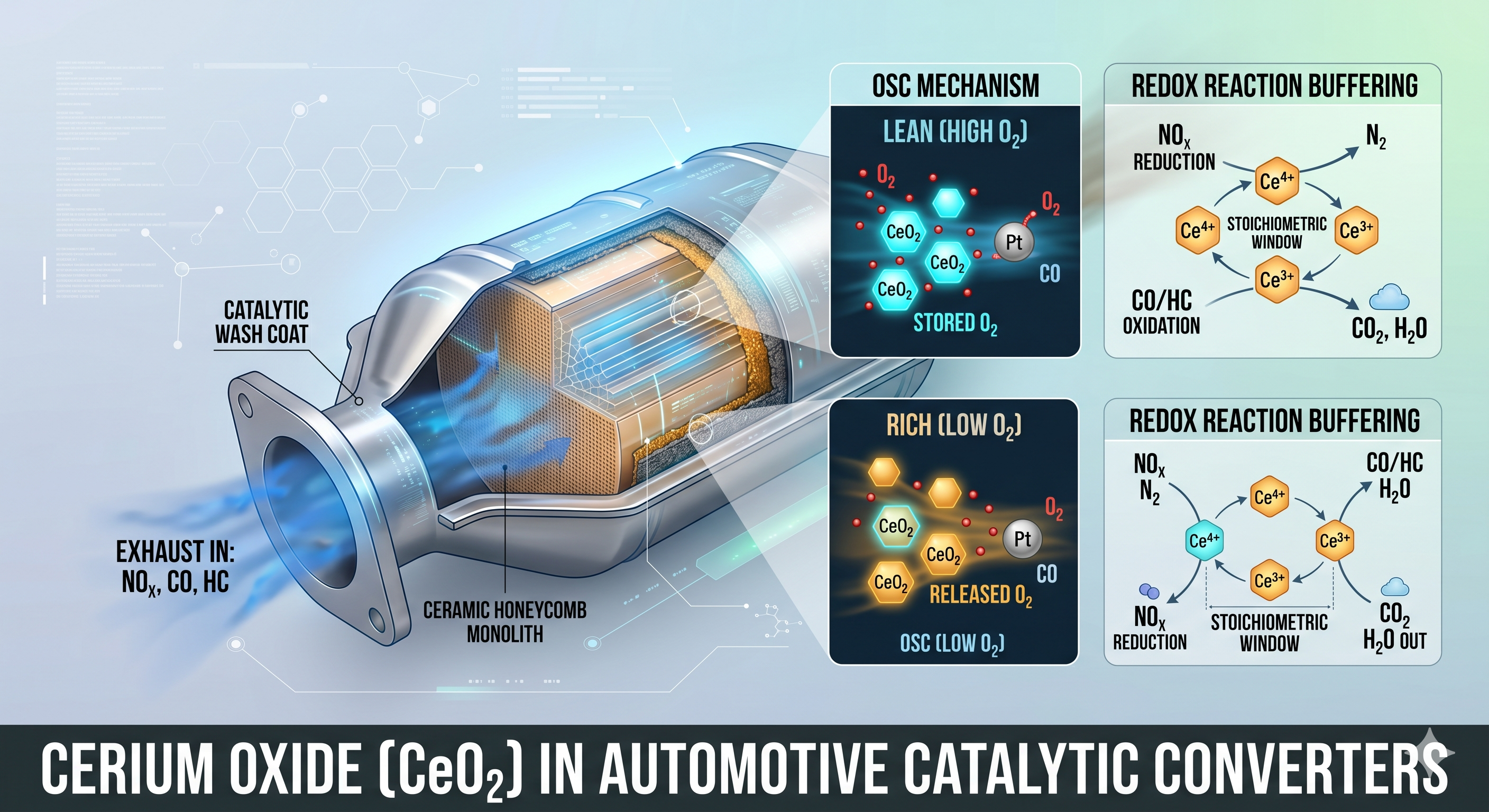
The inside of the converter is a ceramic honeycomb coated in a microscopic layer called the “washcoat.” Embedded in this washcoat are precious Platinum Group Metals (PGMs) which act as the catalysts—the chemical instigators that convert these toxic gases into harmless water, carbon dioxide, and nitrogen.
However, these PGMs are incredibly picky. They only work efficiently when the ratio of air to fuel in the engine exhaust is absolutely perfect (known as the stoichiometric point). If the exhaust has too much oxygen (running “lean”), the converter cannot effectively neutralize NOx. If it has too little oxygen (running “rich”), it cannot oxidize CO and hydrocarbons. Because the engine is constantly accelerating and decelerating, the exhaust stream is constantly fluctuating between lean and rich.
This is where Cerium Oxide steps in to save the day.
The Chemical Sponge: How Cerium Oxide Works
Think of Cerium Oxide as a chemical sponge, or a microscopic set of lungs. Its primary role in a catalytic converter is to provide Oxygen Storage Capacity (OSC).
Cerium is a fascinating element because it can effortlessly flip between two different oxidation states: Ce4+ and Ce3+. In simple terms, it can easily grab hold of an oxygen atom, and just as easily let it go.
-
When the engine runs “lean” (Too much oxygen): The exhaust is flooded with excess oxygen. The cerium oxide acts like a sponge, soaking up this extra oxygen and storing it within its crystal lattice structure, converting from Ce3+ to Ce4+.
-
When the engine runs “rich” (Too little oxygen): The engine is burning more fuel, meaning there isn’t enough oxygen left in the exhaust for the precious metals to burn off the carbon monoxide and hydrocarbons. In this critical moment, the cerium oxide “exhales.” It releases its stored oxygen (reverting from Ce4+ to Ce3+), providing the exact amount of oxygen needed to complete the chemical reaction.
By constantly breathing oxygen in and out, cerium oxide smooths out the chaotic fluctuations of the engine exhaust, keeping the local environment inside the catalytic converter at the perfect stoichiometric balance. This allows the precious metals to operate at peak efficiency almost 100% of the time.
Current Research and Real-World Field Studies
In the industrial world, what the medical field calls “clinical trials” takes the form of rigorous real-world driving emissions (RDE) testing, dynamometer stress tests, and nanoscale materials analysis. As global emission standards (like the upcoming Euro 7 and stringent EPA regulations) become incredibly strict, researchers are demanding more from cerium oxide than ever before.
1. The Cold-Start Dilemma Currently, up to 80% of a vehicle’s toxic emissions occur within the first 90 seconds of turning on the engine. This is because catalytic converters only function when they are hot (typically above 300°C). Recent applied research has heavily focused on designing nano-structured cerium oxide that can lower this “light-off” temperature. By engineering CeO2 at the nanoparticle level, scientists increase the surface area drastically, allowing the oxygen storage mechanism to activate at much lower temperatures, trapping pollutants almost the moment the engine turns over.
2. Zirconia Doping for Extreme Durability One of the biggest breakthroughs in recent years is the development of Cerium-Zirconium (Ce-Zr) solid solutions. Field studies proved that pure cerium oxide degrades over time. When subjected to the blistering 1000°C heat of a modern exhaust system, pure cerium nanoparticles tend to clump together (sinter), losing their surface area and their ability to store oxygen. By intentionally contaminating (doping) the cerium with zirconium atoms, researchers created a material that is incredibly stable at high temperatures. Real-world automotive trials have shown that these Ce-Zr catalysts maintain their oxygen-breathing capabilities for well over 150,000 miles of driving, meeting modern regulatory lifespan requirements.
3. Single-Atom Catalysis The cutting edge of current research involves using cerium oxide not just as a sponge, but as an anchor. Platinum and palladium are incredibly expensive. Researchers have discovered that by creating “defect sites” on the surface of nanostructured cerium oxide, they can anchor single atoms of platinum. This prevents the precious metals from clumping together, ensuring that every single atom of platinum is exposed to the exhaust gas. Lab tests indicate this could drastically reduce the amount of expensive precious metals required in car manufacturing while maintaining or even improving emission control.
Advantage and Risk Assessment
The integration of cerium oxide into modern automotive manufacturing is a complex balancing act. While the benefits to urban air quality are undeniable, the lifecycle of this material carries distinct challenges that must be transparently addressed.
The Advantages
-
Dramatic Pollution Reduction: By enabling the Three-Way Catalytic Converter to function under rapidly changing engine conditions, cerium oxide is directly responsible for preventing millions of tons of smog-forming gases from entering our atmosphere every year.
-
Cost Efficiency (PGM Thrifting): Platinum, palladium, and rhodium are some of the most expensive metals on Earth. Because cerium oxide makes these metals work so much more efficiently, automotive engineers can use significantly less of them. This reduces the overall cost of vehicle manufacturing.
-
Increased Component Lifespan: Through modern innovations like Zirconia doping, ceria-based washcoats possess immense thermal stability. This ensures that the vehicle’s emission systems do not fail prematurely, saving consumers from incredibly costly repairs.
The Risks and Challenges
-
The Ecological Toll of Rare Earth Mining: Cerium is classified as a rare earth element. While it is the most abundant of the rare earths (about as common as copper), extracting and refining it is a notoriously dirty process. It requires vast amounts of toxic acids and generates significant chemical runoff. In poorly regulated regions, this mining has led to severe soil and water contamination, presenting a profound ethical and environmental dilemma.
-
Thermal Sintering and Deactivation: Despite advancements, extreme high-speed driving or engine misfires can send raw fuel into the exhaust, creating temperatures that can melt the ceramic honeycomb or permanently deactivate the cerium’s oxygen storage capacity. Once the nano-structure collapses due to heat, the converter must be replaced.
-
Nanoparticle Toxicity Risks: While locked inside a catalytic converter, cerium oxide is safe. However, as the converter physically degrades over hundreds of thousands of miles, there is evidence that microscopic cerium nanoparticles are emitted from the tailpipe. Current environmental health studies are investigating the impact of atmospheric CeO2 nanoparticles. Because they are so small, they can be inhaled deep into human lungs. While not acutely toxic, long-term chronic exposure to atmospheric metallic nanoparticles is an ongoing area of toxicological concern.
The Future of Ceria in a Changing World
With the rapid global push toward Electric Vehicles (EVs), you might wonder if cerium oxide’s days are numbered. The reality is more nuanced.
While pure battery-electric vehicles do not require exhaust systems, the transition phase will take decades. In the meantime, Hybrid Electric Vehicles (HEVs) and Plug-in Hybrids (PHEVs) are bridging the gap. Interestingly, hybrid vehicles place uniquely brutal demands on catalytic converters. Because a hybrid engine turns on and off constantly as it switches between gas and electric modes, the exhaust system struggles to stay hot. The advanced, low-temperature, highly reactive nanostructured cerium oxide currently being developed in laboratories will be absolutely vital for keeping the emissions of the next generation of hybrid vehicles in check.
Furthermore, outside of automotive exhausts, the unique RedOx (reduction-oxidation) properties of ceria are being explored for future green technologies, including solid oxide fuel cells, hydrogen production from water splitting, and even advanced carbon capture systems.
Conclusion
Cerium oxide may never be a household name, but its contribution to modern society is immeasurable. Acting as the microscopic lungs of our vehicles, it manages the chaotic chemistry of internal combustion, allowing us to build powerful machines without sacrificing the air we breathe.
As material science pushes further into the nanoscale, the capabilities of ceria will only continue to expand. The challenge for the future will not just be making these catalysts more efficient, but ensuring that the entire lifecycle of the material—from the rare earth mine to the tailpipe—is sustainable, ethical, and safe for both human health and the environment. By acknowledging both its profound advantages and its real-world risks, we can continue to refine this remarkable material for the generations of green technology to come.