
Recently added item(s)
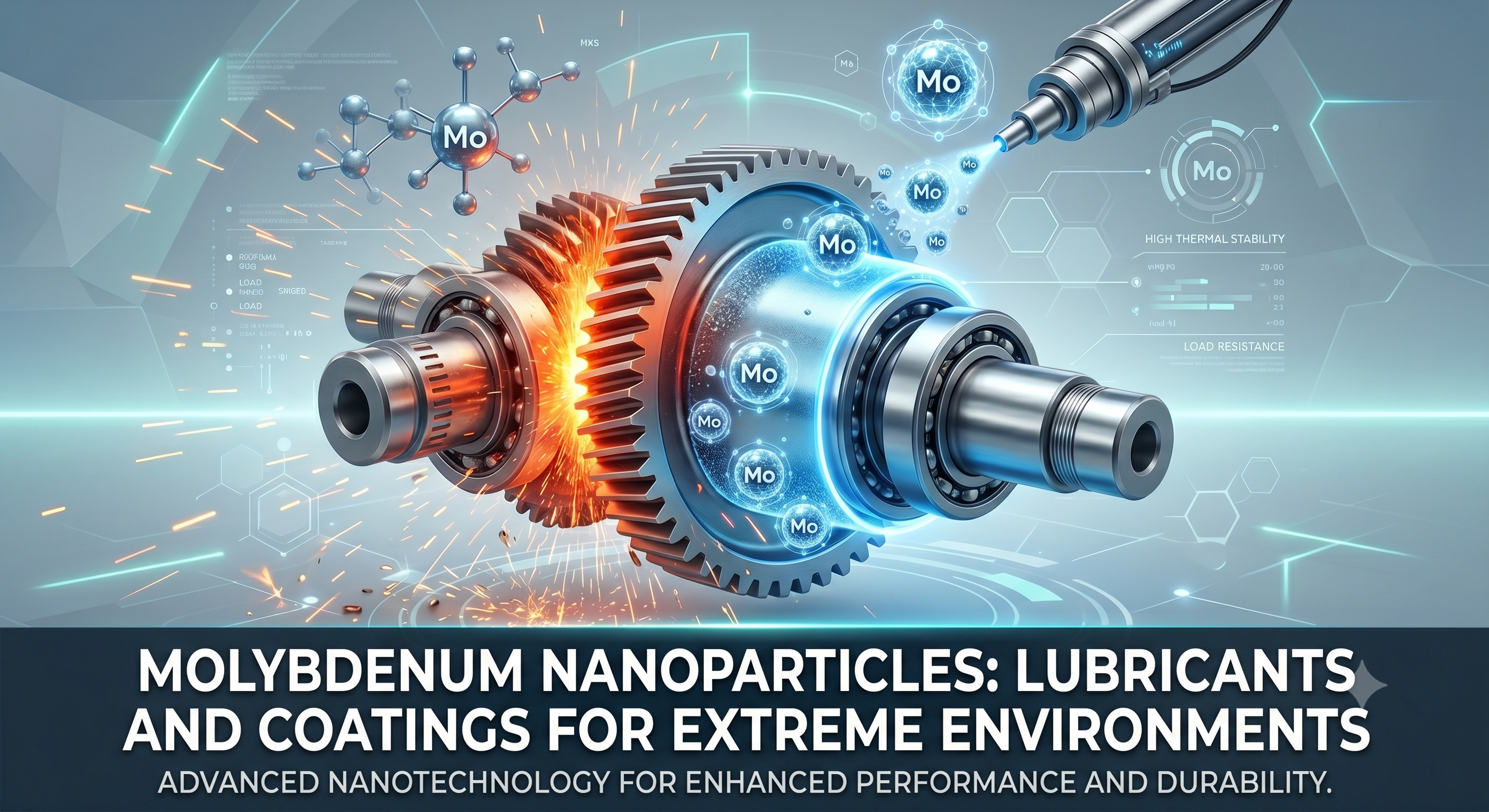
In the realm of advanced engineering, friction is the ultimate enemy. It is the invisible force that drains energy, generates catastrophic heat, and ultimately destroys the moving parts of our most vital machines. For everyday applications, conventional liquid oils and greases do a magnificent job of keeping this enemy at bay. However, as human ambition pushes technology into more extreme environments—from the icy vacuum of deep space to the blistering heat of industrial turbines—traditional liquid lubricants spectacularly fail. They boil off, freeze solid, or simply get crushed under immense pressure.
To solve this, materials scientists have turned to the microscopic world, unlocking the power of Molybdenum Nanoparticles, specifically in the form of Molybdenum Disulfide (MoS2). By engineering this remarkable compound down to the nanometer scale, researchers have created revolutionary solid lubricants and protective coatings that can survive where nothing else can.
This comprehensive guide explores the science behind molybdenum nanoparticles, the latest field research pushing them to their limits, and a realistic assessment of their immense advantages and inherent risks.
Beyond Traditional Oils: The Engineering Bottleneck
Before understanding the nano-solution, we must understand the macro-problem. Traditional lubrication relies on creating a thin liquid film between two moving metal surfaces. This prevents the microscopic rough edges of the metals (called asperities) from grinding against each other.
However, this liquid film is highly vulnerable to environmental extremes:
-
Extreme Heat: High temperatures cause liquid oils to oxidize, break down, or evaporate, leaving metal surfaces completely unprotected.
-
Deep Vacuums: In space or specialized manufacturing vacuum chambers, liquid oils instantly vaporize (outgassing), contaminating the surrounding environment and ruining the machinery.
-
Extreme Cold: Sub-zero temperatures cause conventional greases to thicken into a solid, glue-like paste, halting movement entirely.
-
Massive Pressure: Under extreme heavy loads, the liquid film is simply squeezed out from between the metal parts, leading to immediate metal-on-metal wear.
To overcome these bottlenecks, engineers require a “solid lubricant”—a material that is intrinsically slippery, structurally stable, and resistant to environmental shifts. Molybdenum has proven to be the perfect candidate.
The Science of the Slide: How Molybdenum Nanoparticles Work
Molybdenum disulfide (MoS2) is an inorganic compound that looks like a dark, silvery-black powder. Its magic lies in its unique molecular architecture, which consists of layers of molybdenum atoms sandwiched between layers of sulfur atoms.
The “Deck of Cards” Analogy: Imagine a freshly opened deck of playing cards sitting on a table. If you press down on the top of the deck and push horizontally, the cards easily slide across one another. This is exactly how MoS2 works. The chemical bonds holding the molybdenum and sulfur atoms together within a single layer are incredibly strong. However, the bonds between the different layers (known as Van der Waals forces) are extremely weak. When friction occurs, these microscopic layers easily shear and slide over one another, providing a perfectly lubricated surface without the need for liquids.
Why Go Nano? While macro-sized MoS2 powder has been used for decades as an industrial dry lubricant, it has limitations. Large particles can struggle to stay suspended in oils, eventually settling at the bottom. Furthermore, large particles cannot penetrate the microscopic scratches and valleys present on seemingly smooth metal surfaces.
By reducing the particle size to the nanoscale (1 to 100 nanometers), the material becomes infinitely more effective. Molybdenum nanoparticles are so small that they act like a “smart spackle.” They embed themselves directly into the microscopic imperfections of the metal, creating a flawlessly smooth, ultra-hard, and ultra-slippery protective layer known as a tribofilm.
Methods of Application: Additives vs. Solid Nano-Coatings
Molybdenum nanoparticles are typically deployed into extreme environments via two primary methods, depending on the specific engineering requirement:
-
Nano-Additives in Advanced Fluids: Nanoparticles are blended into specialized synthetic oils or coolants. Because they are so small, they remain perfectly suspended in the fluid (colloidal stability). When the fluid is squeezed out under extreme pressure, the molybdenum nanoparticles remain behind, physically bonding to the metal to provide a last line of defense against friction.
-
Thin-Film Physical Deposition (Solid Coatings): For environments where no liquids can be used (like satellites in orbit), pure molybdenum nanoparticles are bonded directly to the machine parts using techniques like Physical Vapor Deposition (PVD). This creates an ultra-thin, permanent coating that provides lifelong lubrication in a vacuum.
Pushing the Limits: Current Research and Field Studies
The transition of molybdenum nanoparticles from laboratory curiosities to industrial staples is currently supported by rigorous field studies and applied engineering research across several high-tech sectors.
1. Aerospace and Satellite Technology
Space is arguably the most hostile environment for moving parts. Research conducted by space agencies focuses on using nanostructured MoS2 coatings for satellite deployment mechanisms, reaction wheels, and rover joints. Recent extreme-vacuum field studies have demonstrated that nano-MoS2 coatings vastly outperform traditional solid lubricants like graphite. Graphite requires trace amounts of atmospheric moisture to remain slippery; in the dead vacuum of space, graphite acts like sandpaper. Molybdenum nanoparticles, however, rely strictly on their internal crystalline structure, maintaining near-zero friction in deep space.
2. Advanced Automotive Tribology (EVs and High-Efficiency Engines)
The automotive industry is in a relentless pursuit of energy efficiency. In Internal Combustion Engines (ICE), minimizing friction means lower fuel consumption and fewer emissions. Recent studies testing engine oils doped with molybdenum nanoparticles showed a dramatic reduction in engine wear during “cold starts” (when oil hasn’t circulated yet). Furthermore, the Electric Vehicle (EV) sector is driving new research. EV drivetrains operate at incredibly high rotational speeds (RPMs) compared to standard cars. Researchers are utilizing nano-molybdenum coatings on EV reduction gears to handle these immense rotational speeds without generating destructive heat, thereby extending the range and lifespan of the electric motors.
3. Deep Earth Drilling and Heavy Manufacturing
In geothermal and deep-oil drilling, equipment must survive environments that are simultaneously highly pressurized, incredibly hot, and extremely abrasive. Field tests using drilling muds infused with molybdenum nanoparticles have shown a significant increase in the lifespan of drill bits. The nanoparticles form a protective, heat-resistant tribofilm that prevents the cutting tools from welding to the rock formations under extreme pressure.
Advantage and Risk Assessment
While the integration of molybdenum nanoparticles offers revolutionary performance, the technology is not without its challenges. Engineers must carefully weigh the pros and cons before deploying these materials.
The Advantages
-
Extreme Load Capacity: Molybdenum nanoparticles possess a phenomenal load-bearing capacity. They can withstand pressures up to 300,000 psi, preventing metal parts from welding together under extreme stress.
-
Broad Temperature Range: Unlike liquid oils, solid MoS2 nano-coatings can operate efficiently in extreme cold (-200 degrees Celsius) and extreme heat (up to 350 degrees Celsius in standard atmospheres, and much higher in vacuums).
-
Vacuum Stability: They do not evaporate or outgas, making them the ultimate choice for aerospace, semiconductor manufacturing, and high-vacuum optical environments.
-
Self-Healing Properties: When used as an oil additive, the continuously circulating nanoparticles can automatically fill in and “heal” newly formed microscopic scratches on metal surfaces during operation.
The Risks and Limitations
-
Moisture Sensitivity (Oxidation): The Achilles’ heel of Molybdenum Disulfide is high humidity. In the presence of high moisture and oxygen, MoS2 can oxidize and transform into Molybdenum Trioxide (MoO3). Unfortunately, MoO3 is not a lubricant; it is highly abrasive and can accelerate machine wear. Therefore, MoS2 coatings are less ideal for highly humid or marine environments unless specially alloyed with other protective elements.
-
Dispersion and Agglomeration Challenges: Nanoparticles have a natural tendency to clump together (agglomerate) due to surface forces. If they clump up in a liquid oil, they form large, abrasive particles that can clog filters and damage engines. Achieving a stable, even dispersion requires expensive chemical surfactants and complex mixing processes.
-
Occupational Health and Nanotoxicity: The synthesis and application of nanoparticles carry occupational health risks. Airborne molybdenum nanoparticles are highly respirable. If inhaled by manufacturing workers, they can penetrate deep into lung tissue, potentially causing respiratory irritation or cellular toxicity. Strict, highly regulated ventilation and Personal Protective Equipment (PPE) are mandatory during the manufacturing and coating processes.
-
Prohibitive Cost: Synthesizing uniform nanoparticles and applying them via advanced vacuum deposition techniques is highly expensive. Currently, their use is largely restricted to mission-critical applications (aerospace, high-end automotive, military) where failure is not an option and budgets are accommodating.
The Next Frontier: Hybrid Materials and Smart Coatings
The future of extreme lubrication lies in nanocomposites. Materials scientists are currently blending molybdenum nanoparticles with other advanced materials to mitigate their weaknesses. For example, recent studies are testing hybrid coatings combining Molybdenum Disulfide with Graphene and Titanium.
Graphene provides unmatched structural strength and protects the molybdenum from moisture, completely neutralizing the humidity oxidation risk. Meanwhile, the molybdenum provides the “sliding” action. These hybrid “smart coatings” dynamically adapt to their environment, offering high-humidity protection while maintaining extreme-pressure lubricity, paving the way for universal, indestructible industrial coatings.
Conclusion
Molybdenum nanoparticles have fundamentally redefined the limits of mechanical engineering. By harnessing the unique sliding atomic structure of MoS2 and shrinking it to the nanoscale, we have created a material that thrives in the most punishing environments known to science.
While challenges like moisture sensitivity, agglomeration, and high manufacturing costs remain, the relentless pace of tribological research is rapidly overcoming these hurdles. From the joints of Mars rovers to the gears of the next generation of electric vehicles, molybdenum nanoparticles will continue to play a silent but crucial role in ensuring the future of advanced technology runs smoothly.