
Recently added item(s)
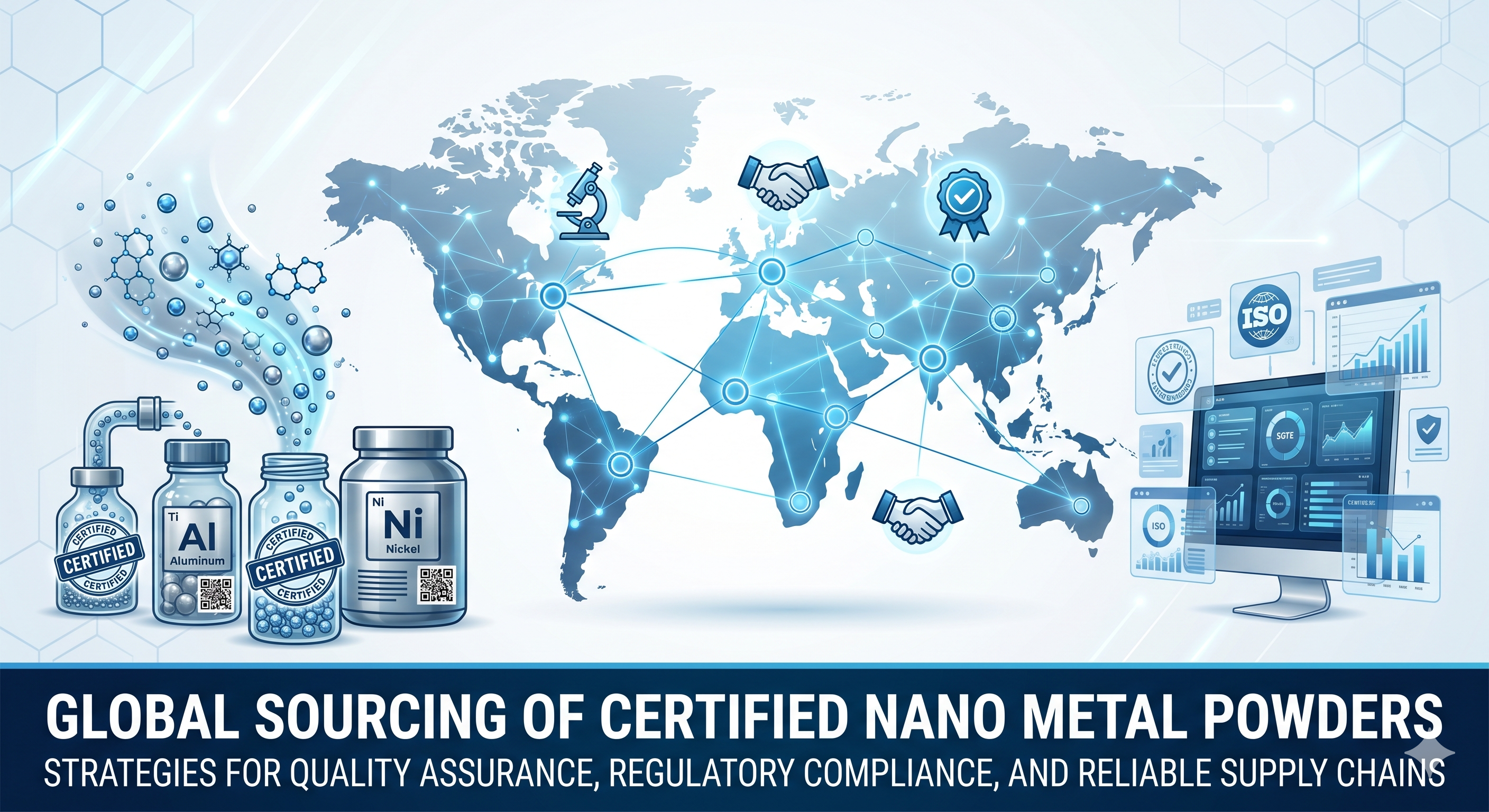
Nanotechnology is no longer a concept confined to the pages of sci-fi novels or elite university laboratories. Today, it drives a multi-billion-dollar global manufacturing supply chain. At the heart of this revolution are nano metal powders—engineered metallic particles measuring between 1 and 100 nanometers. From aerospace components and next-generation electronics to advanced biomedical implants and highly efficient chemical catalysts, these ultra-fine materials are rewriting the rules of industrial performance.
However, moving from macro-scale metallurgy to the nanoscale introduces extraordinary complexity, particularly in procurement. You cannot simply order nano copper or titanium the way you buy standard steel beams. The physical and chemical properties of metals alter drastically at the nanoscale, making quality control, regulatory compliance, and international transport a logistical minefield.
This comprehensive guide breaks down how to strategically and safely source certified nano metal powders globally, blending scientific insight with practical procurement strategies.
What Makes Nano Metal Powders Unique (And Difficult to Source)?
To understand why sourcing nano metal powders requires a specialized approach, we must look at the science of the nanoscale. When a metal is reduced to nanoparticles, its surface area expands exponentially relative to its volume. Imagine a single solid cube of aluminum; it has six faces exposed to the air. If you chop that same cube into billions of nanoscale pieces, the total exposed surface area becomes massive.
This high surface area triggers unique phenomena:
-
Extreme Reactivity: Metals that are stable in daily life can become highly reactive or even pyrophoric (spontaneously catching fire when exposed to air) at the nanoscale.
-
Altered Melting Points: Nanoparticles often melt at much lower temperatures than their bulk counterparts, affecting how they behave during thermal processing or 3D printing.
-
Quantum Confinement Effects: The electrical, optical, and magnetic properties of the metal change, allowing for unprecedented conductivity or catalytic efficiency.
Because a slight variation in particle size or surface chemistry can completely ruin an industrial process, procurement teams cannot rely on basic material descriptions. They require strict, internationally recognized certification.
The Critical Role of Certification and Global Standards
In the nano metal industry, certification is your shield against catastrophic material failure and legal liability. A “Certified Nano Metal Powder” means the material has undergone rigorous characterization by accredited laboratories using standardized testing protocols.
When sourcing globally, you must look for suppliers aligned with leading international standards organizations:
1. ISO/TC 229 (Nanotechnologies)
The International Organization for Standardization has specific technical committees dedicated to nanotechnology. Standards like ISO/TS 17200 specify how to characterize and declare the properties of engineered nanomaterials, ensuring that “99% purity” means the same thing in Tokyo as it does in Berlin.
2. ASTM International Committee E56
This committee develops standards for the evaluation of nanomaterials, focusing on physical characterization, chemical composition, and biological impacts.
3. Regional Regulatory Compliance
-
Europe: Materials must comply with REACH (Registration, Evaluation, Authorisation and Restriction of Chemicals) regulations, which feature strict mandates for nanomaterials.
-
United States: Suppliers should align with EPA (Environmental Protection Agency) regulations under the Toxic Substances Control Act (TSCA).
A legitimate global supplier will readily provide a comprehensive Certificate of Analysis (CoA) detailed with these standards, rather than a generic material safety data sheet.
Scientific Insights: Toxicological Research and Workplace Safety
In traditional industrial manufacturing, clinical or toxicological studies might seem distant from procurement. In nanotechnology, however, they directly dictate how materials must be packaged, shipped, and handled.
Current international occupational health research focuses heavily on the bio-persistence and toxicity of inhaled nanoparticles. Because nano metal powders are so small, they can bypass the human respiratory system’s natural defense mechanisms and enter the bloodstream or lung tissue.
Recent laboratory and field studies conducted by organizations like NIOSH (National Institute for Occupational Safety and Health) have led to the establishment of strict Recommended Exposure Limits (RELs) for metals like silver, titanium dioxide, and carbon-coated metal nanoparticles.
What this means for sourcing:
When sourcing globally, you must ensure your supplier utilizes certified, vacuum-sealed, antistatic packaging that prevents environmental leakage during cross-border transit. If a supplier ships nano-aluminum or nano-nickel in flimsy, standard plastic containers, it indicates a lack of regulatory compliance and poses a severe safety hazard to your customs brokers and receiving dock personnel.
Advantage and Risk Assessment of Global Nano Procurement
Expanding your supply chain globally opens up incredible opportunities, but it balances against highly technical risks. Let’s evaluate the trade-offs.
The Advantages
-
Access to Advanced Syntheses: Different regions excel at different manufacturing methods. Sourcing globally allows you to choose between Bottom-Up approaches (like chemical vapor deposition or laser pyrolysis, which yield incredibly uniform, ultra-high-purity spheres) and Top-Down approaches (like high-energy ball milling, which is highly cost-effective for larger volumes).
-
Cost Optimization: Mass production hubs in the Asia-Pacific region can offer competitive scaling options for mature nanomaterials like nano-silica, nano-copper, or nano-zinc oxide.
-
Resilience Through Diversification: Relying on a single local supplier for an essential nanomaterial creates a single point of failure. A global network protects your production line from local economic or political disruptions.
The Risks and Challenges
-
The Agglomeration Trap: Because nanoparticles possess high surface energy, they naturally want to stick together to form larger clumps (agglomerates). If a material agglomerates during a long ocean voyage due to temperature fluctuations, it arrives as a useless macro-powder.
-
Oxidation and Contamination: A minor seal failure during transit can expose sensitive metal powders (like iron or copper) to oxygen, degrading them into oxides before they reach your factory.
-
Counterfeit and Substandard Certificates: The global market contains bad actors who pass off standard micro-powders as premium nano-powders, or fake their laboratory testing documentation.
The Technical Verification Checklist: How to Audit a Global Supplier
To mitigate these risks, procurement teams must work hand-in-hand with materials scientists to audit prospective global suppliers. When requesting samples and documentation, verify that the supplier utilizes the following scientific characterization techniques:
| Testing Method | What It Measures | Why It Matters for Sourcing |
| TEM & SEM (Electron Microscopy) | Particle shape, morphology, and actual physical size. | Proves the particles are truly nanoscale and spherical, not jagged micro-debris. |
| XRD (X-ray Diffraction) | Crystal structure and phase purity. | Ensures the metal hasn’t oxidized or degraded into an unwanted chemical phase. |
| BET Analysis | Specific Surface Area (SSA). | Confirms the true reactive potential and physical dimensions of the powder. |
| DLS (Dynamic Light Scattering) | Particle Size Distribution (PSD). | Guarantees uniformity; you don’t want a batch where half the particles are 10nm and the other half are 500nm. |
Future Horizons: Blockchain and Sustainable Nanomanufacturing
The global nano metal powder supply chain is rapidly evolving. Two major trends are reshaping how these materials are sourced:
-
Blockchain for Material Traceability: Leading aerospace and defense contractors are starting to require suppliers to log every step of the nano metal synthesis process onto a secure blockchain. This provides an unalterable digital twin of the material, tracking its journey from the raw mining stage to the final certified vacuum package.
-
Green and Bio-Synthesized Nanoparticles: Traditional chemical synthesis often requires toxic solvents. Current materials research is pivoting toward “green chemistry,” using plant extracts or eco-friendly chemical reduction to create nano metal powders. Sourcing green-certified nano metals can significantly reduce your company’s scope 3 carbon emissions and environmental footprint.
Conclusion
Sourcing certified nano metal powders globally is an intricate balance of advanced materials science, international law, and strategic logistics. You are not just buying a commodity; you are purchasing highly engineered chemical structures that demand precise environmental control and bulletproof documentation.
By insisting on international standards like ISO/TC 229, demanding rigorous electron microscopy and diffraction data, and thoroughly vetting the packaging and handling protocols of your international partners, your organization can safely harness the incredible power of nanotechnology. The global supply chain is ready to deliver the building blocks of tomorrow—provided you know exactly what to look for.