
Recently added item(s)
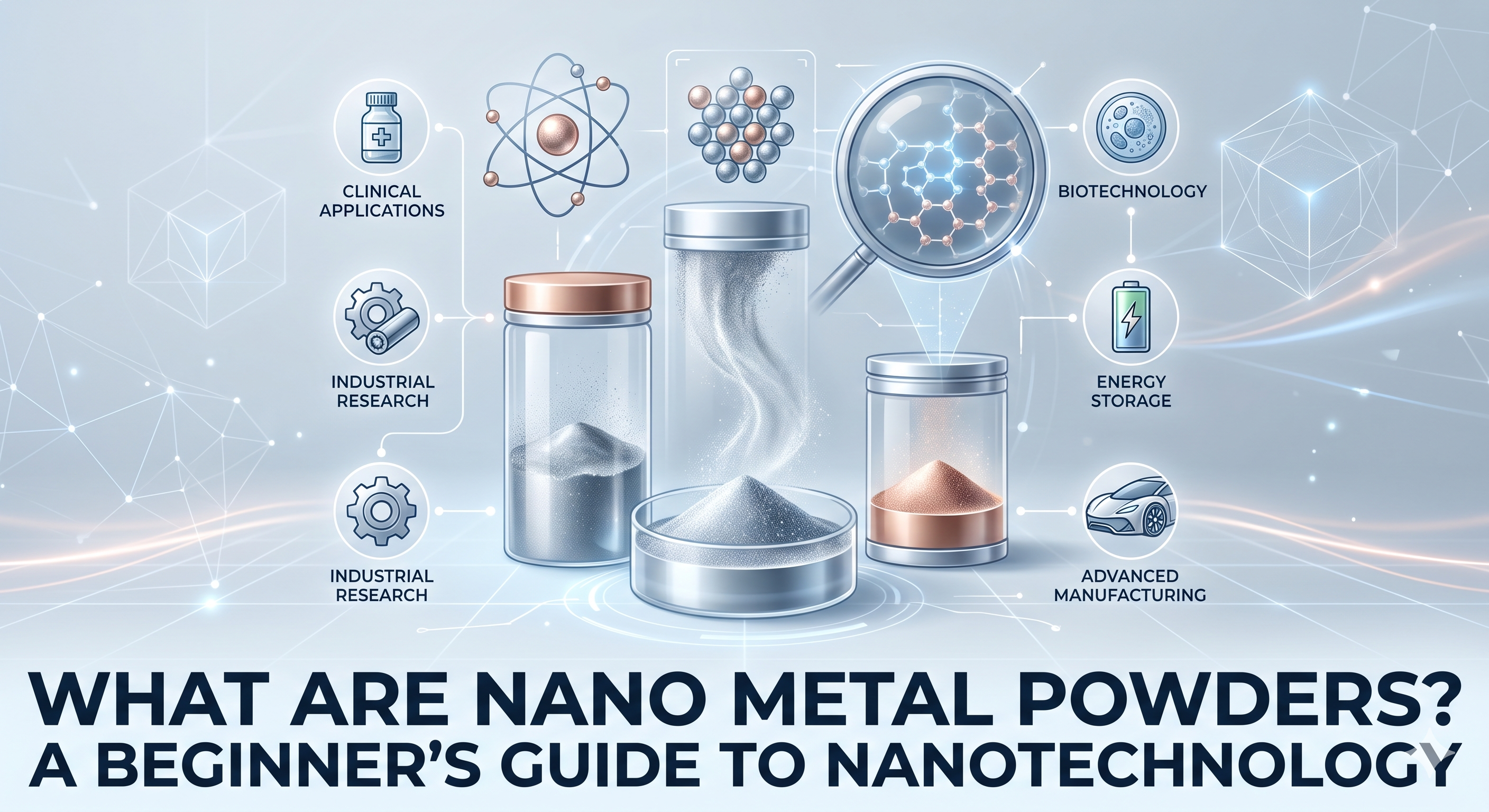
Welcome to the invisible revolution. When we think of metals, we typically picture solid, heavy, and immutable objects—steel girders holding up skyscrapers, copper wires routing electricity, or aluminum panels on automobiles. However, when you take these exact same metals and shrink them down to the nanoscale, the traditional rules of physics and chemistry begin to blur. At this microscopic level, metals cease to be just structural materials and transform into highly reactive, deeply versatile, and incredibly powerful tools.
Nano metal powders are at the cutting edge of modern science, bridging the gap between raw industrial chemistry and futuristic applications ranging from advanced healthcare to next-generation energy storage. If you are new to the world of nanotechnology, this comprehensive guide will walk you through what nano metal powders are, how they are synthesized, their groundbreaking real-world applications, and the delicate balance between their advantages and potential risks.
Understanding the Scale: What Exactly is a “Nano” Powder?
To comprehend nano metal powders, we first need to understand the scale we are dealing with. A nanometer is one-billionth of a meter. To put that into perspective, a single strand of human hair is approximately 80,000 to 100,000 nanometers thick. A strand of DNA is about 2.5 nanometers in diameter.
Nano metal powders are strictly defined as metallic particles that have at least one dimension measuring less than 100 nanometers. While bulk metals are measured in kilograms and meters, nano powders are engineered at the atomic and molecular levels. Because they are so unfathomably small, they do not behave like the bulk materials we interact with daily.
The Science Behind the Magic: Surface Area and Quantum Confinement
Why does shrinking a metal change its properties? The answer lies primarily in two phenomena: the surface area-to-volume ratio and quantum mechanics.
When a solid block of metal is broken down into nanoscale particles, its overall volume remains the same, but its exposed surface area increases exponentially. Because chemical reactions occur on the surface of a material, this massive increase in surface area means that nano metal powders are astonishingly reactive. A catalyst that might take hours to trigger a reaction in its bulk form can accomplish the same task in seconds as a nano powder.
Furthermore, at the nanoscale, the laws of classical physics give way to quantum mechanics. Electrons are confined to much smaller spaces, a phenomenon known as “quantum confinement.” This changes the optical, magnetic, and electrical properties of the metal. For example, while bulk gold is famously yellow and shiny, nano gold particles can appear bright red or purple depending on their exact size, and they become highly reactive rather than chemically inert.
How Are Nano Metal Powders Synthesized?
Creating particles this small requires extreme precision. The production of nano metal powders generally falls into two distinct categories: Top-Down and Bottom-Up approaches.
-
The Top-Down Approach: This is a macroscopic method where bulk metals are broken down into nanoparticles. A prime example used heavily in industrial manufacturing is high-energy ball milling. In this process, bulk metal powders (perhaps starting around 44 microns) are placed in a rotating chamber with heavy grinding balls. The sheer kinetic energy fractures the metal down to the nanoscale over time. Other top-down methods include thermal oxidation and laser ablation.
-
The Bottom-Up Approach: This method builds nanoparticles atom by atom or molecule by molecule. It often involves chemical vapor deposition or wet chemical reduction, where metal ions in a solution are reduced to form uncharged metal atoms, which then clump together to form precise nanoscale clusters.
Current Research and Real-World Applications
The theoretical excitement surrounding nanotechnology has firmly transitioned into practical, world-changing applications. Today, nano metal powders are driving innovations across multiple high-tech sectors.
1. Medicine, Healthcare, and Clinical Studies
Perhaps the most exciting frontier for nano metal powders is biotechnology and medicine.
-
Targeted Drug Delivery: Iron oxide nanoparticles are currently being utilized in clinical trials for targeted drug delivery. Because they are magnetic, doctors can attach chemotherapy drugs to these nano powders, inject them into a patient, and use external magnetic fields to pull the medicine directly into a tumor, drastically reducing damage to healthy surrounding tissue.
-
Antimicrobial Applications: Silver nano powders have profound antimicrobial properties. They are increasingly being integrated into surgical tools, advanced wound dressings, and even burn treatments to prevent severe infections.
-
Bone Regeneration: Researchers are exploring the integration of metal nanoparticles into bioactive glass (biyocam) structures to promote faster bone healing and prevent post-surgical infections in orthopedic implants.
2. Advanced Manufacturing and Sintering
In industrial chemistry and metallurgy, nano powders are revolutionizing how we build complex parts. Standard metal powders require extremely high temperatures to melt and fuse (a process called sintering). However, because nano metal powders have such a high surface energy, their melting point is significantly lower. This allows manufacturers to sinter advanced alloys, boron carbide powders, and complex metal parts at lower temperatures, saving massive amounts of energy and allowing metals to be bonded with temperature-sensitive materials like plastics.
3. Electronics and Inkjet Coding
As electronic devices get smaller, the demand for microscopic conductive materials skyrockets. Copper and silver nano metal powders are suspended in liquid to create highly conductive nano-inks. These inks are crucial for the inkjet coding industry and printed electronics. Using these nano-inks, manufacturers can literally “print” RFID tags, flexible circuit boards, and conductive pathways directly onto films, paper, or 3D objects, powering the next generation of wearable technology.
4. Automotive and Energy Storage
The electric vehicle (EV) industry is intensely researching nano metal powders to solve the bottleneck of battery life and charging speeds. By incorporating nanoscale metals and metal oxides into the anodes and cathodes of advanced batteries (such as optimizing NMC or LFP battery chemistries), engineers can dramatically increase the surface area available for lithium ions to attach to. This results in batteries that charge exponentially faster and hold a significantly higher energy density, pushing the real-world range of electric SUVs and vans further than ever before.
Advantage and Risk Assessment
Like all disruptive technologies, the widespread adoption of nano metal powders requires a careful balancing act between their incredible benefits and their inherent challenges.
The Advantages
-
Unmatched Efficiency: Because of their high reactivity, nano metal powders require far less raw material to achieve the same catalytic or structural results as bulk metals, driving down resource consumption in the long run.
-
Superior Mechanical Properties: Adding just a fraction of a percent of nano metal powders (like carbides or advanced metal oxides) to a standard alloy can exponentially increase its tensile strength, scratch resistance, and durability without adding significant weight.
-
Tailored Conductivity: Their ability to be suspended in solutions makes them the ultimate material for creating flexible, lightweight electronics and advanced inkjet printing systems.
-
Medical Breakthroughs: The ability to interact with human biology at the cellular level provides unprecedented opportunities for diagnostics, MRI contrast enhancement, and cancer therapeutics.
The Risks and Challenges
-
Nanotoxicology and Health Risks: The very thing that makes nano powders useful—their microscopic size—also makes them potentially hazardous. If inhaled during the manufacturing process, particles smaller than 100 nanometers can easily bypass the respiratory system’s natural defenses, enter the bloodstream, and accumulate in organs.
-
Combustion and Handling Hazards: Many nano metal powders are highly pyrophoric, meaning they can spontaneously ignite when exposed to oxygen in the air due to their immense surface reactivity. They require strictly controlled, inert environments (like argon gas chambers) for safe handling, synthesis, and ball milling.
-
Agglomeration: In industrial applications, nano powders naturally want to clump together (agglomerate) to reduce their surface energy. Keeping them evenly dispersed during processes like sintering or ink formulation is a constant, highly technical challenge.
-
Environmental Impact: As products containing nano metals degrade, these microscopic particles can leach into soil and water systems. The long-term environmental impact of nano-pollution on ecosystems and marine life is still the subject of heavy, ongoing clinical and environmental research.
The Future of Nano Metal Powders
The primary hurdle the industry faces today is the transition from laboratory-scale synthesis to mass, autonomous commercial production. Innovators in the chemical sector are increasingly looking toward AI-driven automation—using complex algorithms to perfectly control milling times, chemical recipes, and thermal oxidation environments—to produce flawless nano metal powders at scale.
As we refine “green synthesis” methods that reduce the toxic byproducts of nanomaterial production, and as we implement stricter safety protocols for handling, nano metal powders will undoubtedly become the backbone of 21st-century manufacturing. From the electric vehicles we drive to the life-saving treatments we receive in hospitals, the future is incredibly bright, and it is invisibly small.