
Recently added item(s)
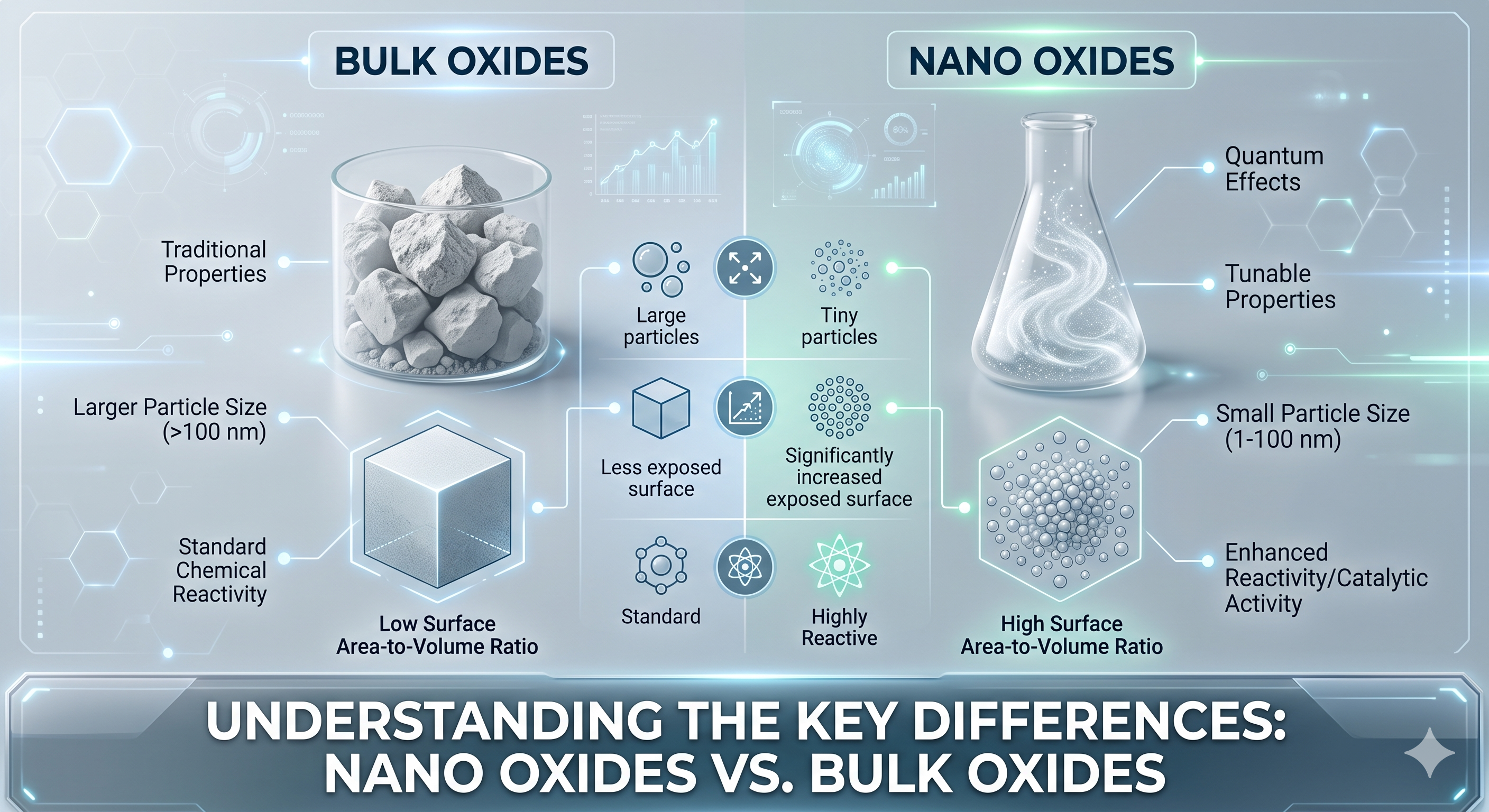
Metal oxides are the unsung heroes of both the natural world and industrial manufacturing. From the rust forming on a piece of exposed iron to the advanced ceramics shielding spacecraft from the intense heat of atmospheric reentry, oxides are everywhere. Traditionally, industries have relied on these materials in their “bulk” form—macroscopic powders, solid blocks, and thick coatings. However, modern materials science has unlocked a new frontier by taking these exact same chemical compounds and shrinking them down to the nanoscale.
When we transition from bulk oxides to nano oxides, we are not merely changing the size of the material; we are fundamentally altering its physics, chemistry, and capabilities. This guide will explore the profound differences between nano and bulk oxides, how they are synthesized, their groundbreaking clinical applications, and a candid assessment of the advantages and risks associated with this invisible revolution.
The Physics of Shrinking: What Defines a Nano Oxide?
To understand the difference, we must first define the scale. A bulk oxide is any metal oxide material where the constituent particles are larger than one micrometer (1000 nanometers). In contrast, a nano oxide is defined as having at least one spatial dimension measuring less than 100 nanometers.
Why does this specific size threshold matter? When a material is reduced to the nanoscale, two critical physical phenomena take over:
-
Exponential Increase in Surface Area: Imagine a solid cube of a metal oxide. It has six distinct sides where chemical reactions can occur. If you slice that cube into millions of nanometer-sized cubes, the overall volume of the material remains exactly the same, but the exposed surface area increases exponentially. Because chemical reactions happen on the surface, nano oxides are vastly more reactive than their bulk counterparts.
-
Quantum Confinement: At the macroscopic level, the behavior of electrons within a bulk oxide is governed by classical physics. But when you shrink the particle down below 100 nanometers, electrons become physically confined in tight spaces. This quantum confinement alters how the material interacts with light, electricity, and magnetic fields.
A classic example is zinc oxide. In its bulk powder form, zinc oxide is a thick, opaque white paste (historically used as a heavy white sunscreen). However, when engineered as a nano oxide, the particles are so small that visible light passes right through them, making the material completely transparent to the human eye, while still absorbing harmful UV radiation perfectly.
From Bulk to Nano: The Challenge of Synthesis
Transforming a bulk oxide into a nano oxide is a marvel of modern engineering. The methods used to synthesize these materials generally fall into “top-down” or “bottom-up” approaches, each requiring immense precision.
Top-Down Manufacturing This approach involves taking larger materials and physically breaking them down. In industrial settings, a common method is high-energy ball milling. For example, a manufacturer might start with a standard 44-micron metal oxide powder. By placing this powder into a high-energy milling chamber with heavy grinding media, the immense kinetic energy repeatedly fractures the particles. Over extended periods, what began as a 44-micron powder is ground down into the nanometer range. While effective, this process requires careful control to prevent contamination from the milling media itself.
Bottom-Up Manufacturing Conversely, the bottom-up approach builds nano oxides atom by atom. Techniques like thermal oxidation involve exposing raw metal vapors to oxygen at highly controlled temperatures to grow ultra-pure oxide layers or nanoparticles. Bottom-up methods are particularly useful when manufacturing complex, multi-metal oxides—such as cobalt aluminate—where the exact ratio of the constituent elements must be perfectly balanced to achieve specific catalytic or optical properties.
Key Differences in Action: How Nano Oxides Outperform Bulk
The transition from bulk to nano unlocks capabilities that engineers and scientists could only dream of a few decades ago. Here is how nano oxides differ from bulk oxides in practical, industrial applications:
1. Thermal Properties and Sintering
In manufacturing advanced ceramics or metallurgical parts, powders must be heated until they fuse together, a process known as sintering. Bulk oxides typically require incredibly high temperatures to sinter because they have low surface energy. Nano oxides, however, possess massive surface energy. Because the nanoparticles “want” to bond together to reduce this energy, nano oxides can be sintered at significantly lower temperatures than bulk oxides. This not only saves massive amounts of energy during industrial production but also allows manufacturers to combine high-strength oxides with temperature-sensitive materials that would otherwise melt or degrade.
2. Mechanical Strength and Dispersion
When added to composites, alloys, or polymers, bulk oxides often create points of structural weakness because they are relatively large and can clump unevenly. Nano oxides, due to their minuscule size, can disperse flawlessly at the molecular level. Adding just a tiny fraction of a nano oxide into a material matrix can exponentially increase its tensile strength, scratch resistance, and overall durability without adding the heavy weight associated with bulk additives.
3. Catalytic Efficiency
In the chemical industry, oxides are frequently used as catalysts to speed up reactions. Because catalysis occurs entirely on the surface of the material, using bulk oxides is highly inefficient—most of the material is “trapped” inside the particle and never touches the chemicals it needs to react with. Nano oxides provide a near-perfect solution, offering maximum surface area with minimum material volume, leading to faster, cleaner, and more efficient chemical processing.
Current Research and Clinical Studies in Nanomedicine
While the industrial applications of nano oxides are vast, perhaps the most exciting current research lies in biotechnology and medicine. The ability to engineer oxides at the same scale as human cells and DNA has opened up revolutionary clinical pathways.
Bioactive Glass (Biyocam) and Tissue Engineering
Bioactive glass is a highly specialized network of silicon, calcium, and sodium oxides used in orthopedics to repair bone defects. In its bulk form, bioactive glass is highly effective; when implanted, it reacts with bodily fluids to form a layer of hydroxyapatite (the main mineral component of bone), bonding the implant to living tissue.
However, recent clinical studies have shown that transitioning to nano bioactive glass dramatically accelerates this process. Because nano-scale bioactive glass has a vastly higher surface area, it dissolves and releases beneficial ions (like calcium and silica) at a highly controlled, accelerated rate. These ions act as biological signals, actively stimulating stem cells to differentiate into bone-forming cells (osteoblasts). Clinical research indicates that nano bioactive glass not only heals bone fractures significantly faster than bulk glass but also exhibits inherent antibacterial properties, drastically reducing the risk of post-surgical infections.
Targeted Cancer Therapeutics
Another major area of clinical research involves iron oxide nanoparticles (often referred to as SPIONs – Superparamagnetic Iron Oxide Nanoparticles). Unlike bulk iron oxide (which is just rust), nano iron oxide exhibits superparamagnetism. In clinical trials, researchers are attaching chemotherapy drugs to these nano oxides. Once injected into the patient’s bloodstream, doctors use external, highly targeted magnetic fields to physically pull the nano oxides directly into the site of a tumor. This ensures that the toxic chemotherapy drugs are concentrated almost entirely within the cancer cells, sparing the healthy tissue and vastly reducing side effects.
Advantage vs. Risk Assessment
As with any highly advanced technology, the widespread adoption of nano oxides requires a rigorous and candid assessment of their benefits versus their potential dangers.
The Advantages
-
Unmatched Efficiency: Nano oxides achieve vastly superior results in catalysis, conductivity, and structural reinforcement while using a fraction of the raw material required by bulk oxides.
-
Energy Savings: The ability to lower sintering temperatures and speed up chemical reactions translates directly into lower energy consumption and reduced carbon footprints for heavy industries.
-
Medical Breakthroughs: From faster-healing orthopedic implants utilizing nano bioactive glass to hyper-targeted cancer treatments, nano oxides are pushing the boundaries of human health and longevity.
The Risks and Challenges
-
Nanotoxicology: The most significant risk associated with nano oxides is human health during the manufacturing process. Because they are smaller than 100 nanometers, these particles can easily evade the body’s natural respiratory defenses. If inhaled, they can penetrate deep into the lungs, cross the blood-brain barrier, and accumulate in vital organs. Strict, highly advanced personal protective equipment and enclosed automated manufacturing environments are absolute necessities.
-
Agglomeration: In industrial settings, the high surface energy of nano oxides makes them incredibly difficult to handle. They naturally want to clump together (agglomerate) back into bulk-like structures. Keeping them evenly dispersed during manufacturing, whether in a high-energy ball mill or a liquid suspension, is a constant and expensive engineering challenge.
-
Environmental Impact: While bulk metal oxides generally sit inertly in the environment, nano oxides are highly reactive. Current environmental research is heavily focused on what happens when products containing nano oxides degrade and release these microscopic particles into soil and water systems. Their potential to disrupt marine ecosystems and bioaccumulate in the food chain remains a critical area of ongoing scientific scrutiny.
Conclusion: The Future is Invisible
The shift from bulk oxides to nano oxides represents one of the most important paradigm shifts in modern materials science. We are no longer simply using materials as nature provided them; we are actively engineering them at the atomic level to extract maximum performance, efficiency, and clinical benefit.
As we continue to perfect synthesis methods—moving away from energy-intensive top-down milling toward highly precise, automated bottom-up chemical processing—the applications for nano oxides will only expand. Navigating the future of this technology will require a delicate balance: aggressively pursuing the medical and industrial breakthroughs these materials offer, while maintaining a profound respect for their potent reactivity and the strict safety protocols they demand. The future of the chemical and materials industry is undeniably powerful, and it is invisibly small.