
Recently added item(s)
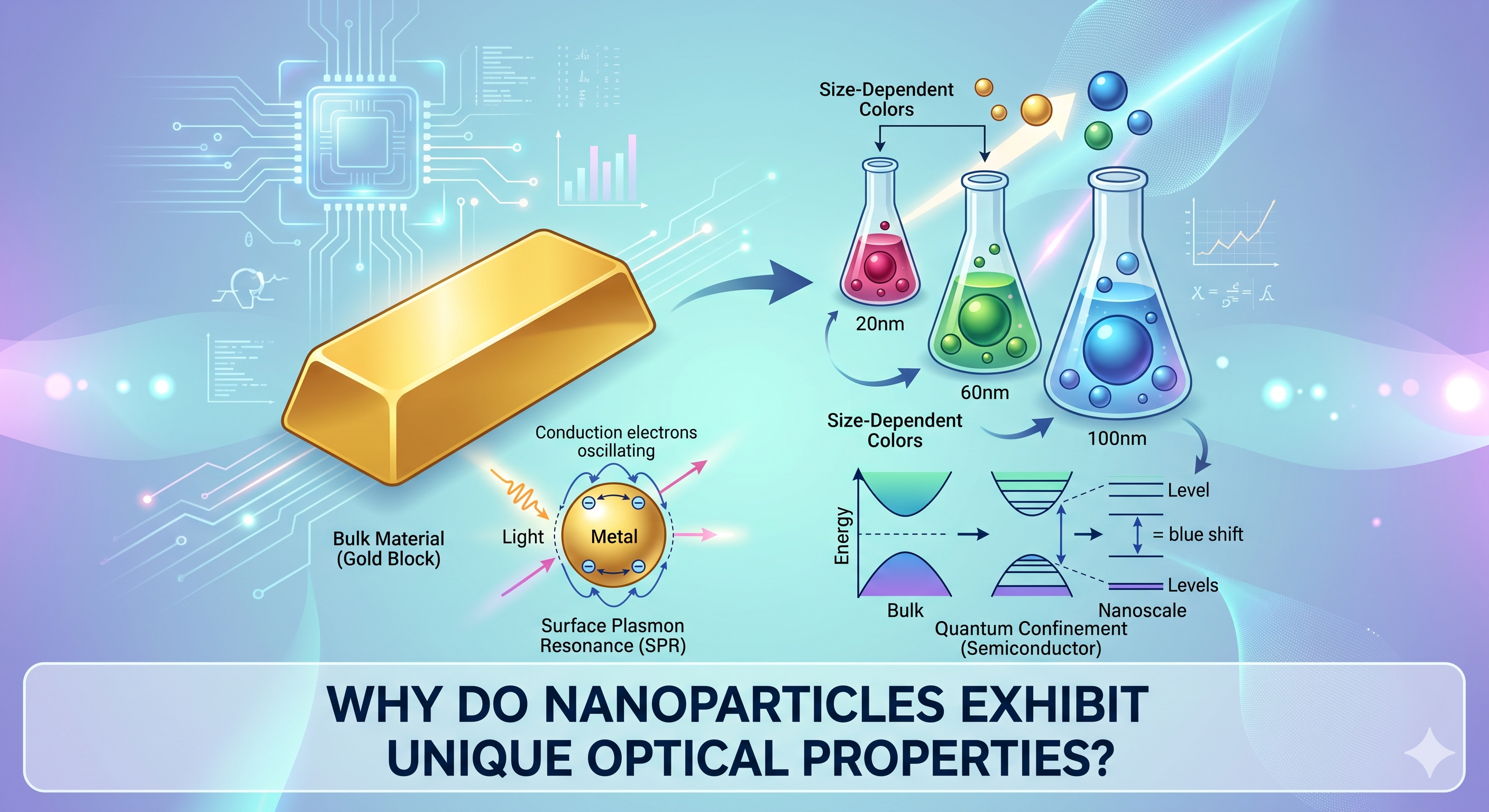
If you were to take a solid bar of pure gold and break it down into smaller and smaller pieces, you would expect the tiny fragments to still look like gold. A microscopic speck of gold should, intuitively, still possess that familiar shiny, yellowish hue. However, the universe plays a fascinating trick on us when we enter the realm of the extremely small. If you shrink that gold down to the nanoscale—to particles just a few billionths of a meter across—it suddenly stops being yellow. Instead, a solution of gold nanoparticles might appear vibrant ruby red, deep purple, or even blue.
This mind-bending phenomenon is not magic; it is the science of nanoscale optics. Nanoparticles exhibit entirely unique optical properties that do not exist in their larger, bulk counterparts. This radical shift in how matter interacts with light is currently driving some of the most exciting advancements in modern science, from ultra-high-definition televisions to groundbreaking cancer treatments.
In this comprehensive exploration, we will decode the scientific mechanisms that give nanoparticles their incredible optical properties, explore current research and clinical applications, and weigh the profound advantages against the inherent risks of this microscopic frontier.
The Physics of Tiny Lights: Why Size Dictates Color
To understand why a material’s color changes when it shrinks, we have to look at how light interacts with electrons. In bulk materials, the sheer number of atoms and electrons creates a continuous “sea” of energy levels. Light hits the material, and the material either reflects, absorbs, or transmits that light based on its uniform, bulk physical structure.
But when a material is reduced to the nanoscale (typically between 1 and 100 nanometers), it becomes comparable in size to the wavelength of light itself, or even smaller. At this scale, the traditional laws of physics begin to blur, giving way to quantum mechanics and specialized electromagnetic effects. Two primary phenomena explain the unique optical behavior of nanoparticles: Surface Plasmon Resonance and Quantum Confinement.
Surface Plasmon Resonance (SPR)
This effect is primarily seen in noble metal nanoparticles, such as gold and silver. Metals have a cloud of “free” electrons that can move relatively easily. When a wave of light strikes a metal nanoparticle, the electric field of the light pushes and pulls on this cloud of electrons.
Because the nanoparticle is so tiny, the entire electron cloud is forced to move back and forth in perfect synchronization with the light wave. Imagine a bowl of water: if you shake it at just the right rhythm, the water sloshes uniformly back and forth. This synchronized sloshing of electrons is called Surface Plasmon Resonance. Depending on the exact size and shape of the nanoparticle (e.g., a sphere versus a tiny rod), the electrons will resonate at different frequencies, absorbing specific colors of light and scattering others. A 10-nanometer gold sphere might absorb blue-green light, leaving our eyes to perceive a brilliant red.
Quantum Confinement
While SPR governs metals, Quantum Confinement is the rule for semiconductor nanoparticles, famously known as “Quantum Dots.” In a semiconductor, electrons need a specific amount of energy to jump from their resting state to an active state where they can conduct electricity or emit light.
When you shrink a semiconductor to a few nanometers, you are literally trapping its electrons in a space smaller than they naturally want to occupy. You are putting them in a tiny quantum box. The smaller the box, the more squeezed the electrons are, and the higher their energy becomes.
When these tiny dots are hit by a light source (like UV light), the electrons jump to a high energy state and then fall back down, releasing the excess energy as visible light. A very small quantum dot (a tight box) has highly energetic electrons that emit short wavelengths, creating blue light. A slightly larger quantum dot (a roomier box) emits lower energy, longer wavelengths, creating red light. By simply adding or removing a few atoms to change the particle’s size, scientists can tune the emitted color with absolute, pinpoint precision.
Current Research and Technological Innovations
The ability to manipulate light at the atomic level has triggered a massive wave of technological innovation across multiple industries. Researchers are no longer just observing these effects; they are engineering them to solve modern challenges.
Next-Generation Displays and Photonics
If you have recently shopped for a premium television, you have likely seen the term “QLED.” This stands for Quantum Dot Light Emitting Diode. Tech companies are utilizing the quantum confinement effect to create displays with unprecedented color accuracy and brightness. By using perfectly sized quantum dots that emit pure red, green, and blue light, these screens waste far less energy and provide a vastly wider color gamut than traditional LCDs. Current research is pushing this further into flexible, printable, and transparent electronics.
Advanced Solar Harvesting
The global push for renewable energy is heavily reliant on improving the efficiency of solar panels. Traditional silicon panels can only absorb a specific portion of the sunlight hitting them; the rest is lost as heat. Researchers are now integrating specialized nanoparticles, such as perovskite nanocrystals, into solar cells. Because the optical properties of these nanoparticles can be tuned to absorb the exact wavelengths of light that silicon misses, layered “tandem” solar cells are currently shattering previous efficiency records, capturing a much broader spectrum of solar energy.
Metamaterials and Optical Cloaking
In highly experimental physics labs, researchers are organizing metal nanoparticles into complex arrays called metamaterials. These structures are engineered to bend light in unnatural ways, including creating a negative index of refraction. The ultimate, heavily researched goal of these materials is the creation of literal “invisibility cloaks”—materials that guide light waves smoothly around an object as if the object were not there at all, rendering it invisible to certain wavelengths of light.
Clinical Studies and Biomedical Applications
Perhaps the most impactful arena for nanoparticles is medicine. Because nanoparticles are similar in size to biological molecules, proteins, and DNA, they can interact natively with the human body, acting as microscopic scouts and weapons.
Photothermal Therapy in Oncology
One of the most groundbreaking clinical applications of optical nanoparticles is targeted cancer treatment. In specific clinical trials, researchers are utilizing gold nanoshells (tiny silica beads coated in a thin layer of gold). By tweaking the thickness of the gold, scientists tune the nanoshells to absorb near-infrared light.
Near-infrared light is unique because human tissue is highly transparent to it; it passes through skin and muscle harmlessly. In photothermal therapy, these nanoshells are injected into the bloodstream and are engineered to gather inside tumors. A doctor then shines a near-infrared laser through the patient’s skin, directly at the tumor. The healthy tissue ignores the light, but the gold nanoshells absorb it massively, violently converting the light into heat. This localized heat literally cooks the tumor from the inside out, destroying cancer cells while leaving surrounding healthy tissue unharmed.
Ultra-Sensitive Bio-Imaging and Diagnostics
The brilliant, tunable light emitted by quantum dots makes them exceptional tools for cellular imaging. Historically, organic dyes were used to highlight cells under a microscope, but these dyes fade quickly when exposed to light (a process called photobleaching). Quantum dots, however, shine intensely and continuously without fading.
Clinical researchers attach quantum dots to specific antibodies that hunt for disease markers. When injected, these glowing beacons latch onto their targets, allowing surgeons and diagnosticians to physically see the exact boundaries of a tumor or track the progression of a viral infection in real-time with stunning clarity. Furthermore, the simplest application of nanoparticle optics is already in our homes: the colored lines that appear on rapid diagnostic tests (like COVID-19 tests or pregnancy tests) are actually dense clusters of gold nanoparticles congregating to form a visible red or pink line.
Advantage-Risk Assessment: The Double-Edged Sword
While the optical manipulation of nanoparticles promises a technological and medical utopia, it is critical to evaluate the very real challenges and risks associated with their deployment.
The Advantages
-
Unprecedented Precision: The ability to tune materials to absorb or emit exact wavelengths of light offers unparalleled efficiency in displays, lighting, and solar energy capture.
-
Non-Invasive Medicine: Optically active nanoparticles enable treatments like photothermal therapy, which can eradicate localized tumors without the systemic devastation of traditional chemotherapy or highly invasive surgeries.
-
High Sensitivity Detection: In diagnostics, nanoparticles can detect minute amounts of viral RNA or cancer biomarkers far earlier than traditional methods, drastically improving patient survival rates through early intervention.
-
Energy Efficiency: By optimizing how devices interact with light—whether emitting it in a TV or absorbing it in a solar panel—nanomaterials significantly reduce the global energy burden.
The Risks and Challenges
-
Toxicity and Biocompatibility: This is the most significant hurdle, particularly for quantum dots. Many high-performing quantum dots are made from heavy metals like cadmium or lead. If these particles break down inside the human body, they can cause severe heavy metal poisoning. A massive area of current clinical research is attempting to create “cadmium-free” quantum dots that retain their optical properties without the lethal toxicity.
-
Environmental Accumulation: As products utilizing nanoparticles degrade, these tiny particles wash into the environment. Their long-term impact on soil, groundwater, and aquatic life is still largely unknown. Because they are so small, they can easily penetrate the cellular walls of microorganisms, potentially disrupting foundational ecosystems.
-
Bio-Persistence: When used in medical imaging, it is crucial that the body can eventually clear the nanoparticles. If a patient is injected with gold nanoparticles, they can accumulate in the liver or spleen. The long-term physiological impact of having microscopic gold trapped in vital organs for decades is an area of intense scrutiny.
-
Manufacturing Complexities and Cost: Synthesizing nanoparticles so that every single particle is the exact same size—down to the atom—is incredibly difficult and expensive. A slight variation in size ruins the precise optical effect. Scaling this up for global industrial or pharmaceutical use requires massive capital and flawless quality control.
Conclusion
The realization that altering the physical size of matter fundamentally changes how it interacts with light is a paradigm-shifting discovery. By unlocking the secrets of Surface Plasmon Resonance and Quantum Confinement, humanity has gained a profound new toolset. We are no longer limited by the natural colors and optical limitations of bulk materials; we can now design our own.
From glowing quantum dots illuminating the darkest corners of human biology to gold nanoshells acting as heat-seeking missiles against cancer, the optical properties of nanoparticles are proving to be as revolutionary as they are beautiful. However, as we integrate these microscopic marvels into our bodies and our ecosystems, we must balance our technological ambition with rigorous safety and environmental stewardship. The invisible world of nanoparticles has finally been brought into the light, and it is up to us to navigate its brilliant, complex future responsibly.