
Recently added item(s)
In an era where modern medicine faces one of its greatest challenges—the rapid rise of antibiotic-resistant “superbugs”—scientists are looking beyond traditional pharmaceuticals to find solutions. We are currently witnessing a microscopic arms race. Bacteria and fungi are constantly evolving to evade the drugs we have relied on for nearly a century. To win this war, researchers are turning to a field that operates on the scale of atoms and molecules: nanotechnology. Among the most promising soldiers in this new microscopic army is Nano Zinc Oxide (ZnO).
You might already be familiar with zinc oxide; it is the thick, white paste lifeguards put on their noses and a common ingredient in diaper rash creams. It has been used for centuries for its soothing and healing properties. However, when you shrink this common compound down to the “nano” scale, its properties change dramatically. It transforms from a simple protective barrier into a dynamic, aggressive, and highly effective antimicrobial agent.
But how exactly does this tiny warrior work? In this comprehensive guide, we will explore the fascinating science behind nano zinc oxide, unpack its mechanisms of action in simple terms, dive into current clinical applications, and objectively weigh its incredible advantages against potential risks.
What Does “Going Nano” Actually Mean?
To understand why nano zinc oxide is so powerful, we first need to grasp the concept of the nanoscale. A nanometer is one-billionth of a meter. To put that into perspective, a single strand of human hair is about 80,000 to 100,000 nanometers wide. When we talk about zinc oxide nanoparticles (ZnO NPs), we are referring to particles that typically range from 1 to 100 nanometers in size.
Why does size matter so much? The secret lies in the surface-area-to-volume ratio. Imagine a solid block of ice. If you drop it into a glass of warm water, it will melt slowly. But if you crush that exact same block of ice into tiny shards and drop them in, they will melt almost instantly. The crushed ice has vastly more surface area exposed to the water.
The same principle applies to zinc oxide. By shrinking the particles, a much larger percentage of the zinc oxide molecules are exposed on the surface. This massive increase in active surface area makes the compound incredibly reactive and allows it to interact with bacteria, fungi, and viruses in ways that regular, bulk zinc oxide simply cannot.
The Three-Pronged Attack: How Nano Zinc Oxide Destroys Microbes
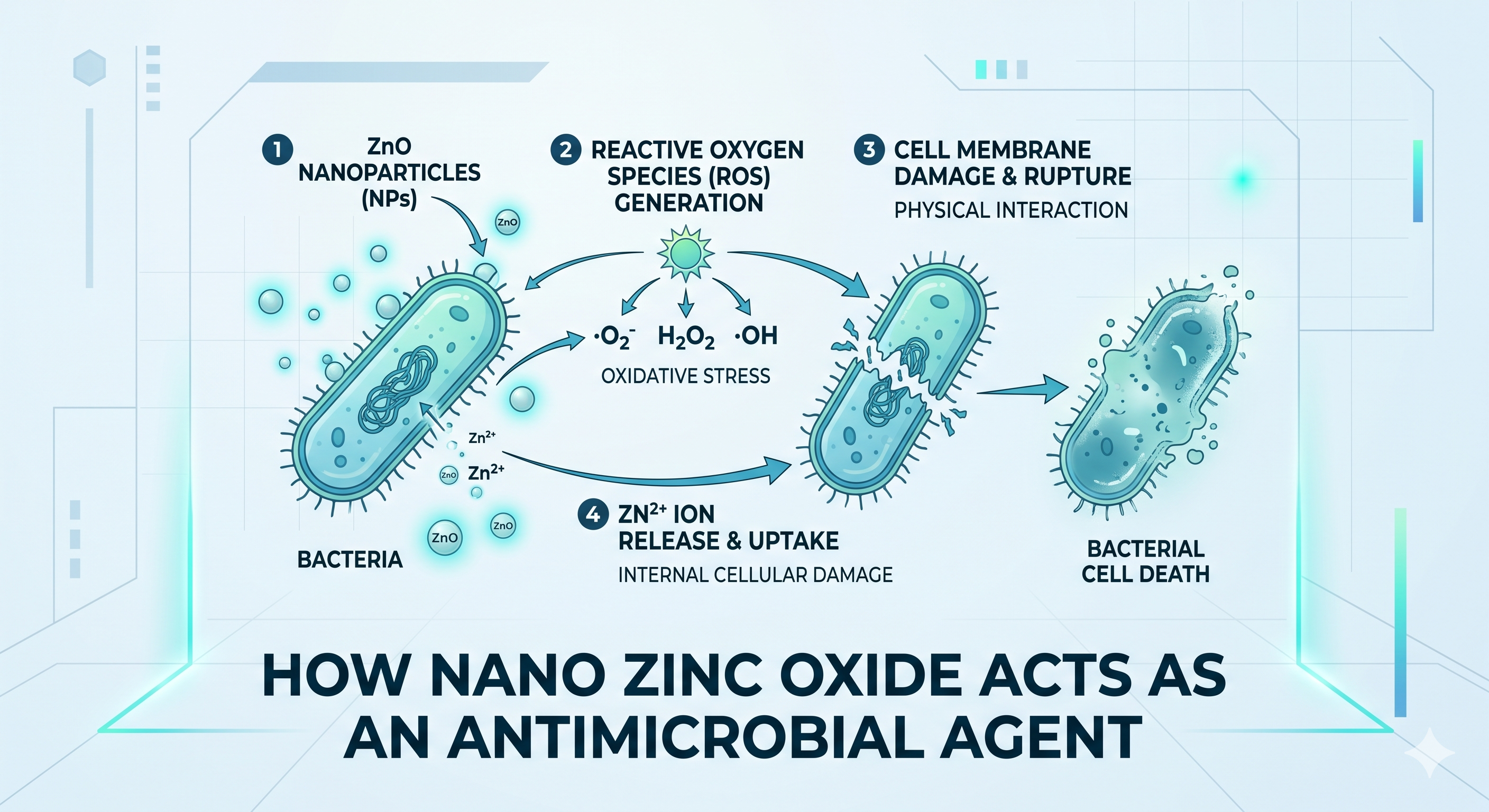
Nano zinc oxide does not just rely on a single method to kill pathogens; it utilizes a multi-modal attack strategy. This makes it incredibly difficult for bacteria to develop resistance, as they are essentially being attacked from three different angles simultaneously. Here is how the microscopic battle unfolds:
1. The Chemical Artillery: Reactive Oxygen Species (ROS)
The most significant weapon in nano zinc oxide’s arsenal is its ability to generate Reactive Oxygen Species, commonly known as ROS. When ZnO nanoparticles are exposed to light (even normal room light or UV light) and moisture, they act as photocatalysts. They react with the water and oxygen in their environment to produce highly volatile molecules like hydrogen peroxide, hydroxyl radicals, and superoxide ions.
Think of ROS as microscopic chemical shrapnel. These volatile molecules desperately want to stabilize themselves by stealing electrons from other molecules. When they encounter a bacterial cell, they aggressively attack its outer walls, tear through its internal proteins, and ultimately shred the bacteria’s DNA. Because human skin acts as a robust barrier against ROS, this reaction is devastating to single-celled microbes but generally safe for human skin contact.
2. The Trojan Horse: Zinc Ion Release
The second mechanism is the continuous, slow release of zinc ions (charged zinc atoms) from the surface of the nanoparticle. Because the nanoparticles are so small, they can sometimes trick the bacteria into absorbing them, or they simply sit on the surface of the bacteria and dissolve locally.
Once these zinc ions penetrate the bacterial cell wall, they act like a wrench thrown into a complex machine. They bind to the bacteria’s internal proteins and enzymes, disrupting their metabolism. The bacteria lose their ability to process nutrients, replicate their DNA, and produce energy. Poisoned from the inside out, the pathogen quickly starves and dies.
3. The Battering Ram: Physical Membrane Disruption
The third method of attack is purely physical. Zinc oxide nanoparticles often carry a positive electrical charge, while the outer membranes of most bacteria carry a negative charge. In the microscopic world, opposites attract intensely.
The nanoparticles are magnetically drawn to the surface of the bacteria. Due to their sharp edges and tiny size, they physically stick to the bacterial cell wall. This accumulation creates immense physical stress, literally puncturing holes in the microbe’s protective outer layer. Just like a balloon that has been pricked by a needle, the bacterial cell’s vital internal fluids leak out, leading to immediate cell death.
Real-World Magic: Current Research and Clinical Studies
The theoretical science behind nano zinc oxide is fascinating, but how is it being applied in the real world? Current research is rapidly moving from the laboratory to clinical and commercial applications.
Advanced Wound Care and Dermatology
One of the most heavily researched areas is wound healing. Chronic wounds, such as diabetic ulcers, are highly susceptible to persistent bacterial infections like Staphylococcus aureus (including MRSA). Clinical studies have demonstrated that incorporating ZnO nanoparticles into hydrogel bandages and wound dressings dramatically reduces bacterial loads. Furthermore, zinc is an essential mineral for human cellular repair. While the nanoparticles destroy the invading bacteria, the trace amounts of zinc released actually stimulate human fibroblasts—the cells responsible for rebuilding damaged tissue—resulting in faster wound closure and reduced scarring.
The Future of Dentistry
The warm, moist environment of the human mouth is a paradise for bacteria. Dental researchers are currently integrating nano zinc oxide into composite resins (tooth fillings), root canal sealers, and orthodontic adhesives. Recent clinical evaluations show that ZnO-infused dental materials actively prevent the formation of biofilm (dental plaque) and drastically reduce the occurrence of secondary cavities around fillings without compromising the structural integrity of the dental work.
Smart Food Packaging
Foodborne illnesses and food spoilage are massive global issues. The food industry is heavily investing in “smart packaging” lined with nano zinc oxide. Studies show that coating the inside of plastic films with ZnO NPs inhibits the growth of E. coli and Salmonella on fresh meats and vegetables. This not only protects the consumer from food poisoning but significantly extends the shelf life of perishable goods, reducing global food waste.
Hospital Surfaces and Antimicrobial Textiles
Hospital-acquired infections are a leading cause of mortality worldwide. To combat this, researchers are developing paints and coatings infused with ZnO NPs for high-touch surfaces like doorknobs, bed rails, and medical instruments. Similarly, the textile industry is weaving these nanoparticles into the fabrics of surgical gowns and everyday activewear. The result is self-cleaning, anti-odor clothing that actively kills the bacteria responsible for body odor and surgical site infections.
The Balancing Act: Advantage vs. Risk Assessment
As with any revolutionary technology, the application of nano zinc oxide requires a careful, objective evaluation of its benefits versus its potential risks. It is not a magical panacea, and its use must be responsibly regulated.
The Advantages
-
Combating Antibiotic Resistance: Because ZnO attacks bacteria mechanically and chemically on multiple fronts, it is virtually impossible for bacteria to mutate and develop resistance to it. This makes it an invaluable tool in a post-antibiotic era.
-
Broad-Spectrum Efficacy: Unlike highly specific antibiotics, nano zinc oxide is a broad-spectrum killer. It is highly effective against Gram-positive bacteria, Gram-negative bacteria, and various strains of fungi.
-
Heat Resistance and Stability: Unlike organic antimicrobial agents (like certain essential oils or biological enzymes) that break down at high temperatures, ZnO is a highly stable mineral. It can withstand the high heat required for manufacturing plastics, ceramics, and textiles.
-
FDA Recognition: In its bulk form, zinc oxide is categorized as “Generally Recognized as Safe” (GRAS) by the US Food and Drug Administration (FDA), which provides a strong foundational safety profile for topical use.
The Risks and Concerns
-
Potential Cytotoxicity (Cell Toxicity): While human skin acts as a great barrier, there are concerns about what happens if ZnO nanoparticles bypass this barrier and enter the bloodstream. High concentrations of nanoparticles, if inhaled or ingested, can cause oxidative stress in human cells, just as they do in bacteria. Researchers are carefully studying the safe dosage limits to ensure they kill pathogens without harming human tissue.
-
Inhalation Risks: The most significant immediate risk is to the workers manufacturing these nanoparticles. Inhaling nano-sized dust can lead to lung inflammation and respiratory issues. Strict industrial safety protocols, including specialized filtration masks and closed-loop manufacturing systems, are mandatory.
-
Environmental Impact: What happens when millions of antimicrobial bandages, sunscreens, and coated textiles are washed down the drain? Environmental scientists are raising valid concerns about ZnO nanoparticles accumulating in aquatic ecosystems. Because they are so effective at killing microbes, a high concentration in rivers or lakes could potentially harm the beneficial bacteria that form the foundation of aquatic food chains, or prove toxic to small fish and algae.
Conclusion: A Powerful Tool Requiring Responsible Use
Nano zinc oxide represents a brilliant synergy between ancient medicine and cutting-edge physics. By leveraging the unique behaviors of matter at the nanoscale, scientists have unlocked a powerful, multi-faceted weapon against some of humanity’s most resilient microscopic enemies. Its potential to revolutionize wound care, dentistry, food safety, and infection control is not just a future dream; it is happening right now in clinical trials and commercial products around the world.
However, the immense power of nanotechnology demands respect. As we integrate these invisible shields into our daily lives, ongoing research must continue to focus on targeted delivery, precise dosing, and environmentally sustainable disposal methods. If we navigate these challenges carefully, nano zinc oxide will undoubtedly play a starring role in the future of global health and hygiene, keeping the invisible threats at bay.