
Recently added item(s)
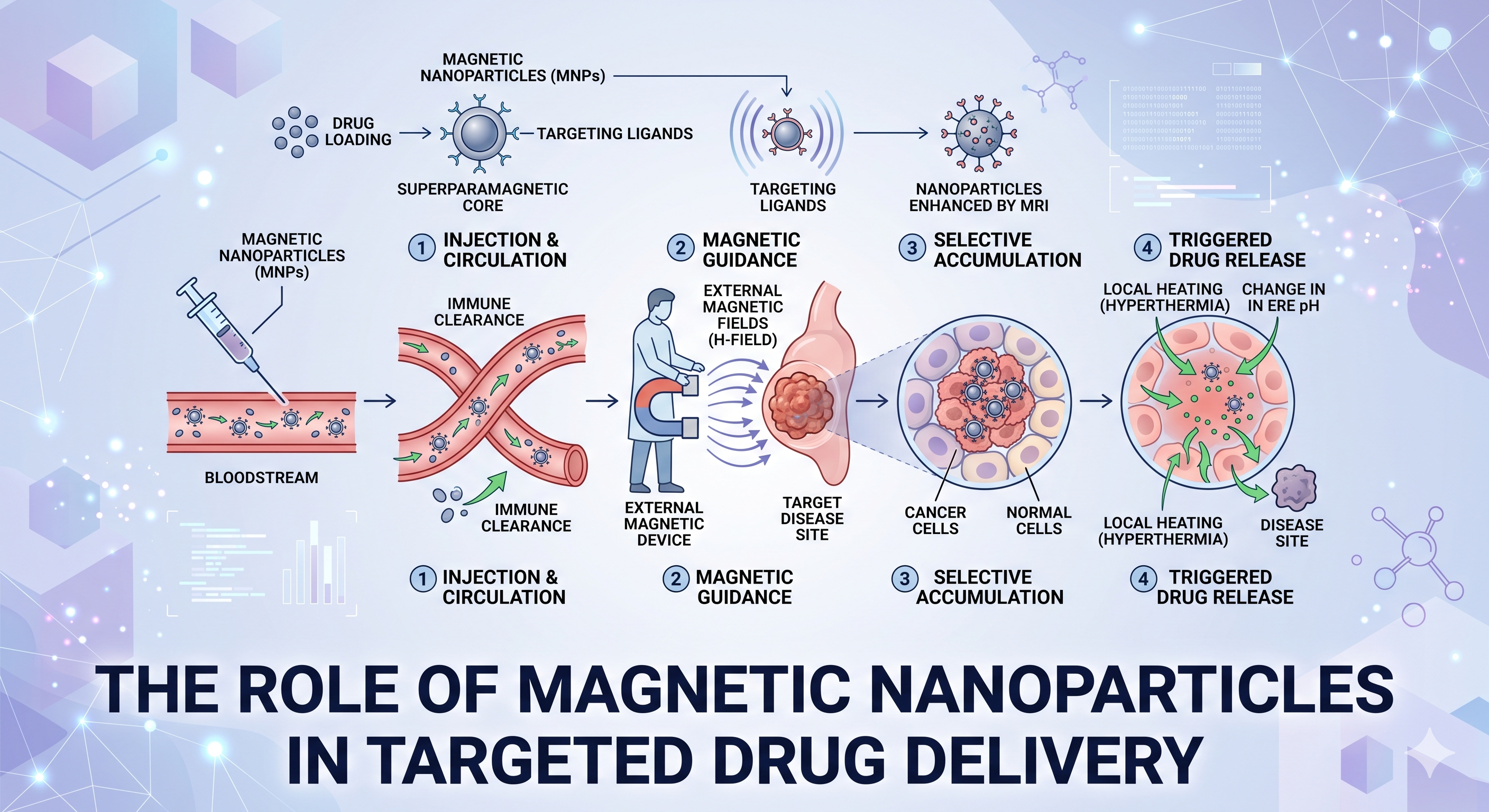
For decades, modern medicine has relied on a fundamentally flawed premise when it comes to treating localized diseases: to cure a problem in one specific part of the body, we often flood the entire system with powerful drugs. The most glaring example of this is traditional chemotherapy. To destroy a tumor in the liver or breast, highly toxic drugs are injected into the bloodstream, circulating indiscriminately and attacking healthy cells alongside cancerous ones. This systemic approach is the root cause of the severe side effects—nausea, hair loss, and compromised immune systems—that patients endure.
Over a century ago, the Nobel laureate Paul Ehrlich envisioned a concept he called the “magic bullet”: a therapeutic agent that could seek out and destroy disease without harming healthy tissue. For generations, this remained a medical fantasy. However, today, we are closer than ever to turning Ehrlich’s dream into reality, thanks to a groundbreaking intersection of quantum physics, material science, and biology.
Welcome to the era of Magnetic Nanoparticles (MNPs) in targeted drug delivery. By transforming pharmaceutical agents into magnetically guided, microscopic vehicles, scientists are rewriting the rules of how we administer medicine. In this comprehensive article, we will explore the science behind magnetic nanoparticles, how they are currently being utilized in clinical research, and the delicate balance between their incredible advantages and potential risks.
What Are Magnetic Nanoparticles? A Microscopic Anatomy
To understand how magnetic drug delivery works, we must first look at the nanoscale. A nanometer is one-billionth of a meter. To put this in perspective, a single strand of human hair is roughly 80,000 to 100,000 nanometers thick. Magnetic nanoparticles used in medicine typically range from 10 to 100 nanometers in diameter.
At their core, these particles are usually made of iron oxide—specifically magnetite or maghemite. Iron oxide is the preferred material for a very important reason: biocompatibility. Unlike other magnetic metals such as cobalt or nickel, which are highly toxic to human cells, iron is a naturally occurring element in the human body, essential for carrying oxygen in our red blood cells.
However, a raw iron oxide nanoparticle cannot simply be injected into the bloodstream. It requires a highly engineered anatomy, consisting of two main components:
-
The Magnetic Core: This provides the “steering” mechanism. A crucial feature of these specific iron cores is a physical property called superparamagnetism. Unlike regular magnets that constantly attract each other (which would cause fatal blood clots if injected into veins), superparamagnetic nanoparticles only exhibit magnetic properties when an external magnetic field is applied. Once the magnet is removed, they instantly lose their magnetism and disperse safely.
-
The Stealth Shell: The human immune system is designed to destroy foreign objects. To prevent the body’s white blood cells from consuming the nanoparticles, the magnetic core is coated with a biocompatible polymer shell (such as polyethylene glycol, or PEG). This shell acts as an invisibility cloak, allowing the particle to circulate freely. Furthermore, this shell acts as a “sponge” or “velcro” to which the actual drug molecules are attached.
The Mechanism: How Magnetically Targeted Delivery Works
The concept of using magnets to move drugs sounds like science fiction, but the mechanism is an elegant, step-by-step physical and chemical process. Here is how the microscopic journey unfolds:
Step 1: Drug Loading
In the laboratory, therapeutic drugs—such as potent anti-cancer chemotherapy agents, genetic material, or antibiotics—are chemically bound to the polymer shell of the magnetic nanoparticle.
Step 2: Injection and Stealth Circulation
The drug-loaded nanoparticles are injected into the patient’s bloodstream, typically via an intravenous (IV) drip. Thanks to their “stealth” polymer coating, they bypass the immune system’s radar and begin circulating throughout the body.
Step 3: Magnetic Navigation
This is where the magic happens. A specialized medical team places a powerful, highly focused external magnet (often an electromagnet similar to those used in MRI machines) precisely over the location of the patient’s tumor or infection. As the circulating blood carries the nanoparticles past the target area, the external magnetic field exerts a strong physical pull. The nanoparticles are dragged out of the main blood flow, crossing the blood vessel walls and accumulating deeply within the diseased tissue.
Step 4: Triggered Release
Simply trapping the drug at the tumor site is not enough; the drug must be released from the nanoparticle to do its job. Scientists engineer the polymer shells to be “stimuli-responsive.” For example, the environment inside a rapidly growing tumor is uniquely acidic compared to healthy tissue. The polymer shell can be designed to dissolve or break apart only when it encounters this specific acidic environment, releasing the toxic chemotherapy payload directly into the cancer cells.
Current Research and Clinical Applications
The transition of magnetic nanoparticles from theoretical physics to practical medicine is happening rapidly. Researchers and oncologists are currently exploring several cutting-edge applications that could revolutionize medical protocols.
Conquering the Blood-Brain Barrier
One of the greatest challenges in treating neurodegenerative diseases (like Alzheimer’s) and brain cancer (like Glioblastoma) is the Blood-Brain Barrier (BBB). The BBB is a highly selective, tightly packed layer of cells that protects the brain from toxins, but it also blocks 98% of life-saving drugs from entering. Recent clinical studies have demonstrated that applying a dynamic, oscillating magnetic field to magnetic nanoparticles can literally “pull” them through the tight junctions of the BBB without causing permanent damage to the brain, delivering vital therapeutics directly to brain tumors.
The Rise of Theranostics (Therapy + Diagnostics)
Because iron oxide nanoparticles are highly visible under Magnetic Resonance Imaging (MRI), they serve a dual purpose. Doctors can inject drug-loaded MNPs, use an MRI to watch the particles physically accumulate in the tumor in real-time, and then activate the drug release. This combination of simultaneous diagnosis and targeted therapy is a rapidly growing field known as “theranostics.” It ensures that no treatment is delivered blindly.
Magnetic Hyperthermia: Heating the Enemy
Beyond simply delivering drugs, magnetic nanoparticles have a secondary, highly lethal trick up their sleeve. When exposed to an alternating magnetic field (a magnet that rapidly turns on and off thousands of times per second), the iron core of the nanoparticle vibrates aggressively. This microscopic friction generates intense, localized heat. Cancer cells are highly sensitive to heat and will die at temperatures around 42 to 45 degrees Celsius (107 to 113 degrees Fahrenheit).
This process, known as Magnetic Hyperthermia, allows doctors to literally cook tumors from the inside out without burning the patient’s skin. In Europe, a pioneering therapy known as NanoTherm has already received clinical approval for treating brain tumors using exactly this method, often in combination with traditional targeted radiation.
Advantage vs. Risk Assessment
As with any disruptive medical technology, the implementation of magnetic nanoparticles requires a sober evaluation of its capabilities and its limitations. While the potential is staggering, rigorous safety evaluations are paramount.
The Advantages of MNP Drug Delivery
-
Drastic Reduction in Side Effects: By concentrating the toxic drugs solely within the diseased tissue, healthy organs (like the heart, liver, and hair follicles) remain untouched. This significantly improves the patient’s quality of life during treatment.
-
Lower Required Dosages: Because the drug is not diluted throughout the entire body, doctors can achieve higher therapeutic concentrations at the tumor site while using significantly less of the actual drug, lowering overall treatment toxicity.
-
Overcoming Multidrug Resistance: Many aggressive cancers develop a resistance to standard chemotherapy by pumping the drugs out of their cells. Nanoparticles can enter cells via different biological pathways, effectively sneaking past the cancer cell’s defense mechanisms.
-
Synergistic Treatments: The ability to combine chemical drug delivery with physical hyperthermia creates a two-pronged attack that highly resilient tumors struggle to survive.
The Risks and Clinical Challenges
-
Long-Term Toxicity and Clearance: While iron is naturally occurring, injecting massive amounts of iron oxide can overload the body’s natural iron metabolism. Nanoparticles that escape the magnetic field often end up trapped in the liver or spleen. Understanding how the body processes and clears these heavy metal concentrations over long periods is a major focus of ongoing toxicity studies.
-
The Depth Challenge: The laws of physics dictate that the strength of a magnetic field drops exponentially the further you move away from the magnet. While pulling nanoparticles to a skin tumor is easy, exerting enough magnetic force to pull nanoparticles deep into the center of a human body (like a pancreatic tumor) requires massive, potentially impractical external magnets.
-
Manufacturing Complexities: Creating perfectly uniform nanoparticles with precise stealth coatings and drug-loading capacities is incredibly difficult and expensive. Scaling up production from a laboratory bench to mass commercial pharmaceutical manufacturing remains a significant hurdle.
-
Premature Drug Leakage: There is always a risk that the drug could detach from the nanoparticle while still circulating in the bloodstream before it reaches the target, potentially causing the very systemic side effects the technology is designed to avoid.
Conclusion: A Magnetic Future
The utilization of magnetic nanoparticles for targeted drug delivery represents a paradigm shift in pharmacology. We are moving away from the era of “carpet-bombing” diseases with systemic drugs and entering an era of microscopic precision, where treatments are guided by physics as much as biology.
While challenges remain—particularly in engineering magnets strong enough for deep-tissue targeting and ensuring long-term cellular safety—the clinical successes already seen in theranostics and magnetic hyperthermia prove that this technology is viable. As research continues to combine these magnetic delivery vehicles with cutting-edge therapies like CRISPR gene editing and customized mRNA treatments, the concept of Paul Ehrlich’s magic bullet is finally taking shape, promising a future where medical treatments are overwhelmingly effective, and side effects are a thing of the past.