
Recently added item(s)
For thousands of years, humanity has revered gold for its unyielding permanence. It does not rust, it does not tarnish, and it requires intense, blazing heat to melt. If you wear a gold ring or own a piece of gold jewelry, you are wearing a metal that obeys a strict set of classical physics rules. However, when you shrink that exact same element down to the nanoscale—a realm where particles are measured in billionths of a meter—those classical rules completely fall apart.
One of the most mind-bending phenomena in nanotechnology is the behavior of gold’s melting point. In the microscopic world, gold loses its famous thermal stubbornness. But exactly how much does the melting point drop, and more importantly, why does the universe allow a material’s fundamental properties to change simply because its size changes?
In this comprehensive guide, we will dive into the fascinating physics of melting point depression, explore the cutting-edge clinical and technological applications of nano gold, and objectively evaluate the advantages and risks of using these microscopic golden spheres in modern science.
The Numbers: Bulk Gold vs. Nano Gold
To appreciate the scale of this scientific anomaly, we first need to look at the baseline.
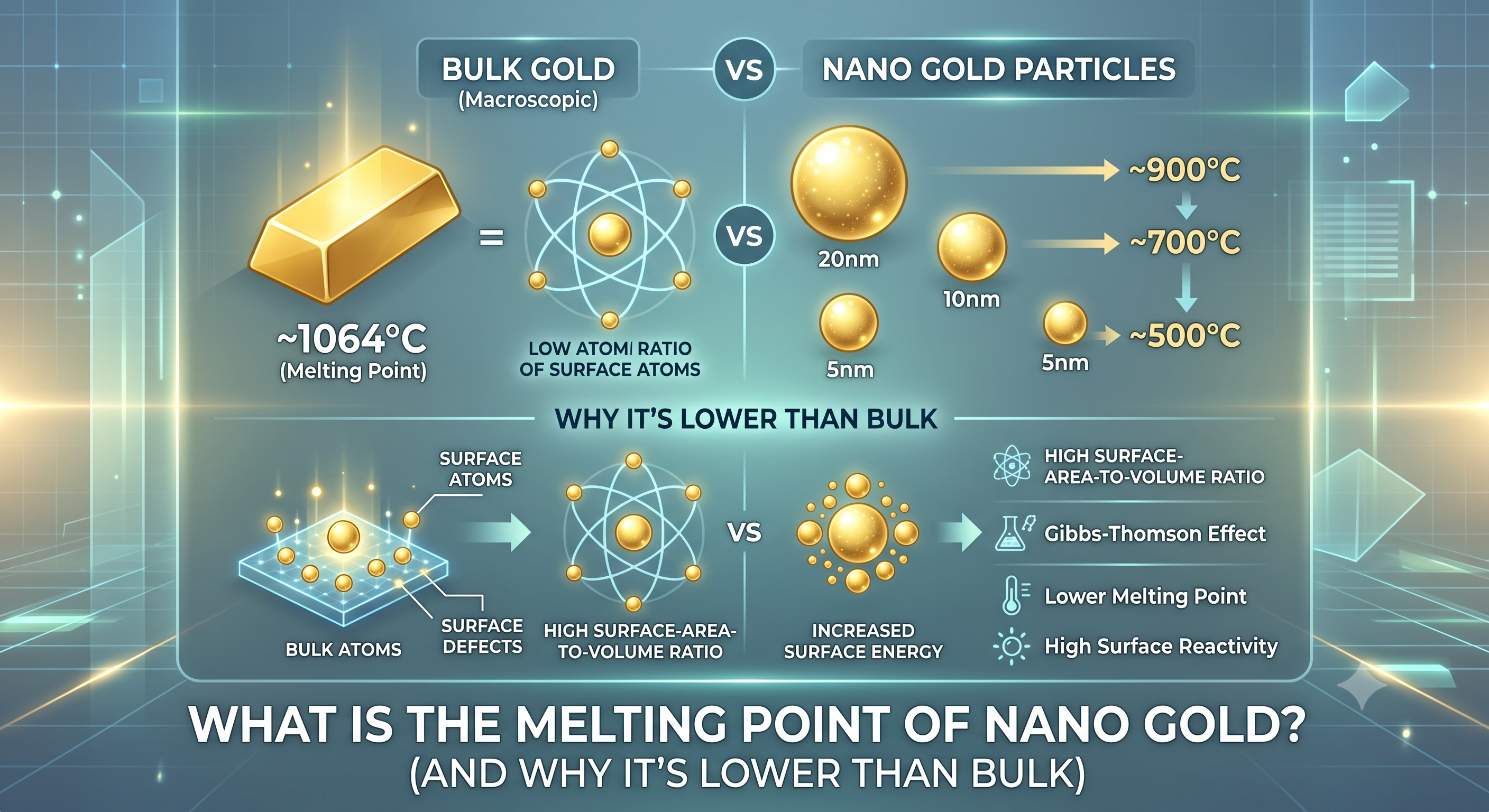
In its standard, macroscopic form (known as “bulk” gold), pure gold has a highly specific and well-documented melting point: 1064°C (1947°F). This temperature is a constant. Whether you are melting a one-gram gold coin or a one-ton gold brick, the temperature required to turn that solid metal into a liquid remains exactly 1064°C.
However, when you mill that gold down into nanoparticles, the melting point plummets.
-
A gold nanoparticle with a diameter of 20 nanometers melts at roughly 1000°C.
-
A particle at 5 nanometers melts at around 830°C.
-
When you shrink the particle down to 2 nanometers (which consists of only a few hundred atoms), the melting point crashes dramatically to approximately 300°C.
This phenomenon is scientifically known as Melting Point Depression. It is not a chemical trick; the nano gold is still 100% pure gold. The drastic change in behavior is purely a physical result of its size.
The Physics Behind the Melt: Why Does It Drop?
To understand why nano gold melts at the temperature of a standard kitchen oven while bulk gold requires an industrial furnace, we need to look at the atomic structure of the metal and understand a concept called the Surface-Area-to-Volume Ratio.
The “Crowded Room” Analogy
Imagine a massive block of solid gold. Inside this block, the gold atoms are arranged in a highly organized, tight crystalline grid. An atom located right in the center of the block is surrounded by other gold atoms on all sides—top, bottom, left, right, front, and back. Because it is fully surrounded, it forms strong chemical bonds with all its neighbors. In chemistry, we say this atom has a high “coordination number.” These fully surrounded atoms are incredibly stable, and it takes a massive amount of thermal energy (1064°C) to break those bonds and make the atoms flow freely as a liquid.
Now, consider the atoms on the very surface of the gold block. These atoms are only surrounded by other gold atoms on the inside and the sides; their top is exposed to the air. Because they have fewer neighbors, they have fewer chemical bonds holding them in place. They are essentially “loosely held” compared to the atoms buried deep inside.
The Nanoscale Shift
In a large brick of gold, the number of surface atoms is mathematically insignificant compared to the trillions of tightly bound atoms on the inside. The surface atoms do not influence the overall melting point.
However, when you shrink gold down to a 2-nanometer particle, the geometry completely flips. At this tiny scale, a massive percentage of the total atoms are now “surface atoms.” Because so much of the particle consists of loosely held atoms with fewer chemical bonds, the structural integrity of the entire particle is compromised. It requires drastically less heat energy to shake these surface atoms loose and trigger the transition from solid to liquid.
From Theory to Reality: Current Research and Clinical Applications
The fact that nano gold melts at low temperatures is not just a quirky physics trivia fact; it is a mechanical property that scientists are actively exploiting to revolutionize medicine, electronics, and diagnostics.
1. Targeted Cancer Treatment (Photothermal Therapy)
One of the most exciting areas of clinical research involves using gold nanoparticles (AuNPs) as microscopic weapons against cancer. While the low melting point itself is part of the broader thermodynamic shift of the particle, the related phenomenon of Surface Plasmon Resonance (SPR) is key here.
When nano gold is exposed to specific wavelengths of near-infrared light, its surface electrons begin to oscillate wildly, generating intense, localized heat. In clinical trials for Photothermal Therapy (PTT), doctors inject gold nanoparticles into a patient’s bloodstream. Because tumor blood vessels are leaky, the nanoparticles naturally accumulate inside the cancerous tissue.
Doctors then shine a near-infrared laser through the patient’s skin. The light passes harmlessly through healthy human tissue but is absorbed by the nano gold. The particles rapidly heat up—taking advantage of their unique nano-thermodynamic properties—and literally “cook” the cancer cells from the inside out, without the need for invasive surgery or systemic chemotherapy.
2. Next-Generation Flexible Nanoelectronics
The tech industry is desperately trying to build flexible screens, wearable health monitors, and microscopic circuits printed directly onto plastic or paper. The problem? You cannot use bulk gold wires because melting gold at 1064°C would instantly vaporize the plastic or paper underneath.
Enter the low melting point of nano gold. Engineers can create an “ink” made of 2-nanometer gold particles and print complex circuit boards onto flexible plastics at room temperature. They then bake the plastic in a mild oven at just 300°C. Because of the size effect, the nano gold melts and fuses together to form a solid, highly conductive wire.
Here is the brilliant part: once those 2-nanometer particles melt and fuse together, they are no longer nanoscale. They become a bulk structure. Their melting point instantly shoots back up to 1064°C! You have successfully printed a highly durable gold circuit on a delicate plastic sheet.
3. Advanced Drug Delivery Systems
Researchers are designing highly sophisticated drug delivery vehicles using microscopic “cages” made of nano gold. These cages are filled with toxic chemotherapy drugs and coated with antibodies that seek out cancer cells. Once the cage attaches to a tumor, a low-power laser is applied. Because of the altered thermodynamic stability of the nano gold, the localized heat causes the gold cage to “melt” or deform just enough to release the drug payload precisely where it is needed, sparing the rest of the body from toxic side effects.
The Balancing Act: Advantage vs. Risk Assessment
While the unique melting point and thermal properties of gold nanoparticles offer groundbreaking possibilities, translating this technology from the laboratory to human patients and consumer goods requires a strict, objective assessment of its benefits and potential dangers.
The Advantages
-
Incredible Biocompatibility: Gold is generally inert and non-toxic in its bulk form. At the nanoscale, it remains highly biocompatible compared to other metallic nanoparticles (like silver or zinc), making it an excellent candidate for injection into the human body.
-
Easy Functionalization: The surface of a gold nanoparticle is like chemical Velcro. Scientists can easily attach DNA, proteins, antibodies, or pharmaceutical drugs to its surface using simple “thiol” (sulfur-based) chemistry. This makes nano gold incredibly versatile for targeted therapies.
-
Tunable Optical and Thermal Properties: By simply changing the size and shape of the gold particle (spheres, rods, or stars), scientists can tune exactly what color of light it absorbs, how much heat it generates, and at what precise temperature its physical structure begins to degrade.
The Risks and Clinical Challenges
-
Bioaccumulation and Long-Term Toxicity: What goes in must come out, or at least, it should. The human body struggles to filter and excrete certain sizes of heavy metal nanoparticles. Clinical studies show that while gold nanoparticles are highly effective at destroying tumors, the leftover particles often accumulate in the liver, spleen, and kidneys. The long-term effects (years or decades) of having nano gold trapped in organ tissues are still not fully understood, though there are concerns about long-term oxidative stress on cells.
-
The “Corona” Effect in the Blood: When nano gold enters the bloodstream, proteins immediately stick to its surface, forming a “protein corona.” This can change the particle’s intended size, alter its thermodynamic properties, and sometimes cause the immune system to attack it before it ever reaches the tumor.
-
Environmental Impact and Cost: Synthesizing highly pure, perfectly sized gold nanoparticles is incredibly expensive and energy-intensive. Furthermore, as nano gold becomes heavily used in electronics and medical testing, the environmental runoff of these microscopic heavy metals into water systems poses a largely unregulated ecological risk to aquatic life.
Conclusion: The Magic of the Margins
The fact that nano gold melts at a fraction of the temperature of bulk gold is a perfect reminder that our physical world is full of surprises. By breaking a seemingly indestructible element down into clusters of just a few hundred atoms, we completely rewrite the rules of thermodynamics.
The dramatic drop in the melting point of nano gold—driven by the sheer dominance of surface atoms over internal atoms—has opened the door to an entirely new era of scientific innovation. From non-invasive cancer treatments that melt tumors away with light, to flexible electronics printed at the temperature of a pizza oven, we are harnessing the quirks of the nanoscale to solve macro-scale problems.
However, as we push these technologies into clinical trials and consumer markets, we must proceed with profound respect for the unknown. Balancing the miraculous capabilities of nano gold with rigorous safety testing, toxicity monitoring, and environmental stewardship will be the ultimate key to unlocking its full, golden potential.