
Recently added item(s)
Have you ever noticed how hot your smartphone gets when you are playing a graphic-intensive game or watching a high-definition video while charging? Or perhaps you have read about the challenges of keeping electric vehicle (EV) batteries cool to prevent them from catching fire. As technology advances, our devices are becoming smaller, faster, and more powerful. However, this massive leap in performance comes with a universal, unavoidable byproduct: heat.
For decades, the tech and manufacturing industries have relied on metals like aluminum or copper to draw heat away from sensitive electronics. But metals have distinct disadvantages—they are heavy, expensive to manufacture in complex shapes, and, most importantly, they conduct electricity. In many electronic applications, putting a highly electrically conductive metal right next to a delicate microchip is a recipe for a short circuit.
This is where polymers (plastics) come into the picture. Polymers are lightweight, incredibly easy to mold into any shape, chemically resistant, and excellent electrical insulators. They seem like the perfect material—except for one major flaw: they are thermal insulators. They trap heat rather than release it.
So, how do we bridge this gap? How do we create a material that is as light and flexible as plastic, insulates against electricity, but conducts heat like a metal? The answer lies in the fascinating world of nanotechnology, specifically with a microscopic hero known as Nano Alumina, or Aluminum Oxide (Al2O3).
In this comprehensive guide, we will dive deep into the science of how Nano Alumina is transforming ordinary plastics into high-tech, heat-dissipating super-materials. We will explore the underlying physics in a way that is easy to understand, look at the latest research and real-world trials, and weigh the advantages and risks of this cutting-edge technology.
The Heat Problem: Why Ordinary Polymers Fail
To understand the magic of Nano Alumina, we first need to understand why regular plastics are so bad at handling heat.
In physics, heat travels through solid materials via “phonons.” You can think of phonons as tiny packets of vibrational energy. Imagine a line of people trying to pass buckets of water to put out a fire. If the people are standing in a highly organized, straight line (like the crystalline structure of metals or diamonds), they can pass the buckets rapidly and efficiently. The heat moves quickly.
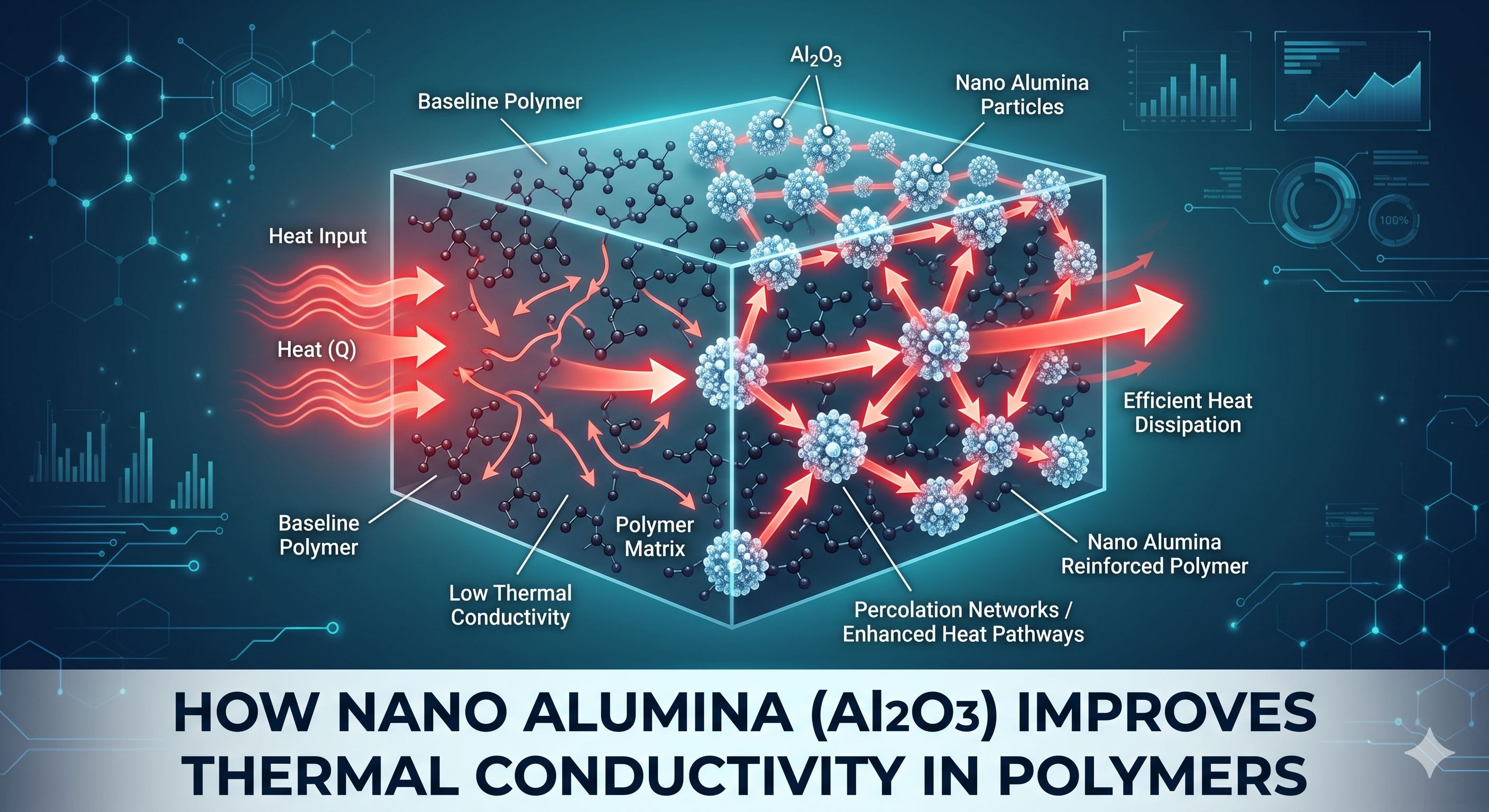
Polymers, however, have what scientists call an “amorphous” structure. On a molecular level, a polymer looks like a massive, tangled bowl of cooked spaghetti. The polymer chains are twisted, random, and full of empty spaces. When heat (our bucket of water) tries to travel through this tangled mess, the phonons constantly crash into each other, bounce off in the wrong direction, or get trapped in the microscopic gaps. Because the “bucket brigade” is entirely disorganized, heat builds up rather than moving through the material.
Enter Nano Alumina (Al2O3): The Microscopic Bridge Builder
Alumina (Aluminum Oxide) is a naturally occurring ceramic compound. In its bulk form, it is highly prized for its hardness and durability—it is commonly used to make sandpaper and industrial cutting tools. Crucially, ceramic alumina has a unique set of thermal and electrical properties: it is a fantastic conductor of heat, but completely blocks the flow of electricity.
When we take this alumina and shrink it down to the “nano” scale (where particles are measured in billionths of a meter), something incredible happens. Because the particles are so unimaginably small, they have a massive surface-area-to-volume ratio.
When Nano Alumina particles are mixed into liquid polymer during manufacturing, they disperse throughout the tangled “spaghetti” of the plastic. If you add just a little bit of Nano Alumina, the particles float around independently, and the plastic’s heat conductivity barely changes.
However, as you add more and more Nano Alumina, the particles begin to touch one another. Eventually, they hit what scientists call the “Percolation Threshold.” At this magical tipping point, the nano-particles form continuous, interconnected chains from one side of the plastic to the other.
Suddenly, the disorganized “bucket brigade” of the polymer is bypassed entirely. The phonons (heat energy) hop onto the highly organized alumina particles and travel at lightning speed down these newly formed “thermal highways.” The result? A piece of plastic that rapidly pulls heat away from a source, all while remaining an electrical insulator.
The Secret Sauce: Surface Engineering and Overcoming “Kapitza Resistance”
It sounds simple enough: just mix a lot of Nano Alumina into melted plastic, stir, and cool. Unfortunately, nature makes things a bit more difficult.
Nanoparticles have high surface energy, meaning they love to stick to each other. When you dump them into a polymer, they tend to clump together into useless balls (a process called agglomeration) rather than spreading out evenly. Furthermore, there is a physical incompatibility between the two materials. Alumina is inorganic and hydrophilic (loves water), while polymers are organic and hydrophobic (repel water). They mix about as well as oil and water.
When an alumina particle and a polymer chain do not bond well, a microscopic gap is left between them. In thermodynamics, this gap causes what is known as Interfacial Thermal Resistance, or Kapitza Resistance. Going back to our analogy, it is like placing a toll booth on our thermal highway. The heat hits the gap and slows down significantly.
Current research heavily focuses on solving this through Surface Modification. Scientists coat the Nano Alumina particles with special chemical “coupling agents,” such as Silanes. These coupling agents act as diplomats. One end of the silane molecule loves the inorganic alumina, and the other end loves the organic polymer. By coating the nanoparticles in this chemical bridge, they mix perfectly into the plastic without clumping, eliminating the microscopic gaps, destroying the Kapitza resistance, and allowing heat to flow seamlessly.
Current Research and Applied “Clinical” Industrial Trials
While we do not run “clinical trials” on plastics like we do with medical drugs, the materials science world conducts rigorous applied industrial trials and stress-tests to bring this technology from the lab to the real world. The current landscape of research is incredibly exciting.
1. Electric Vehicle (EV) Battery Thermal Management: One of the most critical areas of applied research involves EV batteries. When charging or discharging, lithium-ion batteries generate immense heat. If one cell gets too hot, it can trigger a “thermal runaway,” causing neighboring cells to catch fire. Automotive engineers are currently running massive field trials using polyurethane and silicone polymers loaded with Nano Alumina as “potting compounds.” These liquid polymers are poured over the battery cells, hardening into a solid block. The Nano Alumina pulls the heat away from the cells and dissipates it, drastically reducing the risk of fire while keeping the battery pack lightweight and safe from electrical shorts.
2. The 5G Revolution and Electronics Packaging: 5G antennas and modern microprocessors process data at unprecedented speeds, generating intense localized heat (hotspots). Recent industrial trials have focused on using Nano Alumina to create advanced Thermal Interface Materials (TIMs). TIMs are the thermal pastes or pads placed between a computer chip and a cooling fan. Studies have shown that utilizing nanometer-sized alumina—rather than traditional micrometer-sized particles—allows for thinner, more efficient cooling pads that significantly extend the lifespan of consumer electronics.
3. The Rise of Hybrid Fillers: The most bleeding-edge research right now involves “Hybrid Filler Systems.” Scientists have realized that while Nano Alumina is great, it works even better when teamed up with other nanomaterials. Recent studies published in major materials science journals show that combining spherical Nano Alumina particles with flat, plate-like materials like Boron Nitride or Graphene creates a synergistic effect. The different shapes pack together more tightly, filling in the microscopic gaps better than alumina alone. This hybrid approach is yielding polymers with thermal conductivities previously thought impossible for plastics.
Advantage and Risk Assessment
Like any disruptive technology, incorporating Nano Alumina into polymer matrices comes with a complex balance of benefits and engineering challenges.
The Advantages:
-
Dual Functionality (Thermal Conductivity + Electrical Insulation): This is the crown jewel of Nano Alumina. It solves the electronics cooling problem without the risk of short-circuiting delicate components.
-
Cost-Effectiveness: Compared to other thermally conductive nanofillers like Aluminum Nitride (AlN), Boron Nitride (BN), or synthetic nanodiamonds, Nano Alumina is highly abundant and significantly cheaper to synthesize, making mass commercial production viable.
-
Chemical and Environmental Stability: Alumina is exceptionally resistant to oxidation, corrosion, and chemical breakdown. Polymers reinforced with Al2O3 maintain their structural integrity even in harsh, high-temperature industrial environments.
-
Lightweight Design: By replacing heavy aluminum heat sinks with Al2O3-enhanced plastics, aerospace and automotive industries can shave off precious weight, improving fuel efficiency and range.
The Risks and Challenges:
-
The Rheology Problem (Viscosity Issues): To achieve a high level of thermal conductivity, a large amount of Nano Alumina must be added to the polymer (sometimes up to 60-70% by weight). This massive addition drastically increases the viscosity of the melted plastic. It turns from a smooth, flowing liquid into a thick, sludge-like paste, making it extremely difficult to inject into intricate molds during manufacturing.
-
Mechanical Embrittlement: While plastics are prized for their flexibility and impact resistance, packing them full of ceramic nanoparticles can make them brittle. If the balance is not struck perfectly, an impact that would normally just bounce off the plastic might cause it to shatter like glass.
-
Tool Wear and Manufacturing Costs: Alumina is inherently abrasive. Pumping liquid plastic filled with microscopic ceramic sand through steel injection molding machines causes severe wear and tear on the manufacturing equipment, leading to higher maintenance costs.
-
Dispersion Consistency: If the nanoparticles are not mixed perfectly, “hot spots” will form in the polymer where there is not enough alumina. In high-stakes applications like EV batteries, a single localized hot spot due to poor manufacturing can lead to system failure.
Future Horizons: Where Do We Go From Here?
The future of thermally conductive polymers is intimately tied to the advancement of Nano Alumina. One of the most promising frontiers is 3D printing (Additive Manufacturing). Researchers are currently trying to perfect 3D-printable filaments infused with Nano Alumina. This would allow engineers to print custom, complex heat-sinks on demand, perfectly tailored to the geometry of specific electronic components.
Furthermore, as the world pushes toward wearable technology and flexible electronics (like smart clothing or foldable smartphones), the demand for highly flexible, heat-dissipating elastomers (rubbers) will skyrocket. The challenge for the next decade will be refining surface modification techniques to lower the amount of Nano Alumina needed, preserving the extreme flexibility of these materials while maintaining a strong thermal highway.
Conclusion
Nano Alumina (Al2O3) is much more than just microscopic ceramic dust. It is a vital key unlocking the next generation of technological advancement. By transforming ordinary, heat-trapping plastics into efficient thermal conductors, Nano Alumina is silently protecting our smartphones from overheating, making electric vehicles safer, and enabling the rapid expansion of 5G infrastructure.
While the challenges of manufacturing, high viscosity, and material brittleness remain, the relentless pace of materials science research is overcoming these hurdles day by day. Through surface engineering and smart hybrid composites, the microscopic thermal highways built by Nano Alumina are paving the way toward a cooler, faster, and more efficient future.