
Recently added item(s)
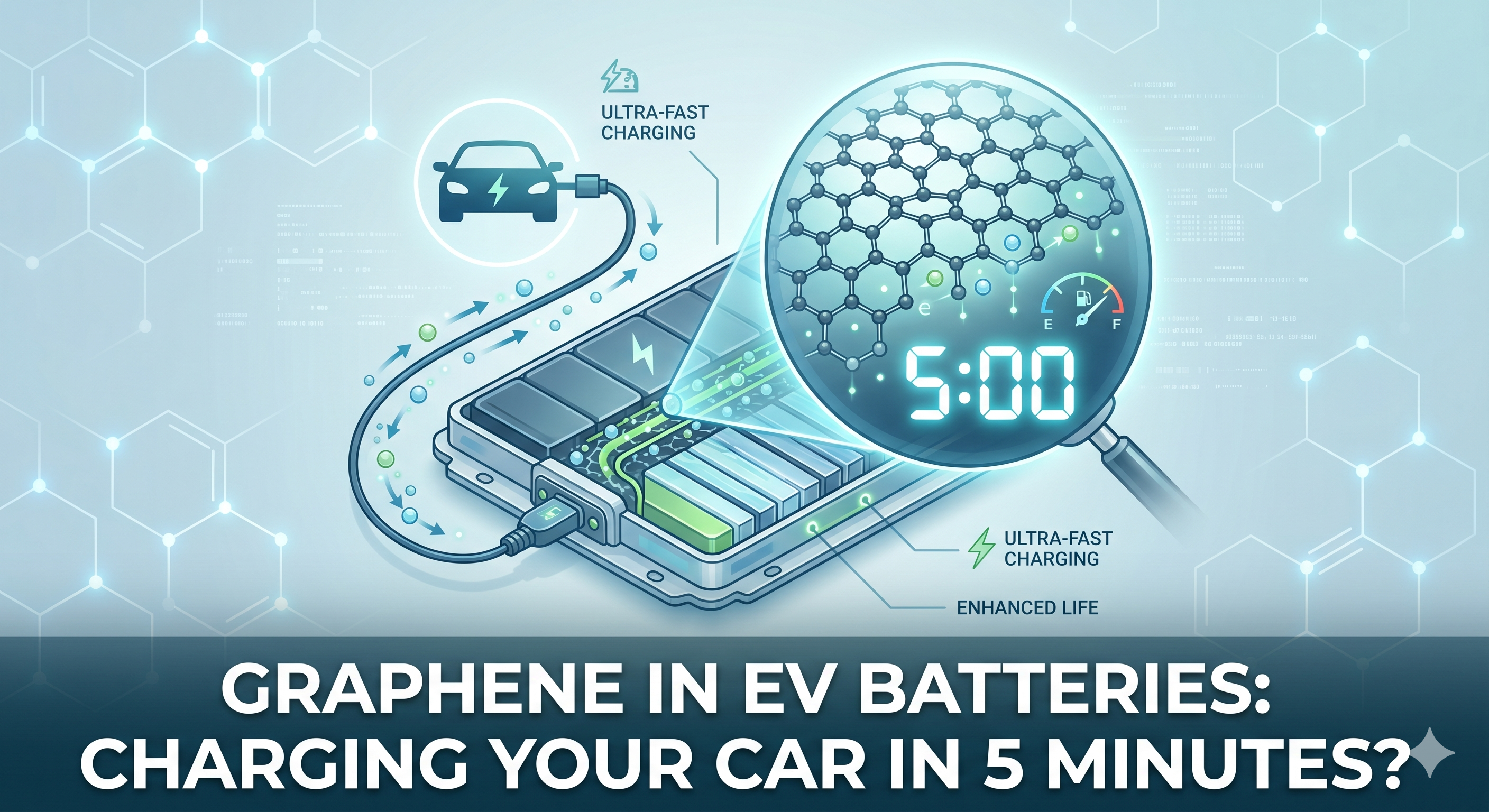
The electric vehicle (EV) revolution is no longer a distant dream; it is parked in our driveways. However, for many gasoline-car loyalists, two major hurdles remain: range anxiety and charging time. While pumping gas takes mere minutes, fully charging a standard EV can take anywhere from forty minutes to several hours.
Enter Graphene. Often hailed as a “magic material,” graphene is a single layer of carbon atoms arranged in a hexagonal lattice. Its integration into battery technology promises to shatter the current limitations of Lithium-ion (Li-ion) cells. But is the “5-minute charge” a realistic goal for 2026, or just laboratory hype? Let’s dive into the science, the current research, and the road ahead.
1. The Bottleneck: Why Current Batteries Are Slow
To understand how graphene helps, we must first understand the problem with current Lithium-ion batteries. In a standard battery, lithium ions move from the cathode to the anode during charging. This process is limited by:
-
Internal Resistance: Moving ions through liquid electrolytes and solid electrodes generates heat. If you charge too fast, the battery can overheat or even catch fire.
-
Ion Traffic Jams: In traditional graphite anodes, lithium ions have to find their way into the layers of the material. At high speeds, they tend to “pile up” on the surface, leading to a phenomenon called “lithium plating,” which permanently damages the battery.
Graphene solves these problems by providing a “superhighway” for both electrons and ions.
2. The Graphene Advantage: Conductivity and Cooling
Graphene is the most conductive material ever discovered. When used in EV batteries, it serves three primary functions:
Supercharged Conductivity
Graphene can be used as a coating on the electrodes or mixed into the slurry. Because electrons move through graphene with almost zero resistance, the electrical current flows much more freely. This reduces the energy lost as heat and allows the battery to accept a much higher current—the key to ultra-fast charging.
Superior Thermal Management
Heat is the enemy of battery life. Graphene is an incredible thermal conductor (better than copper). A graphene-enhanced battery can dissipate heat much more effectively than a standard one. This means that even during an intense 5-minute ultra-charge, the battery stays within a safe temperature range, preventing degradation.
Increased Surface Area
Because graphene is 2D, it has a massive surface area relative to its weight. This allows for more “active sites” where lithium ions can attach, increasing the capacity and power density of the battery.
3. Current Research and Industrial Breakthroughs (2025-2026)
As of early 2026, the transition from “lab-scale graphene” to “industrial-scale EVs” has hit a major acceleration phase.
-
The Hybrid Anode: Recent research published in early 2026 by a consortium of European universities has demonstrated a “Silicon-Graphene” hybrid anode. Silicon can hold much more lithium than graphite but tends to expand and crack. Graphene acts as a flexible, conductive “cage” that holds the silicon together, allowing for batteries that are both high-capacity and fast-charging.
-
GAC Aion and Real-World Testing: Chinese automaker GAC Aion has already begun testing “Graphene-Enhanced” batteries in their SUV models. Their 6C fast-charging technology claims to charge from 0% to 80% in roughly 8 minutes. While not quite 5 minutes for a full 100% charge, it is a massive leap over the 40-minute industry average.
-
Solid-State Integration: Scientists are now using graphene in solid-state batteries (batteries with a solid electrolyte instead of liquid). Graphene helps maintain the contact between the solid layers, which is currently the biggest hurdle for solid-state technology.
4. The Clinical Side: Safety and Longevity Studies
While we don’t perform “clinical trials” on batteries in the medical sense, the industry performs Long-Cycle Reliability Studies that serve the same purpose.
Longevity Tests
Standard Li-ion batteries begin to degrade after 500 to 1,000 charge cycles. Recent long-term studies on graphene-enhanced cells show that they can maintain 90% of their capacity even after 3,000 cycles. For an EV owner, this means the battery could easily outlast the car itself, potentially lasting for 500,000 miles (800,000 km).
Safety Evaluations
The “nail penetration test” is the gold standard for battery safety. Graphene-enhanced batteries have shown a much lower tendency to undergo “thermal runaway” (exploding when punctured) because the graphene layers help distribute the heat and electrical surge across a larger area, preventing the localized fire that typically destroys the cell.
5. Advantage vs. Risk Assessment
Every technological leap comes with a balance of pros and cons.
Advantages
-
Time Efficiency: Reducing a 40-minute stop to a 5-minute stop makes EVs viable for long-haul trucking and taxi fleets.
-
Longer Life: Less heat during operation means the battery degrades slower, increasing the resale value of used EVs.
-
Lightweight: Graphene is extremely light. Replacing heavier metal components with graphene-carbon composites reduces the overall weight of the car, further increasing its range.
Risks and Challenges
-
The “Purity” Problem: Producing “pristine” single-layer graphene is still expensive. Many “graphene” batteries on the market today actually use “graphene nanoplatelets,” which are essentially very thin graphite. The performance is better than standard, but not the “miracle” level promised by pure graphene.
-
Grid Strain: To charge a car in 5 minutes, the charging station needs to deliver a massive amount of power instantly. Current electrical grids in many cities are not yet capable of supporting dozens of cars charging at this speed simultaneously.
-
Cost of Production: While carbon is cheap, turning it into high-quality graphene at a scale of millions of tons per year is an industrial challenge that we are only just beginning to solve.
6. Is the 5-Minute Charge Realistic?
The answer is: Technically yes, but infrastructure is the bottleneck.
In a lab setting, we can already charge graphene-based cells in under 2 minutes. In a high-end commercial EV in 2026, we are seeing 8 to 10-minute charges for significant portions of the battery. To reach a true “5 minutes for a full tank” across the entire industry, we need two things:
-
Lower Cost of Graphene: Continued innovation in Chemical Vapor Deposition (CVD) to make graphene as cheap as plastic.
-
Megawatt Charging Systems (MCS): New charging stations that can deliver the extreme power levels required for 5-minute charging without melting the cables.
7. Conclusion: The Carbon Future
Graphene is moving out of the “hype” phase and into the “deployment” phase. By 2030, we likely won’t even call them “graphene batteries”—the material will simply be a standard ingredient in every high-performance EV on the road.
The 5-minute charge is more than just a convenience; it is the final nail in the coffin for the internal combustion engine. When an EV can be refueled as fast as a gasoline car but at a fraction of the cost per mile, the world will change overnight. Graphene is the key that will finally unlock that door.