Recently added item(s)
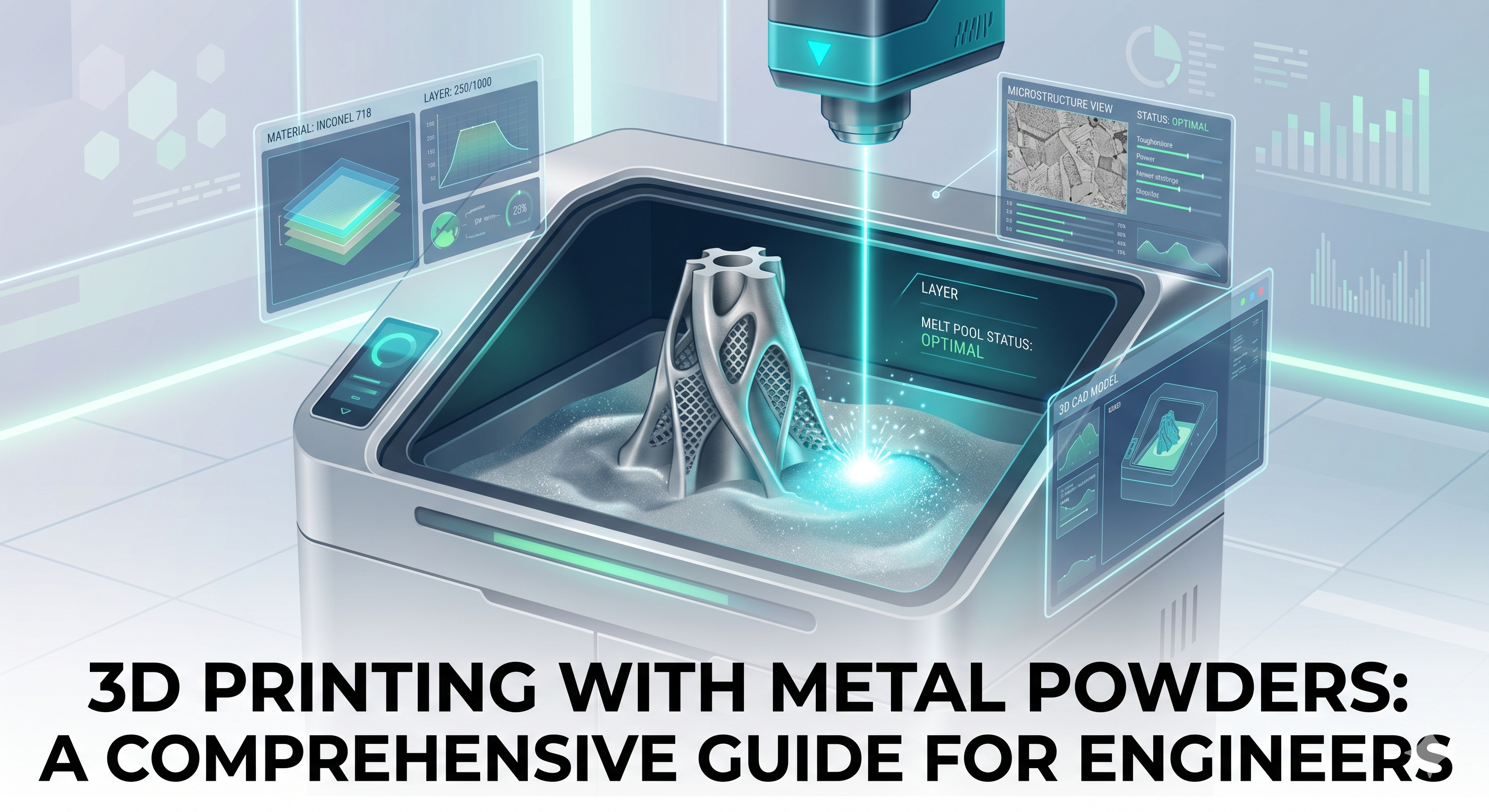
In the history of manufacturing, we have spent millennia being “subtractive.” We took a block of stone, wood, or steel and chipped away at it until the desired shape remained. Today, we are witnessing a fundamental shift. We are no longer carving; we are “growing.” Metal Additive Manufacturing (AM)—commonly known as 3D printing with metal powders—has moved from the fringes of rapid prototyping to the core of aerospace, automotive, and medical engineering.
For an engineer, metal 3D printing isn’t just a new tool; it’s a new language. It allows for geometries that were previously impossible to cast or machine. But this “alchemy” of turning dust into high-performance components comes with a steep learning curve. This guide explores the metallurgy, the mechanics, and the future of metal powder bed fusion.
The Anatomy of the Process: How Powder Becomes Part
At the heart of most metal 3D printing lies Powder Bed Fusion (PBF). Whether you are using a laser (Selective Laser Melting – SLM) or an electron beam (Electron Beam Melting – EBM), the basic principle is the same: a thin layer of metal powder is spread across a build plate, and a high-energy source selectively melts the particles to form a cross-section of the part.
1. Selective Laser Melting (SLM/DMLS)
This is the most common method. A high-powered fiber laser melts fine metal powder in an inert gas environment (usually Argon or Nitrogen) to prevent oxidation. SLM produces parts with excellent surface finish and high dimensional accuracy.
2. Electron Beam Melting (EBM)
Unlike SLM, EBM takes place in a vacuum. It uses an electron beam to melt the powder. Because the build chamber is kept at high temperatures (often above 700°C), the resulting parts have lower internal stresses. However, the surface finish is generally coarser than laser-based systems.
3. Directed Energy Deposition (DED)
In DED, the powder isn’t sitting in a bed; it is blown through a nozzle into the path of a laser. Think of it as “3D welding.” This is primarily used for repairing expensive components (like turbine blades) or adding features to existing parts.
The Metallurgy of the Dust: Why Powder Quality is Everything
In metal AM, the powder is the “ink.” If the ink is clogged or inconsistent, the print will fail. Engineers must focus on four critical powder characteristics:
-
Morphology: For the powder to flow smoothly across the bed, the particles should be as spherical as possible. “Satellites” (tiny particles stuck to larger ones) or elongated shapes cause friction and lead to uneven layers.
-
Particle Size Distribution (PSD): You don’t want all particles to be the same size. A mix of sizes allows smaller particles to fill the gaps between larger ones, increasing the “packing density” and resulting in a denser final part.
-
Chemical Purity: Metal powders have a massive surface area, making them highly reactive. Oxygen and nitrogen pick-up can embrittle the part. For materials like Titanium or Aluminum, managing “interstitial” elements is a full-time job.
-
Flowability: This is a measure of how easily the powder moves. It is tested using a Hall Flow Meter. If the powder doesn’t flow, the recoater blade will “hop,” leaving gaps in the build.
Common Materials and Their Engineering Profiles
| Material | Key Properties | Primary Applications |
| Ti6Al4V (Titanium) | High strength-to-weight, biocompatible. | Aerospace frames, medical implants. |
| Inconel 718 (Nickel Alloy) | Extreme heat and corrosion resistance. | Rocket engines, gas turbines. |
| 316L Stainless Steel | Corrosion resistance, ductility. | Chemical processing, jewelry, marine. |
| AlSi10Mg (Aluminum) | Lightweight, good thermal conductivity. | Heat exchangers, automotive brackets. |
| Cobalt-Chrome (CoCr) | High wear resistance, biocompatible. | Dental crowns, knee joints. |
Design for Additive Manufacturing (DfAM): Rethinking the Blueprint
One of the biggest mistakes engineers make is “printing a part designed for a CNC machine.” This is inefficient and expensive. To succeed in metal AM, you must embrace DfAM.
-
Topology Optimization: Using software to place material only where the stress lines require it. This often results in “organic” or “skeletal” looks that are lighter and stronger than traditional blocks.
-
Lattice Structures: 3D printing allows for internal “honeycomb” or “gyroid” structures. These provide high stiffness with minimal weight and can even be used for heat dissipation.
-
Support Structures: In metal AM, you aren’t just fighting gravity; you are fighting heat. Supports act as “heat sinks” to pull thermal energy away from the part, preventing it from warping or “curling” like a potato chip during the build.
Current Research (2025-2026): The “Pulse” of Innovation
The research landscape in 2026 is moving away from “Can we print it?” to “How perfectly can we print it?”
1. In-Situ Process Monitoring
Researchers are now using high-speed IR cameras and acoustic sensors to monitor the melt pool in real-time. If the AI detects a “cold spot” (a place where the metal didn’t melt perfectly), the laser can adjust its power mid-layer to fix the defect before the next layer is spread. This “closed-loop” manufacturing is significantly reducing scrap rates.
2. Multi-Metal Printing
The “Holy Grail” of metal AM is printing two different metals in the same part—for example, a copper core for conductivity with a steel outer shell for strength. New “dual-feeder” systems are beginning to make this a reality in research labs, promising a revolution in electric motor design.
3. Nano-Functionalized Powders
By coating metal powders with a thin layer of nanoparticles (like carbon nanotubes or ceramic oxides), researchers are creating “Grain Refiners.” These nanoparticles act as nucleation sites, resulting in a much finer microstructure and preventing the “hot cracking” typically seen in high-strength aluminum alloys.
Clinical and Medical Applications: Metal in the Human Body
The medical field has been the most aggressive adopter of metal 3D printing. The “clinical” advantage isn’t just the shape—it’s the texture.
Orthopedic Breakthroughs and Osteointegration
When a surgeon replaces a hip or a knee, the goal is for the patient’s natural bone to grow into the implant. Traditional smooth titanium implants rely on mechanical fit. However, 3D printed implants can be designed with a Trabecular (Porous) Structure.
Clinical studies published in 2025 have shown that these “bone-mimicking” porous surfaces increase the rate of osteointegration by up to 40% compared to traditional grit-blasted surfaces. Because the bone grows through the implant, the long-term stability is significantly improved, reducing the need for painful “revision” surgeries.
Patient-Specific Implants (PSI)
For complex cranial or maxillofacial reconstructions, surgeons can now take a CT scan and print a titanium plate that fits the patient’s unique anatomy to within a fraction of a millimeter. This reduces surgery time and improves aesthetic outcomes.
Advantage vs. Risk Assessment: The Engineer’s Balance Sheet
Metal 3D printing is not a magic wand; it is a high-stakes engineering choice.
The Advantages:
-
Complexity for Free: A complex part costs the same to print as a simple one.
-
Part Consolidation: You can turn an assembly of 20 parts into a single printed component, eliminating bolts, welds, and points of failure.
-
Supply Chain Resilience: Instead of keeping a warehouse full of spare parts, you keep a library of digital files and a few drums of powder.
The Risks and Challenges:
-
Surface Roughness: Printed parts often require “Post-Processing” (CNC milling, polishing, or sandblasting) to meet tight tolerances or fatigue requirements.
-
Residual Stress: The rapid heating and cooling can leave massive internal tensions in the part. Without proper “Stress Relief” heat treatment, the part may crack weeks after it was printed.
-
Powder Safety: Metal powders (especially Titanium and Aluminum) are highly flammable and even explosive in dust form. Inhaling these powders is a severe health risk, requiring strict PPE and “Explosion-Proof” facility designs.
-
Anisotropy: Like wood, 3D printed metal can be stronger in one direction than another (usually weaker in the ‘Z’ or build direction). Engineers must account for this in their stress simulations.
The Sustainability Angle: Near-Zero Waste
In traditional machining, you might start with a 10kg block of titanium and shave it down to a 1kg part—wasting 90% of the material. In metal AM, you only use what you melt. The “overflow” powder is collected, sieved, and recycled for the next print. While there is a limit to how many times powder can be reused before its oxygen levels become too high, the “Buy-to-Fly” ratio of 3D printing is vastly superior to traditional methods.
Conclusion
Metal 3D printing is maturing. We have moved past the hype and into the era of serious production. For the modern engineer, the challenge is no longer mastering the software, but mastering the Material Science. Understanding how a micron-sized particle of powder behaves under a 400-watt laser is the key to building the next generation of spacecraft, heart valves, and high-performance engines.
As we look toward 2030, the integration of AI-driven design and real-time defect correction will make metal AM as reliable as traditional casting. The only limit left will be the engineer’s imagination—and their willingness to forget the “rules” of subtractive manufacturing.