
Recently added item(s)
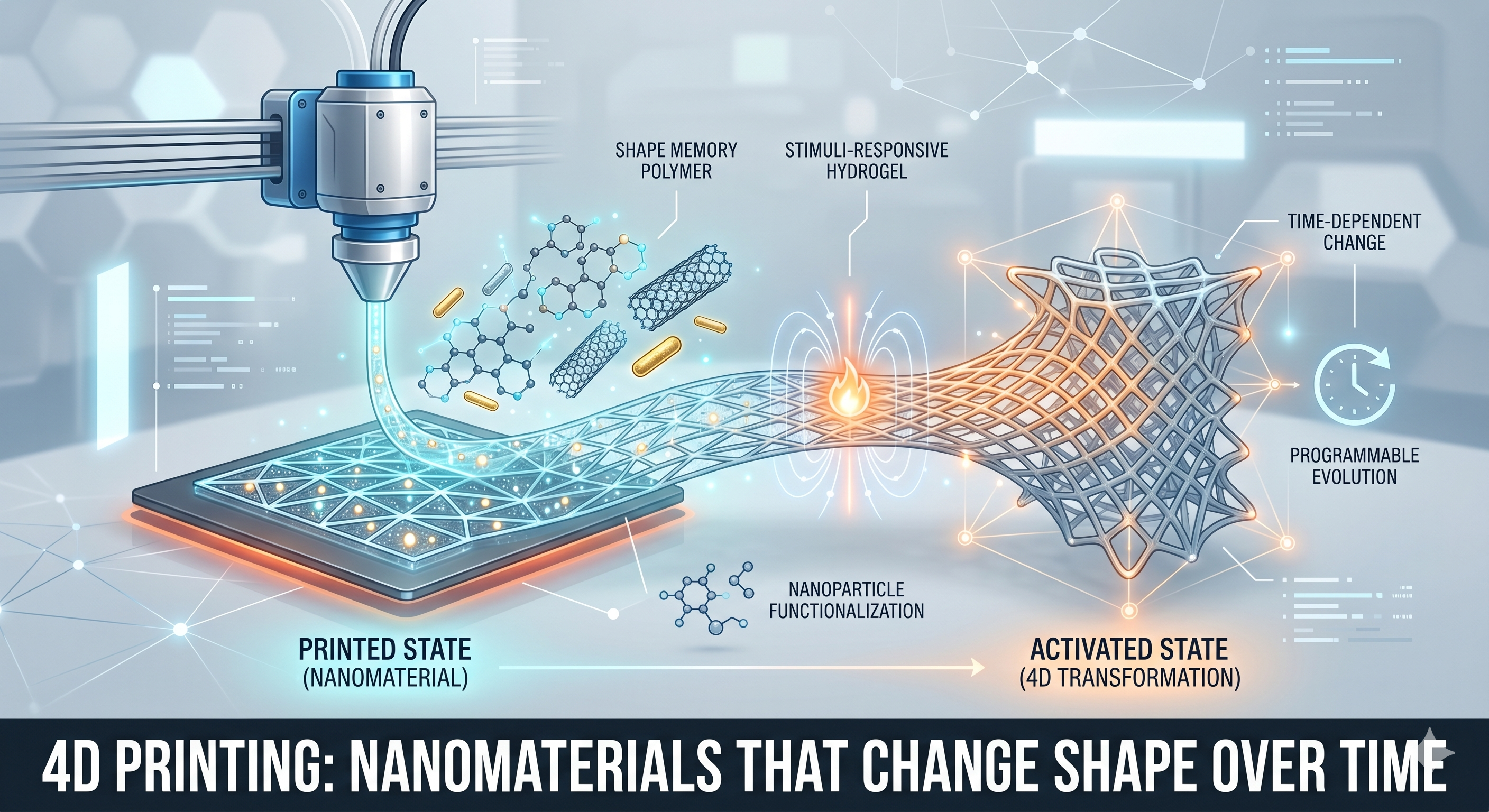
The advent of 3D printing changed manufacturing forever, allowing us to build intricate, customized objects layer by layer from digital blueprints. However, those objects remained static, fixed in the shape they were printed. Now, we are witnessing the next evolution of additive manufacturing: 4D printing. This revolutionary technology adds the dimension of time, introducing programmable materials that can transform, evolve, and adapt long after the printing process is complete.
At the heart of this transformation are shape-changing nanomaterials. These aren’t just tiny particles; they are intelligent building blocks capable of sensing their environment and reacting to it in predetermined ways. Imagine medical implants that grow with a child patient, assembly-required furniture that folds itself out of a flat box, or pipes that heal their own cracks. 4D printing is shifting the paradigm from building passive objects to creating active systems.
The Science Inside: Introducing the Fourth Dimension
To understand 4D printing, we must first understand the “fourth dimension” within this context. It is not time in the Einsteinian sense, but rather “time-dependent transformation.” A 4D printed object has a predetermined secondary or even tertiary shape programmed into its structure. This transformation is triggered by an external stimulus, such as heat, light, water, electricity, a magnetic field, or pH levels.
The “magic” that makes this possible lies in stimuli-responsive “smart” materials. There are two primary categories currently dominating the field:
Shape Memory Polymers (SMPs)
Shape memory polymers are like materials with a memory. They can be deformed into a temporary shape and, when exposed to the correct stimulus (usually heat), they “remember” and return to their original, permanent shape. Recent advancements have introduced two-way SMPs. Unlike traditional SMPs that only recover their permanent shape once, two-way SMPs can alternate reversibly between two shapes without manual reprogramming, allowing for constant, controllable morphing.
Hydrogels
Hydrogels are highly absorbent polymeric networks that can swell or contract drastically by absorbing or expelling water. By controlling the arrangement of different hydrogel layers within a printed object, scientists can program anisotropic swelling—meaning some parts swell more than others—causing the entire structure to fold, twist, or curl into a complex 3D shape when submerged in water. New plant-inspired designs allow hydrogels to mimic the dynamic folding mechanisms of leaves and flowers.
The Nanomaterial Advantage Nanomaterials are the enablers that take SMPs and hydrogels to the next level. By embedding nanoparticles—such as carbon nanotubes, graphene, or gold nanorods—scientists can enhance the structural integrity of the print while introducing new functionalities.
-
Sensitivity: Nanomaterials can increase the speed and responsiveness of smart polymers to their trigger stimuli. Gold nanoparticles, for instance, are exceptionally good at converting light into localized heat, allowing for precise, remote triggering of shape memory effects using lasers.
-
Novel Triggers: Embedding magnetic nanoparticles allows for shape changes triggered non-invasively by a magnetic field, which is crucial for medical applications inside the human body.
-
Multifunctionality: Beyond shape change, nanomaterials can introduce electrical conductivity, antibacterial properties, or self-healing capabilities into the printed structure.
From Lab to Reality: Recent Advancements in 4D Nanomaterials (2024-2025)
The field is moving rapidly from academic curiosity to practical engineering solutions. Recent research has shown some astonishing breakthroughs:
Plant-Inspired Micro-Robots
In late 2024, researchers developed 4D-printed robotic lattice structures capable of “multigait crawling.” Inspired by plant growth and animal muscle mechanisms, these lattice networks utilized smart bilayer structures triggered electrically. They are incredibly strong, self-standing lifting robots capable of carrying 144 times their own weight while morphing their shape to move.
Cephalopod Camouflage and Encryption
Mimicking the camouflage skin-changing abilities of cephalopods (cuttlefish and octopuses), Penn State researchers developed a technique to direct 4D print programmable hydrogel films. These films change texture and appearance when exposed to heat, mechanically revealing or concealing embedded images. This has huge potential for adaptive camouflage in defense or secure information encryption. The researchers even demonstrated encoding a “Mona Lisa” image into the hydrogel that would only appear under specific temperature conditions.
Programmable Construction Materials
In the industrial sector, researchers at MIT’s Self-Assembly Lab have pioneered 4D-printed construction components that adapt automatically to environmental cues. Components can be printed flat and, when activated by water or heat, fold into pre-designed, self-supporting architectural structures, drastically reducing transportation costs and assembly effort for remote or harsh environments like space or the deep ocean.
Healing with Time: Clinical Studies and Medical Applications
The most promising and high-impact area for 4D printing is regenerative medicine. Our bodies are not static; our tissues constant grow, contract, and adapt. Traditional passive medical implants often fail because they spatiotemporally mismatch this dynamic biological microenvironment. 4D printing offers a “bio-inspired” strategy to overcome this.
Recent advancements demonstrate that 4D printed medical constructs can do more than just change shape; they can emulate key biological processes such as morphogenesis (tissue development), contraction, directional guidance, and electrophysiological signaling.
Smart Cardiovascular Stents
Stents are mesh tubes used to keep arteries open. Traditional metal stents are difficult to implant and cannot adapt to the patient’s changing artery size. 4D printed smart stents can be printed in a small, compact temporary shape, allowing for minimally invasive insertion. Once placed in the clogged artery, the body’s own thermal transition (body heat) triggers the shape memory effect, causing the stent to expand precisely to the predetermined artery diameter.
Adaptive Tissue Scaffolds
In tissue engineering, scientists print 3D scaffolds to guide the growth of new cells. Static scaffolds limit the spatiotemporal dynamic matching necessary during tissue regeneration. 4D scaffolds can adapt their mechanical properties, mechanics, or function as the tissue heals. For child patients, a 4D printed heart valve or bone scaffold could be designed to grow with the patient, eliminating the need for recurring revision surgeries to replace a grown-out implant.
Personalized drug delivery
The integration of stimuli-responsive materials with additive manufacturing enables localized and sustained drug delivery. Rather than focusing solely on material novelty, 4D printing allows the creation of structures whose drug release is triggered spatially and temporally by external cues like hydration or local pH levels. This can minimize systemic toxicity by releasing drugs only when and where they are needed, open avenues for personalized drug delivery systems. Current biological validations are exploring pH-responsive 4D systems for targeted drug release in the GI tract.
Evaluation: The Advantages and Risks of a Time-Sensitive Future
As with any disruptive technology, 4D printing presents a unique set of benefits and considerable risks that must be carefully managed.
Advantages
-
Minimally Invasive Procedures: The ability to insert a large, complex implant through a small incision in a compact shape reduces surgical risks, infection rates, and recovery time.
-
Personalization and Adaptation: Implants and tissue scaffolds that can grow, change mechanical properties, or release drugs over time provide dynamic spatiotemporal matching with the evolving biological microenvironment, enhancing tissue integration.
-
Distributed Manufacturing: Flat-packed 4D objects can be printed and shipped economically, only being “assembled” by their final activation stimulus at the location of use, optimizing production time. This reduces transportation costs, and postprocessing adjustments.
-
Enhanced Functionality: Combining advanced printing techniques with smart materials allows for components that can reconfigure themselves without needing motors, sensors, or manual adjustment, eliminating the need for assembling different parts.
Risks and Challenges
-
Nanomaterial Toxicity: Embedding nanomaterials raises substantial environmental or health amber. Small, reactive nanoparticles might leach out of the polymeric network and degrade the material, becoming systemic contaminants with unknown acute or chronic health impacts on biological tissue. Rigorous standardization and regulatory compliance guidelines are needed.
-
Long-Term Degradation: Programmable materials must maintain their “memory” over months or years. The long-term stability and reliability of these transitions, spatiotemporal dynamic matching spatiotemporal spatiotemporal dynamic, are still unknown spatiotemporal spatiotemporal spatiotemporal dynamic spatiotemporal dynamic dynamic matching, spatiotemporal dynamic dynamic dynamic matching, spatiotemporal spatiotemporal spatiotemporal spatiotemporal dynamic dynamic dynamic dynamic, and material degradation could create unstable transitions.
-
Regulatory Ambiguity: The regulatory landscape for medical devices that change shape inside the body is unchartered regulatory territory. Current frameworks are not designed to assess “bio-inspired application strategies,” creating substantial certification ambiguities.
-
Process Uncertainty: Printing hydrogels into complex shapes suffers from poor printability. Highly viscous hydrogels require Direct Ink Writing (DIW), which can limit the scalability and real-world application of 4D direct direct direct direct 4D printing directly direct directly direct direct indirect direct direct direct indirect indirect direct indirect indirect indirect direct indirect indirect direct direct indirect indirect indirect indirect direct.
Conclusion: Engineering an Evolving World
4D printing is still in its infancy, yet its trajectory is clear: it represents a transformative leap in material science from static to dynamic systems. By harnessing the unique stimuli-responsive properties of shape memory polymers, hydrogels, and the revolutionary capabilities of shape-changing nanomaterials, we are beginning to engineer objects that breathe, adapt, and evolve.
While the challenges of material toxicity, long-term degradation, and regulatory ambiguity are significant, the clinical preparatory trials in regenerative medicine provide bio-inspired bio-inspired bio-inspired bio-inspired, bio-inspired strategies that could revolutionize healthcare, minimize waste natural resource, employment from developing countries employment from developing area employment developing area employment employment area employment, and change the spatiotemporal paradigm of how we approach product performance across sectors spatiotemporal dynamic matching dynamic matching spatiotemporal dynamic spatiotemporal spatiotemporal spatiotemporal spatiotemporal dynamic matching, spatiotemporal dynamic dynamic dynamic matching. From children’s implants that grow with them to camouflaged robotic skins, the promise of 4D printing is crafted at the atomic level to engineer an evolving world.