
Recently added item(s)
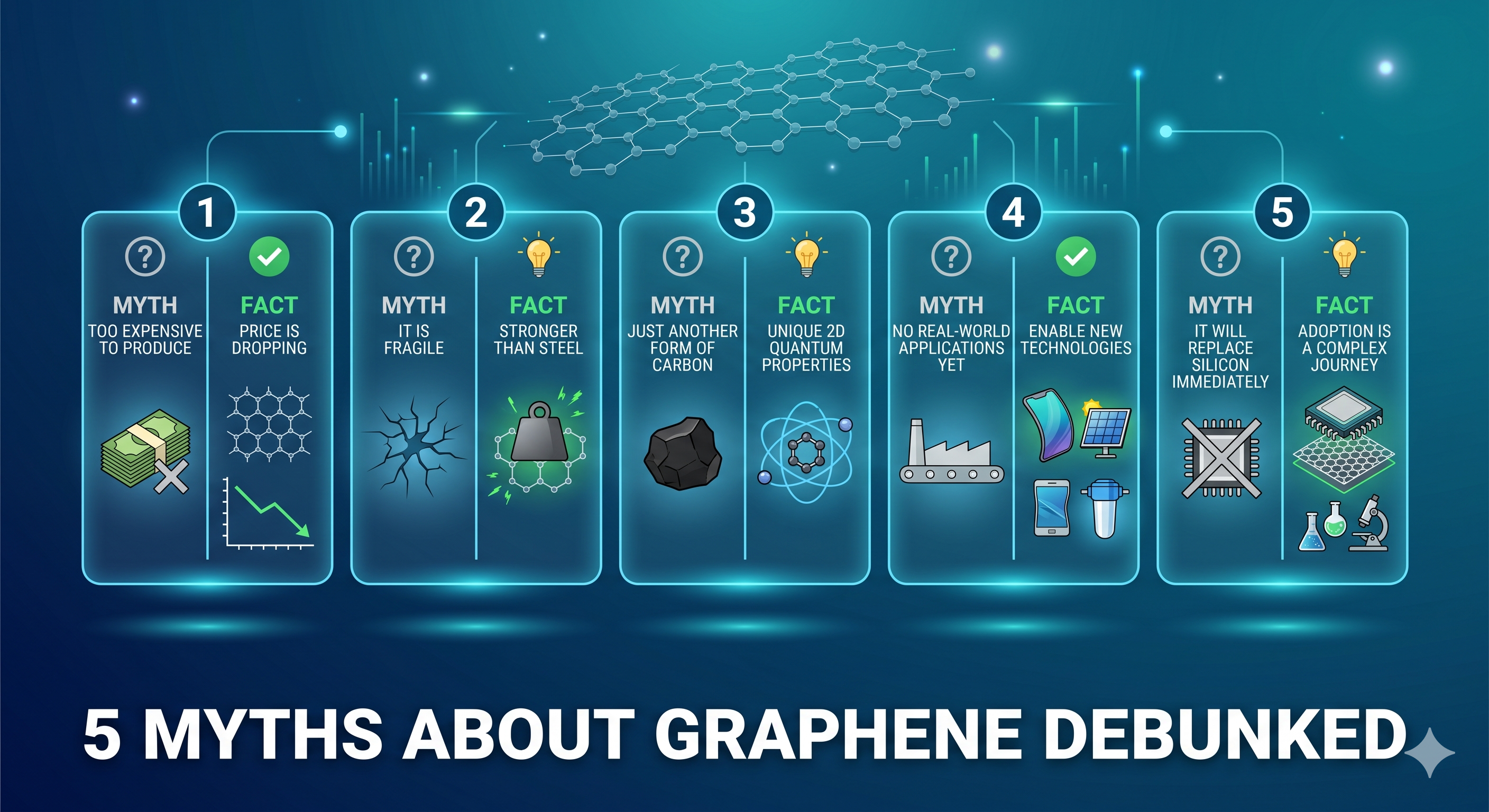
Since the 2010 Nobel Prize in Physics was awarded for its isolation, graphene has been hailed as the “wonder material” that will change everything. From space elevators to smartphones that charge in five seconds, the hype has been astronomical. However, with great hype comes great misunderstanding.
As graphene transitions from the laboratory to industrial-scale production, it is vital to separate scientific fact from science fiction. For manufacturers, researchers, and tech enthusiasts, understanding the limitations and true potential of graphene is the only way to harness its power effectively.
In this detailed exploration, we debunk five of the most persistent myths surrounding graphene and provide a balanced view of where this technology stands in 2026.
Myth 1: Graphene is a “New” Discovery
A common misconception is that graphene didn’t exist until Andre Geim and Konstantin Novoselov used sticky tape to isolate it in 2004. In reality, scientists have known about graphene for nearly a century.
The Scientific History
Theoretically, graphene was described as early as 1947 by physicist P.R. Wallace as a starting point for understanding the electronic properties of 3D graphite. Throughout the 1960s and 70s, researchers observed single layers of carbon on various surfaces, but they believed a perfectly flat 2D crystal could not exist in a stable form at room temperature—they thought it would “curl up” or melt.
The 2004 “sticky tape” breakthrough wasn’t the discovery of graphene’s existence, but the discovery of a method to isolate it in a way that preserved its incredible properties.
Why it Matters
Understanding that graphene is a fundamental component of graphite (the stuff in your pencil) helps demystify the material. It isn’t an alien substance; it is a specific arrangement of carbon that we have finally learned how to handle.
Myth 2: Graphene is Too Expensive for Industrial Use
If you look at the price of high-purity graphene ten years ago, it was often cited as one of the most expensive materials on Earth, costing hundreds of dollars for a tiny flake. This led to the myth that it will never be commercially viable for “low-tech” industries like construction or textiles.
The Rise of Production Methods
The cost of graphene is directly tied to the production method and the quality required.
-
CVD (Chemical Vapor Deposition): Produces high-quality, single-layer sheets for high-end electronics. This remains expensive but is dropping in price.
-
Liquid Phase Exfoliation: Uses solvents to “peel” layers off graphite. This is much cheaper and ideal for composites and coatings.
-
Flash Graphene: A newer technique that uses high-voltage electricity to turn any carbon source (even trash) into graphene in milliseconds.
The “Doping” Effect
You don’t need a 100% graphene product to see results. In industrial applications like concrete or plastic, adding as little as 0.01% to 0.1% graphene by weight can increase strength and thermal conductivity by over 30%. When you only need a “pinch” of graphene to transform a ton of material, the cost becomes highly competitive.
Myth 3: Graphene is Only for High-End Electronics
Because of its record-breaking electron mobility, the early narrative focused almost entirely on “graphene chips” replacing silicon. When this didn’t happen overnight, critics claimed graphene was a failure.
Diversification of Applications
Graphene is a “multipotential” material. While it is excellent for electronics, its mechanical and thermal properties are currently finding more immediate success in other sectors:
-
Civil Engineering: Graphene-enhanced concrete is more water-resistant and requires less volume for the same structural strength, significantly reducing the carbon footprint of the construction industry.
-
Energy Storage: While it hasn’t replaced lithium, it is being used as a coating on electrodes to allow batteries to charge faster and last through more cycles without degrading.
-
Filtration: Graphene-oxide membranes are being tested in desalination plants. They are so precise they can filter salt out of seawater while allowing water molecules to pass through with minimal friction.
Myth 4: Graphene is Toxic to Humans and the Environment
As with any nanomaterial, there is a fear that graphene could be “the next asbestos.” Some early studies suggested that inhaled graphene flakes could cause lung irritation.
Current Research and Clinical Perspectives
Modern toxicology distinguishes between different forms of graphene.
-
Pristine Graphene: Generally inert.
-
Graphene Oxide (GO): More chemically active and potentially more interactive with biological cells.
Recent clinical and environmental studies have shown that graphene is biocompatible when used correctly. In fact, research into Graphene-based Biosensors and Targeted Drug Delivery is booming. Clinical trials are exploring graphene “scaffolds” for nerve regeneration, as the material can conduct the electrical signals the body uses to heal nerves.
Risk Management
The risk is not in the material itself, but in the handling of dry powders. In industrial settings, graphene is typically embedded in a liquid or a solid polymer matrix (a “masterbatch”). Once it is locked into a plastic or a coating, it cannot be inhaled or leached into the environment, making it safe for the end-user.
Myth 5: Any Product Labeled “Graphene” is Superior
This is perhaps the most dangerous myth for the industry. As graphene becomes a buzzword, many companies are “nano-washing” their products—adding trace amounts of low-quality graphite and calling it a “Graphene Revolution.”
Quality vs. Quantity
Not all graphene is created equal. To see the benefits, the material must be properly exfoliated (separated into thin layers) and dispersed (spread evenly without clumping). If the graphene in a product has clumped back into graphite, it provides almost no benefit.
Buyers must look for technical specifications like the number of layers, lateral flake size, and purity levels. A product with “Graphene” on the label but no technical data sheet is likely marketing hype.
Advantage–Risk Assessment
| Category | Advantage (The Reality) | Risk (The Challenge) |
| Mechanical Strength | Up to 200x stronger than steel; ideal for lightweight armor and aerospace. | Difficult to maintain this strength when scaling from micro-flakes to large sheets. |
| Conductivity | Best known conductor of heat and electricity at room temperature. | Graphene lacks a “bandgap,” making it hard to use as a traditional transistor (on/off switch). |
| Sustainability | Enables “Green Chemistry” by reducing the amount of raw material needed in manufacturing. | Energy-intensive production methods (like CVD) need to transition to renewable energy. |
| Biomedical | High surface area allows for massive drug loading and sensitive diagnostics. | Requires rigorous, long-term FDA/EMA clinical testing for internal human use. |
Current Research Trends: Beyond 2026
The focus of research has shifted from “making graphene” to “functionalizing graphene.” This involves attaching other molecules to the graphene surface to make it compatible with specific plastics, oils, or even human cells.
-
Smart Textiles: Researchers are developing graphene-coated fibers that can monitor a person’s heart rate or body temperature without the need for bulky sensors.
-
Environmental Remediation: New studies are using graphene “sponges” that can soak up oil spills in the ocean while repelling water, allowing for nearly 100% recovery of the spilled oil.
Conclusion: The Era of Implementation
Graphene has moved past the “trough of disillusionment.” We are no longer waiting for a single “killer app” to change the world. Instead, graphene is quietly becoming an invisible ingredient in our everyday lives—making our cars lighter, our buildings stronger, and our sensors more accurate.
The myths surrounding graphene often stem from a desire for instant, miraculous change. The truth is more grounded but no less exciting: graphene is a fundamental tool in the modern materials scientist’s kit, and its true potential is only just beginning to be realized in the industrial world.