Recently added item(s)
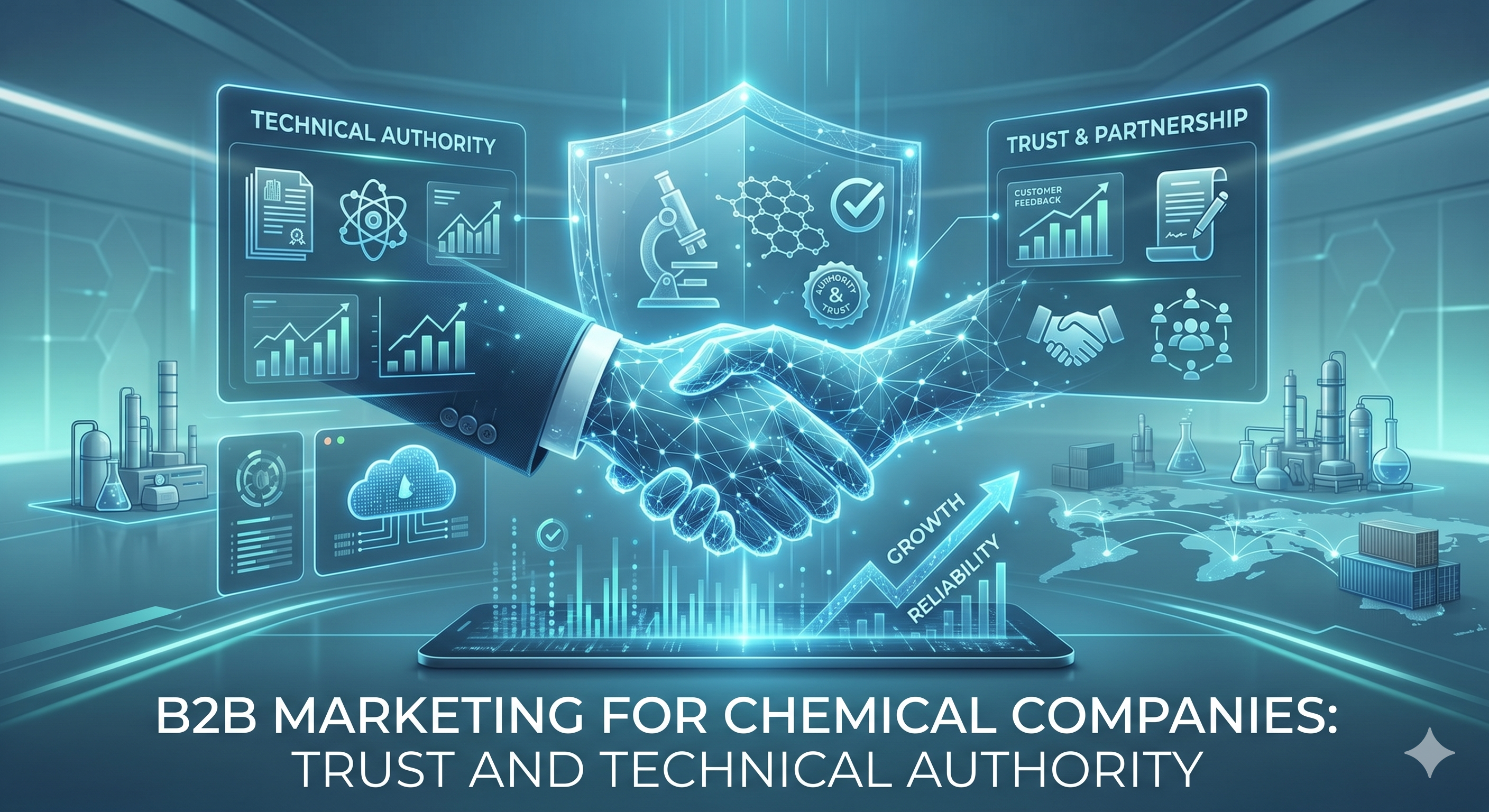
In the complex ecosystem of the chemical industry, marketing is far more than just a creative exercise; it is a high-stakes exchange of information. Unlike the consumer market, where emotional triggers often drive purchases, the B2B chemical sector operates on a foundation of rigorous logic, safety compliance, and performance metrics. When a procurement manager or a formulation chemist chooses a supplier, they are not just buying a substance—they are investing in a partnership that impacts their product’s safety, regulatory standing, and market success.
The modern chemical marketer must balance two critical pillars: Trust and Technical Authority. As supply chains become more globalized and materials like nanomaterials, advanced polymers, and specialty catalysts become more sophisticated, the “sales pitch” has evolved into a “scientific consultation.”
1. The Paradigm Shift: From Product Seller to Technical Partner
Traditionally, B2B chemical marketing focused on availability, price, and basic specifications. However, recent shifts in global trade and environmental regulations (such as REACH in Europe or OSHA in the US) have changed the buyer’s journey. Today, technical authority is the primary differentiator.
What is Technical Authority?
Technical authority is the perceived expertise of a company within its specific niche. It is the ability to provide not only the chemical itself but also the application knowledge, toxicological data, and troubleshooting support required to use that chemical effectively. In a world where basic chemicals are commoditized, authority is what allows a company to command a premium and ensure long-term loyalty.
2. The Science of Trust: Cognitive Load and Decision-Making
Building trust in a scientific field requires an understanding of how technical professionals process information. In B2B environments, buyers are often under high “cognitive load”—they must evaluate thousands of data points regarding purity, stability, and safety.
Empirical Proof as a Trust Builder
Current research in industrial psychology suggests that B2B buyers in the “hard sciences” prioritize empirical evidence over brand storytelling. A study of industrial procurement habits shows that 80% of technical buyers prefer content that includes raw data, peer-reviewed citations, and detailed methodology over traditional marketing brochures.
To build trust, marketing materials should mirror the structure of a scientific paper:
-
Observation: Identifying the industrial challenge (e.g., thermal instability in polymers).
-
Hypothesis: Proposing a chemical solution.
-
Experimentation: Providing case studies or pilot plant results.
-
Conclusion: Demonstrating the ROI and safety profile.
3. The Role of Content: Documentation as Marketing
In the chemical world, your most effective marketing tools are often your most technical documents. As we have seen in global trade, the Material Safety Data Sheet (MSDS/SDS) and the Technical Data Sheet (TDS) are the “passports” of your product. However, from a marketing perspective, these documents are also “proof of authority.”
Beyond the TDS: White Papers and Clinical Studies
To establish true authority, companies must go beyond the standard documentation.
-
White Papers: These allow a company to explore the “why” behind a chemical’s performance. For instance, a company specializing in carbon nanotubes might publish a white paper on “The Rheological Impact of Multi-Walled Carbon Nanotubes in Epoxy Resins.”
-
Clinical and Toxicological Studies: Especially for companies in the pharmaceutical, cosmetic, or food-grade chemical sectors, providing transparent access to clinical safety studies is the ultimate trust builder. Demonstrating that a material is non-cytotoxic or has a specific LD50 value through verified laboratory reports eliminates the “perceived risk” for the buyer.
4. Leveraging Advanced Materials: The Graphene Example
Advanced materials like graphene and nanopowders represent the frontier of technical marketing. These materials are often misunderstood or “over-hyped.” A company that markets graphene by making vague claims about “strength” will lose credibility.
In contrast, a company that establishes technical authority will provide specific data:
-
Instead of “High Strength,” they cite “Tensile strength increases of 25% at 0.1% wt loading.”
-
Instead of “Conductive,” they provide “Electromagnetic Interference (EMI) shielding effectiveness in dB.”
By speaking the language of the engineer, the marketer transforms the product from a “miracle material” into a “predictable industrial input.”
5. Advantage–Risk Evaluation in Chemical Marketing
Every marketing strategy in the chemical sector carries a set of trade-offs. Evaluating these is essential for a balanced, long-term approach.
The Advantages of Authority-Based Marketing
-
Shortened Sales Cycles: When the technical data is comprehensive and transparent, the “technical vetting” phase—which can often take months—is streamlined.
-
Higher Retention Rates: Technical partnerships are “sticky.” Once a customer integrates your chemical into their formulation based on your technical advice, they are less likely to switch to a competitor for a marginal price difference.
-
Regulatory Resilience: Companies that lead with authority are usually ahead of the curve on regulations. When a new environmental law is passed, an authoritative supplier is the first to provide the updated SDS and a compliant alternative.
The Risks of “Technical Washing”
-
The Credibility Gap: The greatest risk in B2B marketing is “Technical Washing”—making scientific claims that cannot be replicated in the customer’s lab. If a batch of metal powder does not meet the particle size distribution (PSD) claimed on the TDS, the trust is broken, often permanently.
-
Over-Complexity: There is a risk of making marketing materials too dense, alienating the procurement side of the business. The goal is to be “scientifically accessible”—accurate enough for the chemist, but clear enough for the CFO.
-
Liability Exposure: Over-promising on safety or performance can lead to significant legal risks. Marketing claims must always be synchronized with the legal realities of the SDS.
6. Digital Transformation and the “Human” Expert
While data is king, the delivery mechanism is changing. We are seeing a move toward Digital Technical Authority.
Virtual Labs and AI-Driven Support
Modern chemical companies are using digital tools to enhance trust.
-
Predictive Modeling: Offering customers a tool where they can input their formulation and see how your additive will affect the viscosity or curing time.
-
Transparency through Blockchain: Using digital ledgers to provide a “Chain of Custody” for raw materials, proving the ethical and geographic origin of minerals or precursors.
The Rise of the Subject Matter Expert (SME)
In B2B marketing, the “face” of the company should not be a polished spokesperson, but the Chief Scientist or the Lead Engineer. Content featuring these experts—whether through webinars, LinkedIn thought leadership, or technical podcasts—humanizes the authority. It shows that behind the chemical drums, there is a brain that understands the customer’s specific pain points.
7. Strategic Recommendations for B2B Chemical Marketers
To effectively build a brand based on trust and authority, companies should follow a structured roadmap:
-
Audit Your Data: Ensure that every claim on your website is backed by a downloadable TDS or a peer-reviewed study.
-
Educate, Don’t Just Sell: Create a “Technical Resource Hub” that helps customers solve general industry problems, not just problems involving your specific product.
-
Invest in Quality Visuals: Use high-resolution SEM (Scanning Electron Microscope) images, 3D molecular renderings, and clear data visualizations. In a technical world, a clear graph is worth a thousand words.
-
Sync Marketing with R&D: Marketing should be the bridge between the lab and the market. Regular meetings between these departments ensure that marketing is communicating the true technical value proposition.
8. Conclusion: Trust as a Competitive Moat
In the global chemical trade, technical authority is the only sustainable competitive advantage. Prices will fluctuate, and logistics will face disruptions, but a reputation for scientific integrity and technical excellence is a “moat” that competitors cannot easily cross.
By prioritizing transparency, embracing the rigors of clinical and laboratory data, and positioning themselves as technical consultants rather than mere vendors, chemical companies can build the deep-seated trust required to lead the markets of the future. Whether you are selling bulk solvents or cutting-edge graphene, the goal remains the same: provide the data that empowers your customer to innovate safely.