
Recently added item(s)
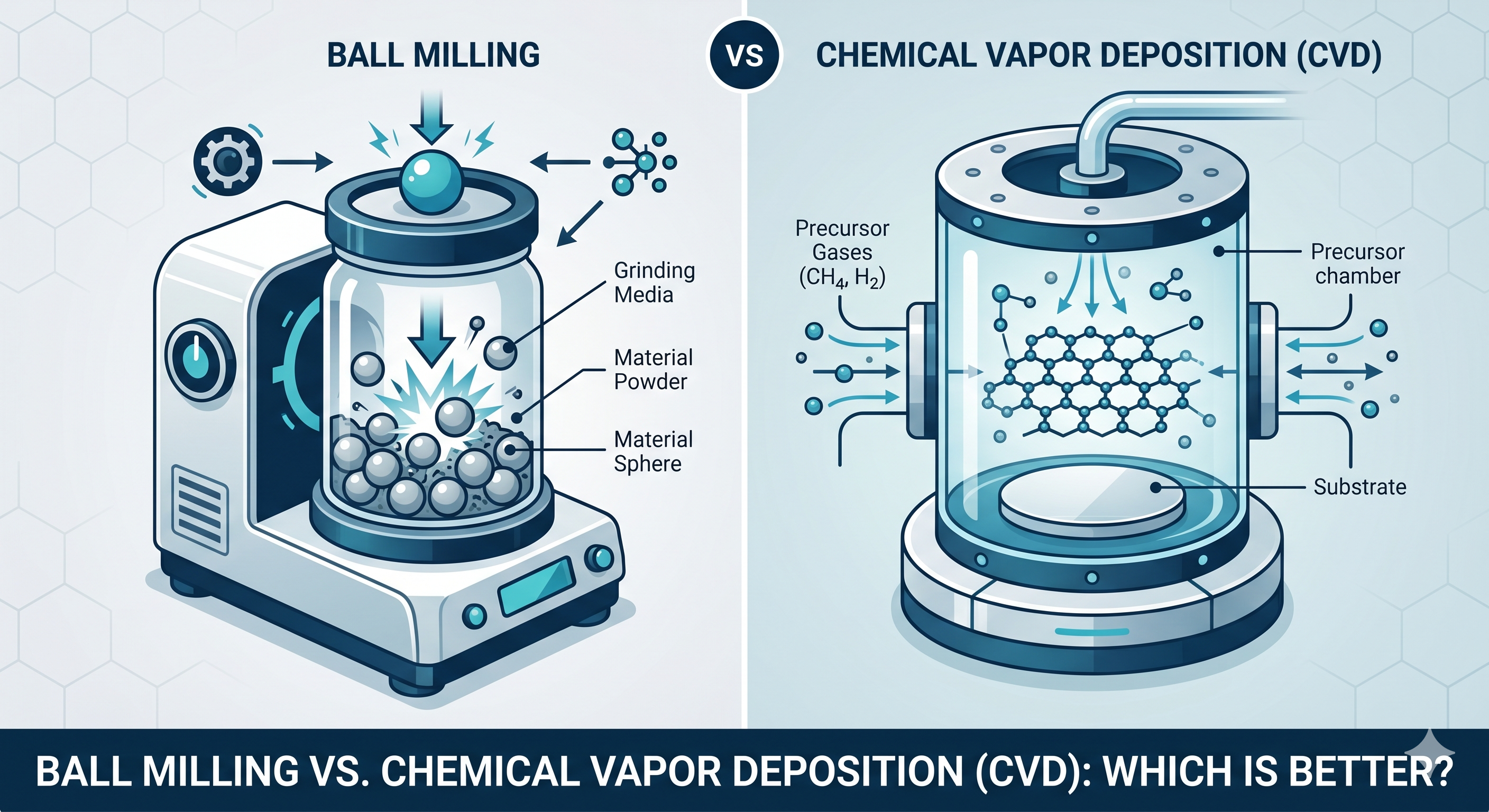
In the rapidly evolving world of nanotechnology, the method used to create materials often dictates their final success in medical, industrial, or electronic applications. Whether we are building scaffolds for regenerative medicine or sensors for rapid pathogen detection, we must choose between two fundamentally different philosophies of construction: Top-Down and Bottom-Up.
Ball Milling and Chemical Vapor Deposition (CVD) represent these two extremes. Ball Milling is the “sledgehammer” of the nano-world—a mechanical process that grinds large materials into microscopic dust. CVD, on the other hand, is the “architect”—a chemical process that builds materials atom-by-atom from the vapor phase. This article provides a comprehensive comparison of these two powerhouses, evaluating which is better suited for the future of high-tech manufacturing.
2. Ball Milling: The Power of Mechanical Force
Ball Milling is a “Top-Down” synthesis technique. It involves placing a precursor material (like graphite) into a hollow cylindrical shell filled with grinding media, such as steel or ceramic balls. As the shell rotates or vibrates, the balls collide with the material, breaking chemical bonds through high-energy impacts.
How It Works:
-
Impact and Attrition: The kinetic energy of the falling balls creates localized high pressure and temperature.
-
Size Reduction: Solid materials are repeatedly fractured until they reach the nanoscale.
-
Mechanochemistry: In some cases, the energy is so high that it triggers chemical reactions between different powders, allowing for the creation of new alloys or functionalized nanotubes.
3. Chemical Vapor Deposition (CVD): Precision from the Gas Phase
CVD is a “Bottom-Up” approach. It is the gold standard for producing high-quality, high-purity solid materials, most notably carbon nanotubes (CNTs) and graphene. In a CVD reactor, gaseous precursors are chemically reacted on a heated substrate, often with the help of a catalyst.
How It Works:
-
Precursor Introduction: Gases (like methane or ethylene) are pumped into a vacuum chamber.
-
Thermal Decomposition: The heat causes the gas molecules to break apart.
-
Growth: The carbon atoms settle onto a surface, organizing themselves into perfect hexagonal lattices or tubes.
4. Direct Comparison: Performance Metrics
To decide which is “better,” we must look at specific performance criteria required for modern applications.
A. Purity and Structural Integrity
-
CVD: Produces materials with near-perfect crystal structures. This is essential for Brain-Machine Interfaces, where high conductivity depends on a lack of structural defects.
-
Ball Milling: Frequently introduces impurities from the grinding balls (e.g., iron particles) and creates “defects” in the material’s lattice. While usually a disadvantage, these defects can sometimes be useful for attaching biological molecules in tissue engineering.
B. Scalability and Cost
-
Ball Milling: Highly scalable and cost-effective. It can produce kilograms of nanomaterials in a relatively short time without the need for expensive vacuum systems or toxic gases.
-
CVD: High operational costs. While it can be scaled for industrial use, the energy requirements and the need for specialized gases make it significantly more expensive per gram of material produced.
C. Versatility
-
CVD: Limited to materials that can be formed from vapors. It is excellent for 1D (nanotubes) and 2D (graphene) structures.
-
Ball Milling: Can be applied to almost any solid material, making it a universal tool for creating metal-matrix composites or hybrid powders.
5. Medical and Clinical Research Applications
The choice between Ball Milling and CVD often depends on the specific biological target.
Regenerative Medicine (Scaffolding)
For bone regeneration scaffolds, Ball Milling is often preferred because the “rough” surface of mechanically ground particles encourages better cell adhesion. However, for Neural Scaffolding, CVD-grown carbon nanotubes are superior because their high conductivity is required to facilitate electrical signaling across damaged nerves.
Rapid Pathogen Detection
In biosensors, CVD is almost always the winner. The high sensitivity required to detect a single virus particle depends on the perfect electrical properties of graphene or carbon nanotubes, which can only be achieved through the precision of CVD.
6. Advantage vs. Risk Assessment
Every engineering choice involves a trade-off between performance and safety.
| Metric | Ball Milling (Top-Down) | CVD (Bottom-Up) |
| Purity | Risk of contamination from grinding media. | Very high; catalyst residues are the only concern. |
| Surface Area | High, but often irregular. | High and highly uniform. |
| Control | Difficult to control exact diameter or length. | Excellent control over thickness and orientation. |
| Environmental Impact | Solid waste is manageable; low energy. | Involves toxic precursor gases and high heat. |
| Safety | High-pressure milling can be volatile. | Risks associated with gas leaks and high-temp reactors. |
7. Global Regulatory and Safety Considerations
From a Global Regulatory View, CVD-produced materials are often easier to standardize because their properties are more consistent from batch to batch. Regulators like the FDA or EMA require “physicochemical identity,” and the high precision of CVD makes this characterization easier for developers.
However, Ball Milling is gaining traction in “Green Nanotechnology” because it avoids the use of harsh chemical solvents, making it more compliant with emerging environmental safety standards for healthcare manufacturing.
8. Hybrid Approaches: The Best of Both Worlds?
Recent research is exploring “Milling-Assisted CVD.” In this process, Ball Milling is used to prepare highly active catalyst powders, which are then used in a CVD reactor to grow nanotubes with unprecedented speed. This hybrid approach aims to combine the cost-effectiveness of mechanical processing with the structural perfection of chemical growth.
9. Conclusion: The Verdict
Is Ball Milling better than CVD? The answer is: It depends on your goal.
-
Choose Ball Milling if you need mass-produced, cost-effective nanomaterials for structural reinforcement in bone implants or large-scale composites where slight impurities are acceptable.
-
Choose CVD if you are building high-precision medical tools, such as Brain-Machine Interfaces, rapid diagnostic sensors, or targeted drug delivery systems where atomic-level perfection is mandatory.
As we move deeper into the 2020s, the “battle” is shifting toward collaboration. By using these two methods in tandem, scientists are creating a new generation of bio-compatible materials that are both affordable and incredibly powerful.