
Recently added item(s)
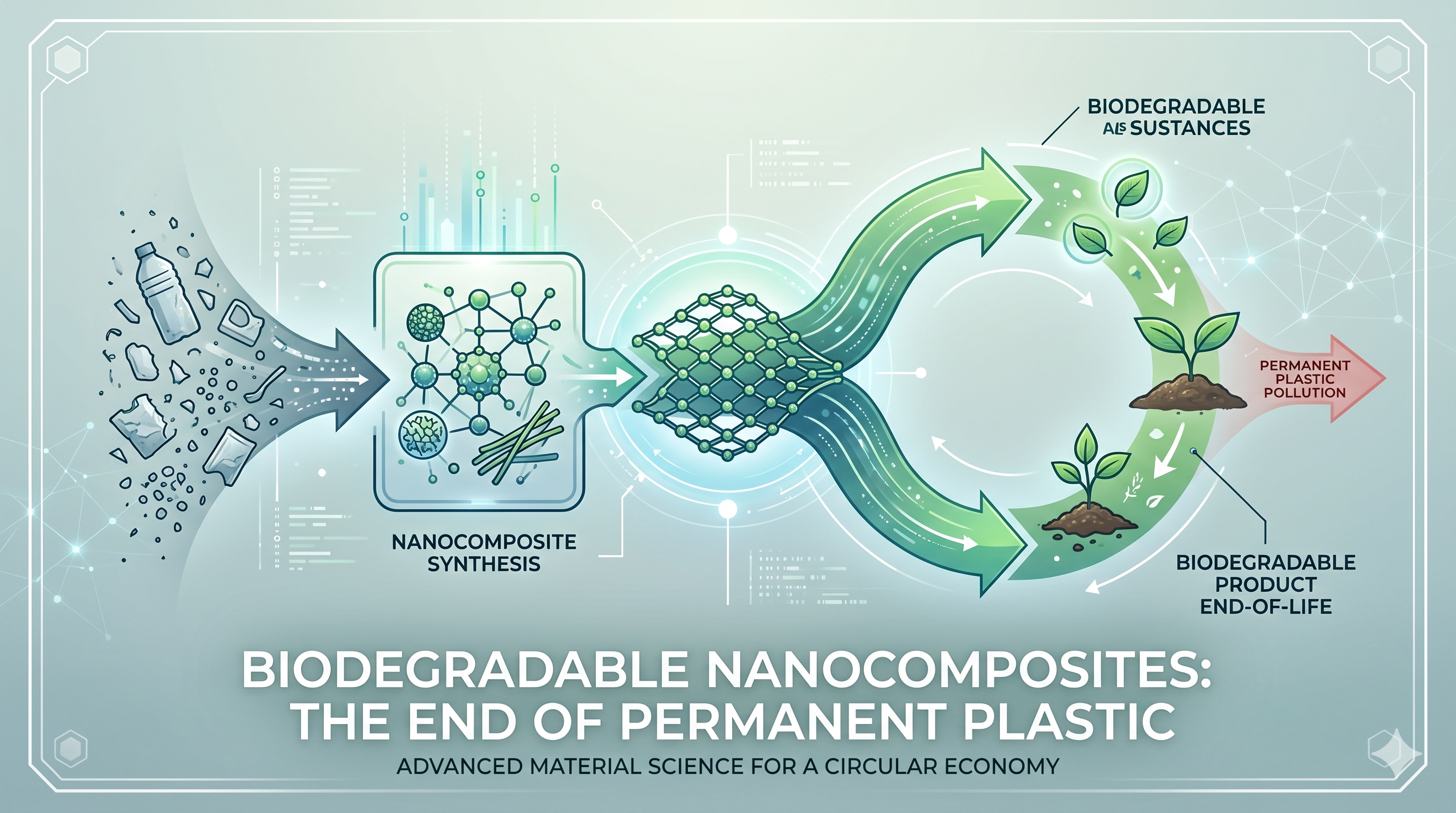
For nearly a century, humanity has had a love affair with plastic. It’s lightweight, durable, versatile, and astonishingly cheap. From intravenous tubes saving lives in hospitals to the packaging that keeps our food fresh, synthetic polymers have fundamentally shaped modern civilization. However, this miracle material has a dark side that is now impossible to ignore. Our planet is drowning in plastic waste. Because traditional plastics are engineered to be permanent, they do not decompose in any human timeframe, instead breaking down into insidious microplastics that contaminate our oceans, soil, and even our own bodies.
Recycling has proved to be an insufficient solution, with only a tiny fraction of plastic ever being reprocessed effectively. The urgent challenge of our time is not simply managing plastic waste, but reinventing the material itself. Enter biodegradable nanocomposites. These advanced materials promise to deliver the high performance we demand from plastic while ensuring they safely return to nature when their job is done, potentially marking the beginning of the end for permanent plastic pollution.
Understanding the Material Science: What Are Nanocomposites?
To understand how biodegradable nanocomposites work, we must look at material science at the molecular level.
Traditional bioplastics, like Polylactic Acid (PLA), derived from corn starch or sugarcane, have existed for years. They are biodegradable under specific conditions. However, pure bioplastics often suffer from significant performance limitations. They tend to be brittle, they often cannot withstand high temperatures, and they have poor “barrier properties”—meaning they allow oxygen and moisture to pass through too easily, making them unsuitable for long-term food packaging.
Nanocomposites solve this problem using nanotechnology. A biodegradable nanocomposite consists of two main components:
-
The Matrix: A biodegradable polymer base (like PLA, PHA, or starch).
-
The Nanofiller: Extremely small particles (at least one dimension is less than 100 nanometers) added to reinforce the matrix.
Imagine reinforced concrete. The matrix is the cement, providing shape and bulk, while the steel rebar provides tensile strength. In nanocomposites, nanofillers—which can include nanoclay, nanocellulose derived from plants, or carbon nanotubes—act as molecular rebar. Because these fillers have an extraordinarily high surface-area-to-volume ratio, they interact intensely with the polymer chain, drastically improving the material’s properties without needing large amounts of filler.
The Performance Boost: Why Nanotechnology Matters
By adding just a tiny percentage of these nanofillers (usually 1% to 5% by weight), scientists can transform weak bioplastics into high-performance materials.
-
Mechanical Strength: Nanofillers bind tightly to the polymer chains, significantly increasing stiffness, tensile strength, and resistance to fracture.
-
Barrier Properties: For food packaging, this is crucial. Nanoparticles disperse throughout the polymer matrix, creating a “tortuous path.” Imagine a maze; oxygen or moisture molecules cannot travel straight through the plastic but must navigate around the impermeable nanoparticles. This dramatically slows down the rate of permeation, keeping food fresher for longer.
-
Thermal Stability: Traditional bioplastics melt at relatively low temperatures. Nanocomposites can increase the heat distortion temperature, allowing these materials to be used for hot beverage cups or microwaveable containers.
Current Frontiers in Research
Global research into biodegradable nanocomposites is exploding. Scientists are moving beyond simple reinforcement to create “smart” and functional materials.
Nanocellulose: The Ultimate Sustainable Filler
Perhaps the most promising nanofiller is nanocellulose. Derived from abundant plant biomass (wood pulp, agricultural waste, or even certain bacteria), it is completely biodegradable, biocompatible, and non-toxic. Recent studies have successfully incorporated crystalline nanocellulose into PLA, creating materials that are not only extremely strong but also optically transparent, which is essential for retail packaging. Furthermore, research is exploring nanocellulose derived from waste sources, such as pineapple leaves and sugarcane bagasse, truly supporting a circular economy.
Smart and Antimicrobial Packaging
Researchers are incorporating metallic nanoparticles, such as silver or zinc oxide, into biodegradable polymer matrices. These nanoparticles have potent antimicrobial properties. In food packaging, this can actively inhibit the growth of foodborne pathogens, extending shelf life while remaining sustainable. Other research is focusing on inserting nanobiosensors that can change color if the food inside has spoiled or has been subjected to temperature abuse.
Clinical and Biomedical Applications: Where Biodegradability Saves Lives
The field where biodegradable nanocomposites are perhaps furthest advanced and making the most direct impact is in biomedicine. Here, the ability of a material to perform a high-tech function and then harmlessly disappear into the body is invaluable.
Tissue Engineering Scaffolds
When a patient has significant bone or tissue loss, doctors use “scaffolds”—three-dimensional porous structures that act as a template for new cell growth. These scaffolds must mimic the body’s natural extracellular matrix. Biodegradable nanocomposites, particularly those using PLA or polycaprolactone (PCL) reinforced with hydroxyapatite nanoparticles (a natural component of bone), are ideal. They provide the necessary mechanical strength to bear loads, they encourage bone cells to adhere and grow, and as the new bone forms, the scaffold gradually degrades into harmless byproducts (water and carbon dioxide), eliminating the need for a second surgery to remove an implant.
Advanced Drug Delivery
Permanent drug implants often require surgical removal. Biodegradable nanocomposites offer a “set it and forget it” alternative. Drugs can be encapsulated within biodegradable polymer nanoparticles or loaded into a nanocomposite matrix. The degradation rate of the polymer can be precisely tuned to release the drug over days, weeks, or even months, maintaining therapeutic levels in the body without the peak-and-trough effect of oral medication.
Clinical Studies on Dissolvable Stents
Significant clinical research has focused on biodegradable coronary stents. While metallic stents can cause long-term complications like late-term blood clots, biodegradable stents support the artery during the healing phase and then completely dissolve, leaving a healed, functional vessel. Emerging studies involve nanocomposite stents that offer thinner struts (improving blood flow) while maintaining the structural integrity of previous polymer versions.
Advantage–Risk Assessment: A Balanced View
While biodegradable nanocomposites offer revolutionary potential, it is crucial to conduct a rigorous analysis of their benefits and potential drawbacks.
The Advantages (The Case for Optimism)
-
Environmental Impact: This is the primary driver. If these materials successfully displace permanent plastics, we can fundamentally stop the accumulation of persistent plastic waste in landfills and oceans.
-
Performance Enhancement: They overcome the weaknesses of first-generation bioplastics, making sustainable alternatives feasible for demanding applications like automotive parts and long-term packaging.
-
Carbon Neutrality: Many matrix polymers (like PLA) are derived from plants that absorb CO2 during their growth, contributing to a lower overall carbon footprint compared to petroleum-based plastics.
-
Biomedical Breakthroughs: They enable entirely new, less invasive medical treatments and tissue regeneration techniques.
The Risks and Challenges (The Case for Caution)
-
The “Greenwashing” Hazard: The label “biodegradable” is often misunderstood. Many bioplastics, even when part of a nanocomposite, only degrade quickly in industrial composting facilities (high heat, specific moisture). If they end up in the ocean or a standard landfill, they may persist almost as long as traditional plastics.
-
Ecotoxicity of Nanofillers: A critical area of concern is what happens to the nanofillers themselves when the polymer matrix degrades. If the material disappears but releases carbon nanotubes or certain metallic nanoparticles into the soil or water, we may simply be replacing one form of pollution (macroplastic) with another (nanoparticles), the long-term toxicity of which to ecosystems is not yet fully understood.
-
High Cost and Scalability: Currently, nanocomposites are significantly more expensive to produce than standard polyethylene or polypropylene. Scaling up manufacturing while maintaining the precise dispersion of nanofillers remains a major engineering challenge.
-
Recycling Confusion: Biodegradable plastics contaminate the recycling stream of traditional plastics. If PLA gets mixed into PET bottles, it ruins the batch. A completely separate sorting and composting infrastructure is required.
The Future: A Nuanced Transformation
Biodegradable nanocomposites represent one of the most exciting material science developments of the 21st century. They provide a technological path out of the permanent plastic crisis. However, they are not a magical “silver bullet.”
The solution will require a multi-pronged approach. Biodegradable materials must be matched to the correct application. For example, they are ideal for single-use items that are often contaminated with food (like ketchup packets or coffee cups), making them easy to compost, but perhaps less suitable for long-term durable goods where longevity is required.
Furthermore, society must invest in the industrial composting infrastructure necessary to process these materials. Simultaneously, regulatory bodies must mandate clear labeling and standardization regarding what can truly be claimed as “biodegradable” to prevent consumer confusion.
If we integrate these advanced materials thoughtfully, combined with a commitment to reduction and reuse, biodegradable nanocomposites may indeed pave the way toward a future where “permanent plastic” is seen not as a modern convenience, but as a historical mistake we have finally overcome.