
Recently added item(s)
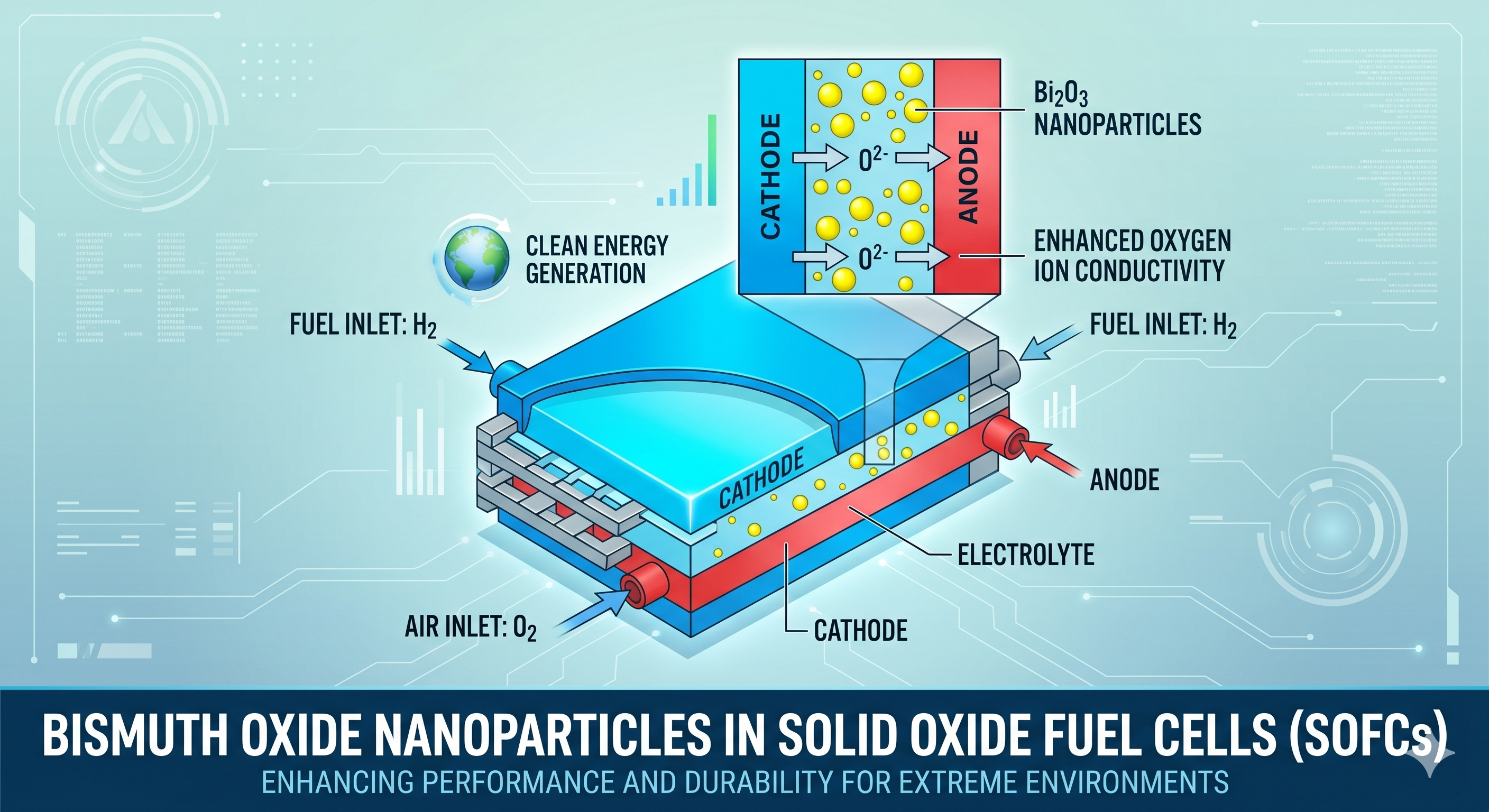
The global transition toward clean, sustainable energy is the defining technological challenge of our era. While solar panels and wind turbines are highly visible champions of this green revolution, they share a common flaw: intermittency. The wind doesn’t always blow, and the sun doesn’t always shine. To build a truly resilient power grid, we need technology that generates clean, continuous electricity on demand.
Enter the Solid Oxide Fuel Cell (SOFC).
SOFCs are highly efficient energy conversion devices that turn chemical fuels into electricity without combustion. However, traditional SOFCs have a major drawback: they require extreme heat to function. Today, a wave of advanced nanotechnology—specifically, the use of bismuth oxide nanoparticles—is stepping in to solve this problem, promising to make these devices cheaper, safer, and far more accessible.
In this comprehensive guide, we will explore the fascinating world of bismuth oxide nanoparticles, how they are upgrading fuel cell technology, the current state of scientific research, and an honest assessment of the advantages and risks involved in this cutting-edge field.
Understanding the Basics: What is a Solid Oxide Fuel Cell?
Before diving into the microscopic world of nanoparticles, we must first understand the machine they are upgrading. You can think of a Solid Oxide Fuel Cell as a battery that never runs dead, as long as you keep feeding it fuel (like hydrogen, natural gas, or biogas).
A traditional SOFC consists of three main parts:
-
The Anode: The negative post where the fuel enters.
-
The Cathode: The positive post where air (oxygen) enters.
-
The Electrolyte: A solid ceramic layer sandwiched between them.
The magic happens in the electrolyte. It acts as a selective bouncer, only allowing oxygen ions (charged oxygen atoms) to pass through from the cathode to the anode. When the oxygen meets the fuel, a reaction occurs that releases water, heat, and—most importantly—a stream of electrons. This flow of electrons is the electricity that powers our homes and devices.
The Problem with Traditional SOFCs
For the solid ceramic electrolyte to let those oxygen ions pass through, it has to be blazing hot. Traditional SOFCs operate at extreme temperatures, typically between 800°C and 1000°C. Maintaining this level of heat requires expensive, specialized heat-resistant metals and dramatically reduces the lifespan of the device because the components expand, contract, and eventually crack over time.
If we want to use SOFCs in everyday applications—like powering residential neighborhoods, commercial buildings, or even electric vehicles—we need them to work at much lower temperatures.
Enter the Nanoscale: The Magic of Bismuth Oxide
To lower the operating temperature of a fuel cell, scientists need an electrolyte material that is incredibly conductive to oxygen ions at medium temperatures (around 500°C to 700°C). This is where Bismuth Oxide (Bi2O3) enters the spotlight.
Bismuth oxide possesses a specific crystal structure known as the “delta-phase.” In this phase, the atomic structure is essentially riddled with microscopic “empty seats” or vacancies. Oxygen ions can rapidly hop from one empty seat to the next, zooming across the electrolyte with remarkable ease. In fact, delta-phase bismuth oxide has one of the highest known oxygen ion conductivities of any solid material on Earth.
Why Nanoparticles?
Bulk materials behave differently than nano-sized materials. A nanoparticle is unbelievably small—about 1 to 100 nanometers in size, which is roughly the size of a single virus.
When you take bismuth oxide and engineer it into nanoparticles, you drastically increase its surface area. Imagine a solid block of ice versus crushed ice; the crushed ice melts and reacts to its environment much faster because more of its surface is exposed. By using bismuth oxide nanoparticles to create or coat fuel cell components, scientists create an ultra-reactive, highly conductive pathway. This allows the fuel cell to achieve incredible efficiency even when the thermostat is turned down from 1000°C to a much more manageable 500°C.
Current Research and “Clinical” Pilot Studies
In the medical world, a new drug undergoes “clinical trials” to prove its safety and efficacy in the real world. In materials science, the equivalent of a clinical trial is long-term stability testing, pilot-scale field deployments, and extreme-environment stress tests.
Currently, the scientific community is heavily focused on moving bismuth oxide out of the laboratory and into commercial viability. Here is what the latest research and real-world studies are showing us:
1. The Stabilization Breakthrough (Doping)
The biggest hurdle researchers face is that bismuth oxide’s super-conductive delta-phase is naturally unstable at temperatures below 730°C. When it cools down, it transforms into a different crystal shape that acts like a brick wall, stopping oxygen ions in their tracks.
Recent “pilot” studies have successfully solved this by “doping” the nanoparticles. Doping involves sneaking tiny amounts of other elements—like Yttrium (Y), Erbium (Er), or Tungsten (W)—into the bismuth oxide crystal lattice. These extra atoms act like architectural scaffolding, locking the crystal structure into its high-performance delta-phase even when the temperature drops to 500°C. Long-term degradation studies (running the fuel cells continuously for thousands of hours) show that heavily doped bismuth oxide nanoparticles maintain exceptional performance without crumbling.
2. Composite Electrolytes
Modern research is also moving away from using a single material. Instead, engineers are creating “nanocomposites.” By mixing bismuth oxide nanoparticles with other reliable ceramics like Gadolinium-Doped Ceria (GDC), they create a hybrid material. Real-world testing of these hybrid fuel cells demonstrates the best of both worlds: the extreme ionic speed of bismuth and the rugged mechanical strength of ceria.
3. Advanced Coating Techniques
Researchers are exploring Atomic Layer Deposition (ALD) to apply bismuth oxide nanoparticles as ultra-thin protective coatings on existing fuel cell components. Studies have shown that these nanocoatings not only improve electrical output but also protect the internal parts of the fuel cell from chemical poisoning (such as carbon buildup when using natural gas).
Advantage and Risk Assessment
As with any frontier technology, replacing traditional components with bismuth oxide nanoparticles involves a careful balancing act. Let’s look at an objective assessment of the pros and cons.
The Advantages (The Potential)
-
Lower Operating Temperatures: This is the ultimate prize. Dropping the operating temperature to 500°C–700°C means manufacturers can stop using exotic, expensive superalloys to build the fuel cells. Instead, they can use cheaper, standard stainless steel, drastically reducing the cost of the technology.
-
Faster Startup Times: Because the fuel cell doesn’t have to heat up to 1000°C, it can turn on and start generating power much faster. This makes SOFCs viable for smaller applications, potentially even as backup generators for hospitals or data centers.
-
Enhanced Longevity: Lower heat means less thermal expansion and contraction. The internal components experience less physical stress, meaning the fuel cell will last years longer before needing maintenance.
-
High Efficiency: Nanoparticles provide a massive surface area for chemical reactions, maximizing the amount of electricity you can extract from a single drop of fuel.
The Risks and Challenges (The Reality Check)
-
Chemical Instability and Reactivity: Bismuth is a somewhat reactive element. If the oxygen levels inside the fuel cell drop too low, the bismuth oxide can chemically reduce back into liquid bismuth metal. This completely destroys the electrolyte layer and ruins the cell.
-
Interface Reactions: When placed directly next to certain cathode materials, bismuth oxide nanoparticles can react chemically over time to form an insulating “dead layer.” This prevents electricity from flowing. Engineers currently have to build tiny protective chemical “buffer layers” to prevent this, adding complexity to the manufacturing process.
-
Manufacturing Scalability: Creating perfectly uniform nanoparticles in a highly controlled lab environment is one thing; producing them by the ton in a factory while maintaining that microscopic perfection is incredibly difficult and, currently, quite expensive.
-
Long-term Aging: While doped bismuth oxide is stable, “aging” studies show that over tens of thousands of hours, the atomic structure can slowly degrade. More research is needed to guarantee 10-to-20-year lifespans required for commercial grid applications.
Future Topics and Emerging Ideas
The integration of bismuth oxide nanoparticles into extreme energy environments is still a highly active field of study. For researchers, students, and tech enthusiasts looking toward the horizon, here are the most exciting future topics in this domain:
-
Green Synthesis of Nanoparticles: Currently, creating bismuth oxide nanoparticles requires harsh chemicals and high energy. A booming area of research is “green synthesis,” which uses plant extracts and environmentally friendly biological processes to “grow” these nanoparticles cleanly and cheaply.
-
AI-Driven Material Discovery: Artificial intelligence and machine learning are being used to predict the perfect recipe for doping bismuth oxide. Instead of scientists using trial and error in a lab for years, AI algorithms can simulate millions of atomic combinations in seconds to find the ultimate, most stable nanoparticle formula.
-
Reversible Fuel Cells (SOECs): What if a fuel cell could run backward? Solid Oxide Electrolysis Cells (SOECs) use electricity to turn water back into hydrogen fuel. Bismuth oxide nanoparticles are currently being tested to make these reversible systems highly efficient, acting essentially as massive, grid-level rechargeable batteries for storing excess solar and wind power.
-
3D Printing of Nanotech Components: Additive manufacturing (3D printing) is being explored to print fuel cells layer-by-layer using nanoparticle inks. This could allow for complex, highly optimized internal geometries that are impossible to create with traditional manufacturing.
Conclusion
We are standing on the precipice of a massive shift in how humanity generates and manages its power. While renewable energy sources like wind and solar will harvest the energy of the environment, Solid Oxide Fuel Cells will provide the reliable, efficient backbone required to keep the modern world running.
Bismuth oxide nanoparticles represent a beautiful marriage between advanced nanotechnology and sustainable engineering. By manipulating matter at the scale of atoms, scientists are finding ways to cool down these blazing-hot energy engines, making them cheaper, safer, and far more practical for everyday use. While there are genuine hurdles to overcome—particularly regarding long-term chemical stability and manufacturing costs—the rigorous real-world testing happening right now paints a highly optimistic picture. The energy grid of the future might just be powered by tech so small, it can’t even be seen.