
Recently added item(s)
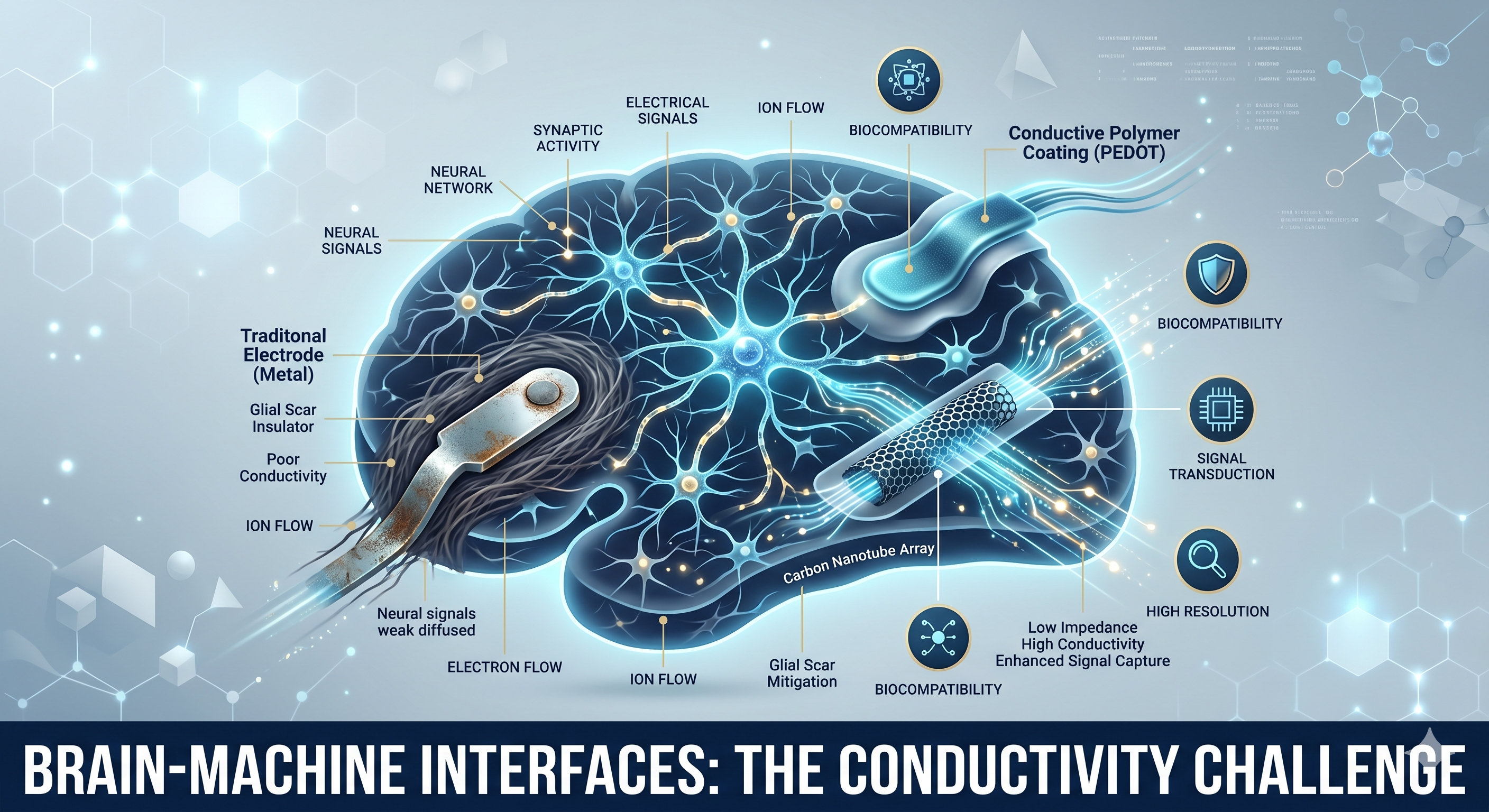
The concept of controlling technology with our thoughts was once relegated to the pages of cyberpunk novels. Today, Brain-Machine Interfaces (BMIs)—also known as Brain-Computer Interfaces (BCIs)—are a reality. These systems establish a direct communication pathway between the electrical activity of the brain and an external device, such as a computer, a robotic arm, or even a speech synthesizer.
While we have made massive strides in decoding neural signals, we face a formidable physical obstacle: The Conductivity Challenge. For a BMI to work, it must maintain a stable, high-quality electrical connection with neurons. However, the human brain is a salty, fluid-filled, and highly reactive environment that is inherently hostile to traditional electronic materials. This article explores how science is bridging the gap between biological “wetware” and digital hardware.
2. The Electrical Language of the Brain
The brain operates on electricity. Every thought, movement, and memory is the result of neurons firing electrical impulses called action potentials. To capture these signals, BMI electrodes must be placed either on the scalp (non-invasive), under the skull (semi-invasive), or directly into the brain tissue (invasive).
The “Conductivity Challenge” refers to the difficulty of maintaining low impedance (resistance to electrical flow) at the interface where the electrode meets the neuron. If the conductivity is poor, the signal becomes “noisy,” much like a radio station filled with static, making it impossible to accurately control a prosthetic limb or a computer cursor.
3. The Biocompatibility-Conductivity Paradox
The primary reason for the conductivity challenge is the body’s natural defense mechanism. When a rigid metal electrode is inserted into the soft tissue of the brain:
-
Glial Scarring: The brain’s immune cells (astrocytes and microglia) surround the “invader,” creating an insulating layer of scar tissue.
-
Signal Degradation: This scar tissue acts as an electrical insulator, pushing the neurons away from the electrode and drastically reducing conductivity.
-
Chronic Inflammation: Constant friction between a stiff electrode and the pulsating brain causes micro-trauma, leading to long-term loss of signal.
4. Nanotechnology: The Conductive Solution
To solve the conductivity issue, researchers are turning to nanomaterials that “mimic” the properties of the brain’s extracellular matrix while maintaining superior electrical performance.
A. Carbon Nanotubes (CNTs) and Graphene
As discussed in previous tissue engineering contexts, Carbon Nanotubes are revolutionary for BMIs. Their high surface area allows for a larger contact point with neurons, significantly lowering impedance. Because they are excellent conductors, they can capture weak neural signals that traditional platinum or iridium electrodes might miss.
B. Conductive Polymers (PEDOT)
PEDOT is a “soft” conductive plastic. Unlike stiff metals, PEDOT-coated electrodes are flexible and can be “doped” with biological molecules that encourage neurons to grow closer to the sensor. This reduces the glial scar and maintains high conductivity for years rather than months.
C. Hydrogel Interfaces
Researchers are now using conductive hydrogels to create a “bridge” between the electrode and the brain. These gels are mostly water, matching the mechanical softness of brain tissue, which minimizes inflammation while allowing ions to flow freely, ensuring a clear signal.
5. Advanced Clinical Research and Recent Trials
The battle for better conductivity is currently being fought in high-profile clinical settings.
-
High-Bandwidth Neural Threads: Companies like Neuralink are using ultra-thin, flexible “threads” instead of rigid needles. These threads move with the brain, reducing the inflammatory response and preserving conductivity over time.
-
Stentrode Technology: Clinical trials are testing “Stentrodes”—electrode arrays delivered through the blood vessels. By sitting inside a blood vessel near the motor cortex, the device avoids direct contact with brain tissue, bypassing the scarring problem entirely while still capturing high-quality conductive signals.
-
ECoG Evolution: Recent research in 2025 has focused on graphene-based Electrocorticography (ECoG) arrays. These sit on the surface of the brain (semi-invasive) and provide much higher conductivity and resolution than previous versions, allowing for the decoding of complex speech patterns in paralyzed patients.
6. Advantage vs. Risk Assessment
Developing highly conductive, long-lasting BMIs requires balancing extreme performance with biological safety.
| Advantage | Clinical Impact | Risk / Challenge | Technical Difficulty |
| High Signal-to-Noise Ratio | Allows for precise, fine-motor control of robotic fingers. | Over-Sensitivity | High conductivity can sometimes pick up “crosstalk” from distant neurons. |
| Long-Term Stability | Patients don’t need “revision” surgeries to replace degraded sensors. | Bio-Persistence |
Some conductive nanomaterials (like CNTs) may not be biodegradable.
|
| Reduced Heat Dissipation | Efficient conductors generate less heat, protecting delicate brain cells. | Surgical Complexity | Inserting ultra-flexible conductive threads requires high-precision robotic surgery. |
| Biomimetic Integration | Soft, conductive coatings trick the brain into accepting the device. | Long-term Toxicity | We still need more data on the 10+ year safety of nanomaterial-coated electrodes. |
7. The Future: Wireless and “Liquid” Electronics
The ultimate goal in overcoming the conductivity challenge is the development of Neuro-Dust or Liquid Electrodes.
-
Neuro-Dust: Tiny, wireless sensors powered by ultrasound that don’t require wires (which often cause the tugging that leads to scarring).
-
Injectable Electronics: Conductive “mesh” electronics that can be injected through a syringe. Once in the brain, they unfurl and interweave with neurons, creating a seamless, highly conductive network that grows with the tissue.
8. Conclusion: Beyond the Hardware
The “Conductivity Challenge” is the final frontier in making Brain-Machine Interfaces a standard medical treatment. By mastering the materials science at the interface of biology and electronics, we are doing more than just building better tools; we are creating a new way for humans to interact with the world.
As we move from rigid metals to soft, carbon-based, and biomimetic conductors, the static in our neural communication will fade away. This will pave the way for a future where paralysis is reversible, sensory loss is restored, and the boundary between human intent and digital execution becomes invisible.