
Recently added item(s)
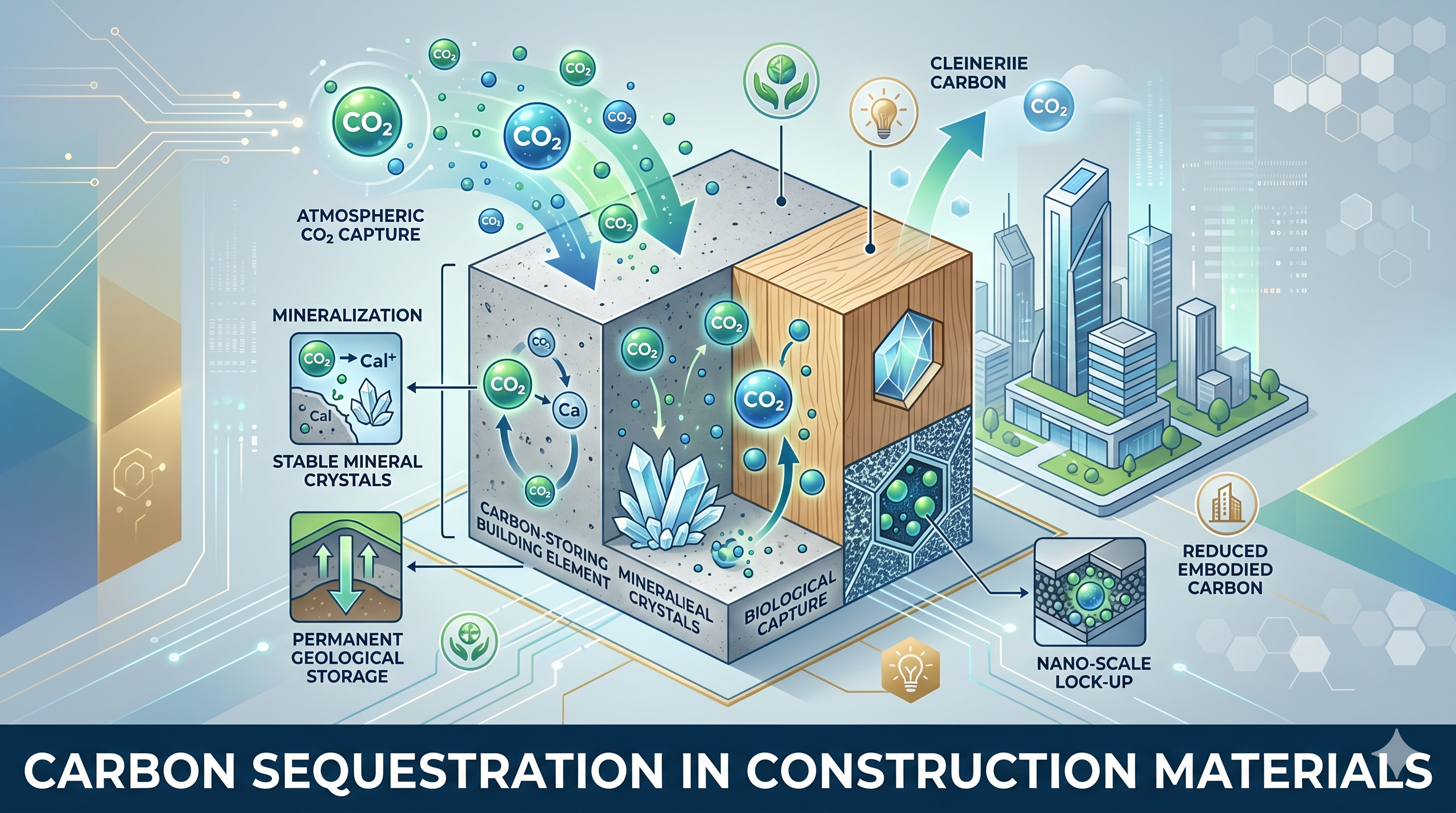
The climate crisis is a challenge of unprecedented scale, and its solutions require rethinking how we live, travel, and crucially, how we build. The built environment is responsible for nearly 40% of global energy-related carbon emissions. While much attention has been paid to the “operational carbon” (the energy used to heat, cool, and power buildings), a growing urgency surrounds “embodied carbon”—the emissions resulting from manufacturing, transporting, and assembling the building materials themselves.
Concrete, steel, and aluminum hold a heavy carbon footprint. Concrete alone, the second most consumed substance on earth after water, accounts for roughly 8% of global CO2 emissions. To achieve net-zero goals by 2050, we must stop viewing buildings as carbon emitters and start reimagining them as carbon sinks. This is where carbon sequestration in construction materials changes the game. It is not just about emitting less; it is about actively removing carbon dioxide from the atmosphere and locking it away permanently within the very walls of our structures.
The Science of Turning Buildings into Sinks
How can a material lock away carbon? Sequestration in construction generally occurs through two distinct pathways: biological and chemical/mineral.
1. Biological Sequestration: Storing Carbon via Photosynthesis
This pathway relies on biology’s natural carbon capture mechanism. Plants absorb atmospheric CO2 through photosynthesis as they grow, converting it into biomass and locking it into their physical structure (cellulose and lignin). When these plants are harvested sustainably and converted into construction materials, that carbon is prevented from returning to the atmosphere until the building is demolished and the material decays or burns.
Materials that use this pathway include timber (especially Mass Timber), bamboo, hempcrete, and agricultural waste products like straw. A building made largely of these materials is effectively a warehouse for atmospheric carbon.
2. Chemical Sequestration: Mineralization within the Material Matrix
This pathway uses chemistry to mimic the natural geological processes that turn carbon dioxide into stable rock. When certain alkaline minerals are exposed to CO2, they react to form solid, stable carbonates. This is a permanent chemical bonding process.
This process can be integrated into the construction supply chain in several ways:
-
Carbon Curing: Injecting CO2 into concrete while it is being mixed or as it cures. The CO2 reacts with cement components to form calcium carbonate crystals, strengthening the concrete and permanently storing the gas.
-
Aggregate Production: Reacting industrial CO2 waste streams with industrial residues (like slag or ash) to create synthetic stones (aggregates) that can be used in concrete.
-
Cement Manufacturing: Developing new types of cement that require CO2 to cure (unlike standard Portland cement, which releases it).
Key Materials and Emerging Technologies
The landscape of carbon-sequestering materials is rapidly diversifying, ranging from ancient techniques to cutting-edge chemical engineering.
Mass Timber and Engineered Wood
Engineered wood products like Cross-Laminated Timber (CLT) are the current leaders in bio-sequestration. Unlike traditional lumber, Mass Timber consists of layers of wood glued together to form massive, load-bearing panels and beams that can replace steel and concrete in high-rise constructions.
A single cubic meter of CLT can contain approximately one tonne of stored CO2. This storage, coupled with the fact that wood replaces traditional high-emission materials, creates a powerful net benefit for the climate. However, this relies entirely on sustainable forestry practices to ensure that new trees are planted to replace those harvested, maintaining the overall forest carbon sink.
Carbon-Cured Concrete (The Mineralization Revolution)
Given concrete’s dominance in the construction market, innovations in this sector are critical. Several major players are scaling up mineralization technologies:
-
CarbonCure: This company’s technology, now implemented in hundreds of concrete plants globally, injects captured CO2 into the concrete mixer. The CO2 becomes mineralized and improves the compressive strength of the concrete, which sometimes allows for a reduction in cement content (the highest emitter in the concrete mix).
-
Mineral Carbonation International (MCi): This Australian company reacts industrial CO2 waste with minerals (magnesite or olivine) or residues (like steel slag) to create solid materials for construction, effectively making a product that stores more carbon than is emitted in its production.
Hempcrete and Plant-Based Bio-materials
Hempcrete is a non-structural material made from the core of the hemp plant mixed with a lime binder. Hemp is an incredibly fast-growing crop that absorbs vast amounts of CO2 during its short lifecycle. The lime binder also re-absorbs CO2 as it cures (a process known as carbonation). The result is a highly insulating material that is often “carbon negative”—meaning it has stored more carbon from the atmosphere than was emitted during its manufacturing.
Similar products are being developed using rice husks, straw, and even fungi (mycelium) to create insulating blocks and panels.
Current Research, Case Studies, and Industrial Trials
We are moving past laboratory theories and into real-world pilot projects and industrial trials. Here are some of the most recent and relevant scientific benchmarks:
Industrial Trials in Concrete Mineralization
A landmark academic study published in Journal of Cleaner Production in 2023 reviewed data from several full-scale trials of carbon curing in readymix concrete plants. The research confirmed that injecting CO2 during mixing not only captured carbon but also accelerated the early-strength development of the concrete. This breakthrough is essential because traditional “green” concrete additives like slag sometimes slow down the hardening process, which can delay construction schedules. The mineralization approach overcomes this.
Case Study: Sustainable Forestry and CLT Scalability
In Europe, which leads in Mass Timber implementation, the city of Växjö in Sweden stands as a real-world case study. The city decreed that all new public buildings must be built of timber. Since implementing this policy, a study assessing a decade of Växjö’s experience showed a measurable reduction in the city’s construction-related carbon footprint. Critically, the study also verified through forestry inventory data that the Swedish forests remained a net carbon sink during this period, confirming that sustainable supply chains can match the CLT demand.
The Rise of Living Construction Materials (Bioconcrete)
Current cutting-edge research, particularly from teams at the University of Colorado Boulder, is looking into “living concrete.” Scientists use bacteria (Cyanobacteria) within a sand and gel matrix to grow calcium carbonate. Instead of intense heat to fuse ingredients, the bacteria use photosynthesis to cement the particles together. While still largely experimental, pilot trials in 2024 have demonstrated that these living blocks can be strong enough to meet non-load-bearing structural standards and, because of the living bacteria, even possess “self-healing” properties (the bacteria can grow new carbonate to fill small cracks).
Advantage–Risk Assessment
Carbon sequestration in construction materials is a high-potential strategy, but it is not without complex challenges.
The Advantages (The Case for Optimism)
-
Permanent Sequestration: Chemical mineralization is virtually permanent over geological timescales; the carbon will not leak out. Biological sequestration locks up carbon for the decades-long lifespan of the building.
-
Addressing Embodied Carbon: This is one of the only viable technologies to address the 11% of global emissions specifically caused by producing concrete, steel, and aluminum.
-
Circular Economy: Technologies that react industrial waste gas with industrial waste slag to create construction products create a circular loop, reducing waste as well as emissions.
-
Performance Improvements: Several of these materials (timber, hempcrete) offer superior insulation properties, which reduces operational emissions for the life of the building.
The Risks and Challenges (The Constraints)
-
Cost and Scalability: Most new, carbon-storing cements or mineralization aggregates are currently significantly more expensive than standard materials. Injecting CO2 requires expensive capture, transportation, and setup infrastructure.
-
Land Use (for Bio-materials): Relying heavily on Mass Timber or hempcrete requires massive amounts of land. If not managed carefully, this could lead to monoculture forestry, biodiversity loss, or even competition with land needed for food production. If timber production leads to net forest loss globally, biological sequestration becomes a net carbon positive (an emitter).
-
Regulatory Barriers: Building codes are understandably conservative. Proving the long-term durability and fire resistance of novel bio-based materials or newly cured concretes to the satisfaction of global regulators is a slow and difficult process.
-
Measurement and Reporting (The Additionality Problem): It is notoriously difficult to measure the exact net climate benefit of biological materials. Did using the wood cause more trees to be grown, or did it just divert wood that would have been used elsewhere? Standardizing carbon accounting in construction is a global scientific challenge.
The Outlook: Shaping the Future Workforce
The path to net-zero requires that we view every new building not as a climate emitter but as a climate solution. The construction professional of the future must be as literate in carbon chemistry and ecology as they are in structural engineering. To make buildings carbon sinks, the industry will require engineers, architects, materials scientists, and contractors who specialize in specifying and working with these new, novel carbon-sequestering materials. This emerging field represents not just a necessary environmental pivot but an immense opportunity for innovation and new careers. Turning our cities into carbon repositories may be the single most potent way to build our way out of the climate crisis.