
Recently added item(s)
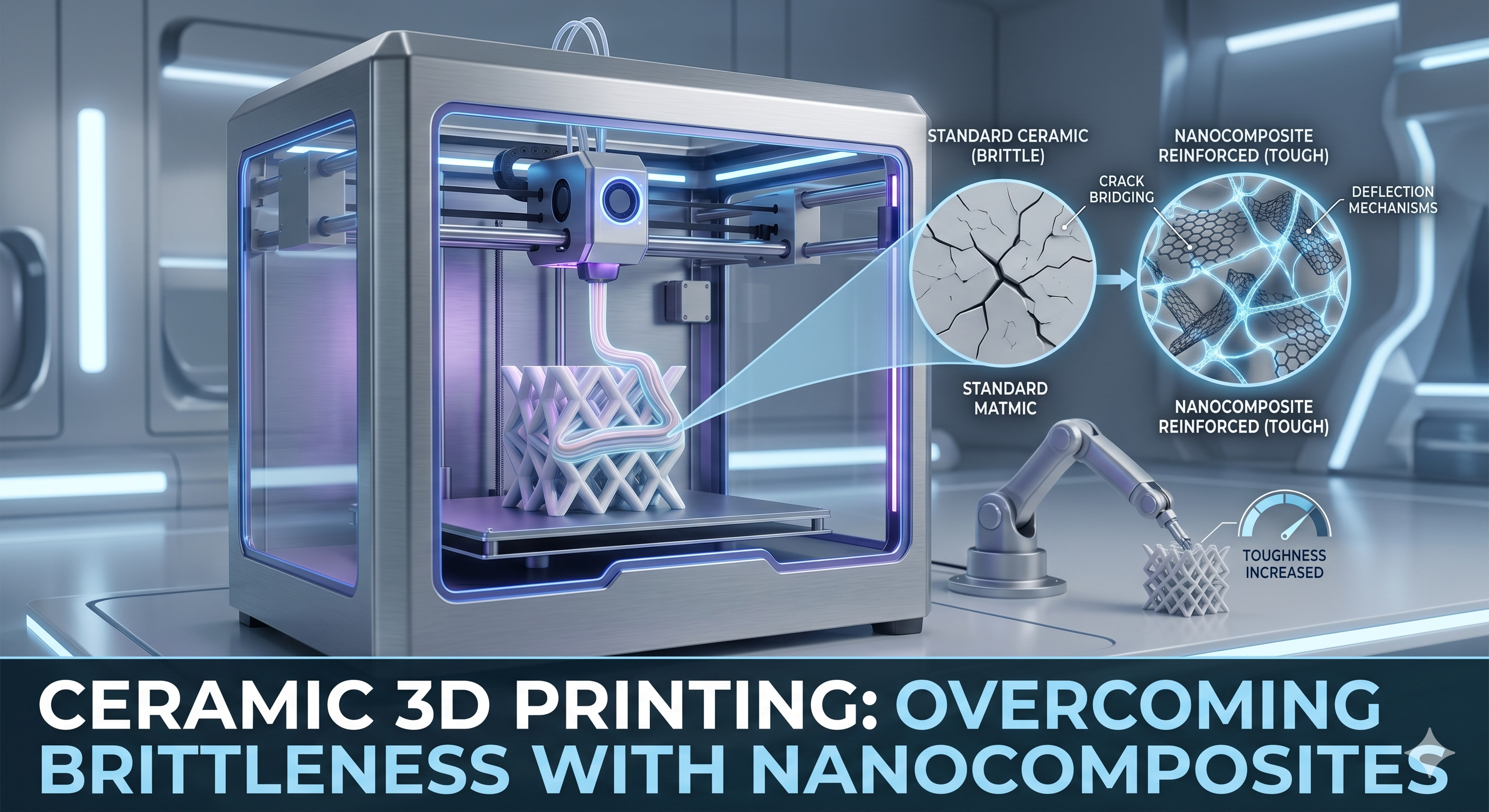
The world of additive manufacturing is currently witnessing a silent but profound shift. For years, the headlines were dominated by plastics and metals, but as of 2026, the spotlight has moved toward high-performance ceramics. Traditionally, ceramics have been the “difficult child” of 3D printing—prized for their extreme heat resistance, hardness, and chemical stability, yet plagued by a fatal flaw: intrinsic brittleness.
In industrial and medical applications, a ceramic part that can withstand 1500°C is useless if it shatters like glass under a minor impact. However, the emergence of ceramic nanocomposites is rewriting this narrative. By integrating nanoscale reinforcements into the ceramic matrix, researchers are finally bridging the gap between ceramic’s legendary durability and the fracture toughness required for real-world engineering.
1. The Paradox of Ceramics: Hardness vs. Brittleness
To understand why nanocomposites are necessary, we must look at the atomic structure of ceramics. Unlike metals, which have “metallic bonds” that allow atoms to slide past each other (plasticity), ceramics are held together by ionic or covalent bonds. These bonds are incredibly strong but rigid.
When a ceramic material is stressed, it cannot deform to soak up the energy. Instead, the stress concentrates at microscopic flaws or pores—often introduced during the 3D printing process—leading to catastrophic crack propagation. In 3D printing, this is amplified by the layer-by-layer nature of the build, where the “seams” between layers act as natural fault lines.
2. The Rise of Nanocomposites: The “Nanoscopic Rebar”
The solution to ceramic brittleness isn’t found in the bulk material, but at the nanoscale. By infusing ceramic slurries or powders with nanomaterials, we create a composite that behaves fundamentally differently.
Toughening Mechanisms
How exactly does adding tiny particles stop a crack? There are three primary mechanisms currently dominating 2025–2026 research:
-
Crack Bridging: Imagine a microscopic crack trying to move through the material. If it encounters a carbon nanotube or a graphene platelet, that nano-additive acts like a bridge, holding the two sides of the crack together and requiring significantly more energy for the crack to advance.
-
Crack Deflection: When a crack hits a hard nanoparticle (like Alumina or Silicon Carbide), it cannot go through it. It is forced to tilt or twist, moving around the particle. This longer path dissipates energy, slowing down the eventual failure.
-
Transformation Toughening: This is most common in Zirconia-toughened ceramics. Under the stress of a moving crack, the zirconia particles undergo a phase transformation (from tetragonal to monoclinic), which involves a volume increase. This “swelling” effectively squeezes the crack shut from the inside.
3. Cutting-Edge Research: 2025-2026 Breakthroughs
The last 18 months have seen a surge in “Multi-Material” and “Functional Grading” in ceramic 3D printing.
Slurry-Based DLP and SLA Advancements
In late 2025, researchers at the Zurich Institute of Material Science published a landmark paper on High-Loading Nanocomposite Slurries. One of the biggest hurdles in ceramic 3D printing (specifically Digital Light Processing – DLP) is that adding nanoparticles often makes the resin too thick to print or too opaque for the UV light to penetrate.
The breakthrough involved using refractive index matching, where the liquid resin and the ceramic nanoparticles have identical light-bending properties. This allows for 3D printing parts with up to 60% nanoceramic content with unprecedented precision and significantly reduced Z-axis weakness.
Carbon Nanotube (CNT) Integration
Recent studies in early 2026 have focused on the alignment of CNTs during the extrusion process in Direct Ink Writing (DIW). By using magnetic fields to align the nanotubes as they pass through the nozzle, engineers have created “anisotropic toughness.” This means the ceramic part is specifically reinforced in the direction where it is expected to face the most stress, similar to how the grain in wood provides strength.
4. Clinical Studies: The Bio-Ceramic Revolution
The most immediate impact of “tough” 3D-printed ceramics is felt in the medical and dental sectors. Standard ceramic implants (like Hydroxyapatite or Alumina) were often too prone to “stress shielding” or sudden failure.
Dental Implants and Crowns
A multi-center clinical study concluded in March 2026 followed 500 patients who received Lithium Disilicate-Zirconia nanocomposite crowns printed via DLP. The results showed a 98.5% success rate over two years, with fracture rates lower than traditionally milled crowns. The nanocomposite structure allowed for thinner walls, preserving more of the patient’s natural tooth structure while offering superior aesthetics.
Bone Tissue Engineering
In the realm of orthopedics, Bio-active glass nanocomposites are being used to print custom scaffolds for bone regeneration. A 2025 clinical preparatory trial demonstrated that adding Copper-doped Silica nanoparticles to the ceramic matrix not only increased the toughness of the scaffold (preventing it from collapsing under the patient’s weight) but also provided a steady release of ions that stimulated blood vessel growth (angiogenesis), speeding up the healing of complex fractures.
5. Advantage vs. Risk Evaluation
For any enterprise or lab considering the move to ceramic nanocomposites, a balanced view is essential.
Advantages
-
Extreme Thermal Stability: Unlike metals, these composites maintain their structural integrity at temperatures where even superalloys begin to soften.
-
Weight-to-Strength Ratio: 3D-printed ceramic nanocomposites are significantly lighter than high-strength steel or titanium, making them ideal for the next generation of electric vehicle (EV) heat shields and aerospace components.
-
Chemical Inertness: They are virtually immune to corrosion, making them perfect for “harsh environment” sensors in the chemical and oil/gas industries.
-
Design Freedom: 3D printing allows for complex internal lattice structures (TPMS – Triply Periodic Minimal Surfaces) that further dissipate stress—designs that are impossible to manufacture via traditional casting or pressing.
Risks and Challenges
-
Shrinkage Control: Ceramics must be “fired” or sintered in a furnace after printing. During this process, the part can shrink by 15% to 30%. Predicting this shrinkage with nanocomposites is mathematically complex and often requires AI-driven simulation software.
-
Nano-Toxicity: Handling dry nanopowders poses significant respiratory risks. In 2026, safety protocols have become much stricter, requiring closed-loop “wet” processing systems to prevent aerosolization.
-
Cost of Hardware: Printing high-viscosity nanocomposite slurries requires specialized printers with high-torque wipers and high-intensity light engines, which remain a significant capital investment.
-
Sintering Cracks: Because the nano-additives and the base ceramic often have different thermal expansion rates, cooling the part too quickly after firing can actually create the very cracks you are trying to avoid.
6. Industrial Applications: Beyond the Lab
In 2026, we are seeing the first large-scale industrial adoptions.
-
Aerospace: Companies are using Silicon Carbide (SiC) nanocomposites to print small, complex turbine vanes for micro-turbines. These parts operate at temperatures that would melt traditional nickel-based alloys, leading to higher engine efficiency.
-
Electronics: As AI chips get hotter, the need for advanced thermal management is critical. 3D-printed Aluminum Nitride (AlN) nanocomposites are being used as high-conductivity heat sinks that also act as electrical insulators.
7. The Future: AI and Self-Healing Ceramics
The next frontier, expected to mature toward 2028-2030, is autonomous material discovery. With the vast number of possible nanoparticle combinations, researchers are using machine learning to predict which “cocktails” will yield the highest toughness.
Furthermore, early-stage research into “Self-Healing Ceramics” is underway. These materials contain “sacrificial” nanoparticles that, when a crack occurs, react with oxygen in the air to expand and fill the crack, effectively “scarring” over the wound and restoring the part’s integrity.
Conclusion
Ceramic 3D printing is no longer a niche curiosity; it is a vital pillar of modern material science. By overcoming the Achilles’ heel of brittleness through nanocomposite engineering, we are unlocking a class of materials that can survive the harshest environments on Earth—and beyond. Whether it is a custom dental implant that lasts a lifetime or a rocket nozzle that survives the vacuum of space, the marriage of nanotechnology and additive manufacturing is crafting a stronger, more resilient future.