Recently added item(s)
The environmental challenges of the 21st century demand innovative solutions. Among the most promising tools in the environmental engineer’s arsenal is Nano-Scale Zero-Valent Iron (nZVI)—a remarkable material that is revolutionizing how we clean up contaminated soil and groundwater. Yet, as the field matures, we have learned that not all nano iron is created equal. The key to a successful, cost-effective remediation project lies not in merely using nZVI, but in choosing the right nZVI engineered specifically for the site-specific challenges.
This article provides a comprehensive guide to understanding nZVI, evaluating recent research trends, weighing its spectacular advantages against its real-world risks, and ultimately, navigating the complex selection process required to achieve environmental restoring success.
The Superhero at the Atomic Scale: What is nZVI?
To understand why choosing the right nano iron powder matters, we must first appreciate the “nano” aspect. A nanometer is one-billionth of a meter. To put this into perspective, a single strand of human hair is roughly 80,000 to 100,000 nanometers wide. A single particle of nZVI is typically between 10 and 100 nanometers in diameter.
At this incredible scale, the physical and chemical properties of iron are fundamentally transformed.
The primary mechanism by which nZVI treats contamination is a chemical reaction called oxidation-reduction, or “redox.” Zero-valent iron (Fe⁰) is chemically unstable; it “wants” to lose electrons. It is an extraordinary reducing agent. When nZVI is injected into a contaminated aquifer, it donates these electrons to the pollutants.
For organic pollutants like chlorinated solvents—the common dry-cleaning and industrial degreasers (like PCE and TCE) that form dangerous underground plumes—this electron donation process breaks the strong carbon-chlorine bonds. This renders the toxic molecule into harmless hydrocarbons like ethene and ethane. For heavy metals like chromium or arsenic, the reduction reaction often changes their chemical form, making them far less mobile or insoluble, essentially “locking” them into the soil and preventing them from migrating into drinking water sources.
The Diversity of Choice: Not All Nano Iron Powder is the Same
If the science is so effective, why is selection so difficult? The challenge stems from the fact that raw nZVI powder is too reactive. When injected into the real world, several things happen simultaneously that can undermine the project:
-
Agglomeration: The nano iron particles are magnetic. They are instantly attracted to each other, forming large clumps. These clumps quickly settle out, losing their mobility and massive surface area advantage, rendering the expensive material ineffective.
-
Passivation: Iron reacts with water just as eagerly as it reacts with contaminants. Raw nZVI can lose all its “reducing power” simply by reacting with the background groundwater before it ever encounters the pollutant plume.
-
Soil Sticking: Because the particles are so reactive, they are quickly trapped by the soil matrix near the injection point, failing to travel the distance required to treat the extensive contaminant plume.
This is why modern remediation science has moved beyond raw nano iron powder to highly engineered “next-generation” nZVI varieties. This is where the crucial selection choice is made.
Engineering Solutions: The Focus of Current Research
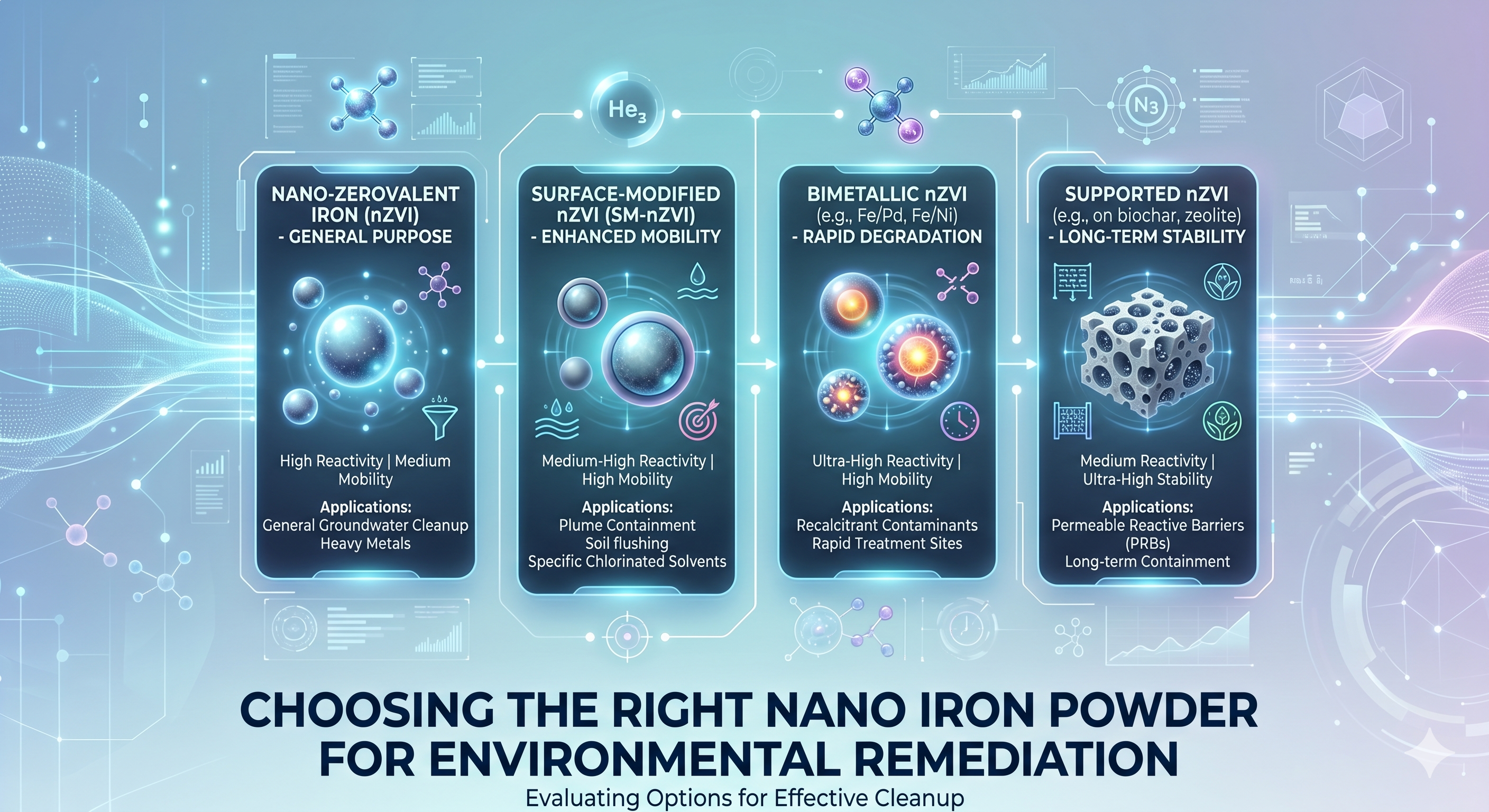
The defining focus of current environmental nanotechnology research is not making particles smaller, but making them smarter. The leading types of modified nZVI engineered to overcome these practical challenges include:
1. Bimetallic Nano Iron (e.g., Fe/Pd, Fe/Ni)
One of the oldest modifications, this involves coating the iron core with a small amount of a second, noble metal catalyst, like palladium (Pd) or nickel (Ni). Current research confirms that this dramatically increases the speed of the reduction reaction—sometimes by factors of 10 or more.
-
When to choose: Excellent for highly persistent chlorinated solvents that resist standard nZVI treatment. However, bimetallic particles can be significantly more expensive.
2. Stabilized and Dispersed nZVI
This is a vital innovation for field application. To prevent agglomeration and “sticking” in the soil, the particles are coated with organic “stabilizers.” These stabilizers can be natural polysaccharides like starch, cellulose, or specialized surfactants (like carboxymethyl cellulose, CMC). The stabilizer creates a protective layer around each particle, preventing them from clumping due to magnetism or electrostatic attraction and allowing them to travel much further within the soil matrix to target the plume.
-
When to choose: Critical when deep injection or extensive underground travel (mobility) is required to reach the contaminant plume.
3. Supported nZVI (e.g., Biochar or Zeolite Support)
This is a burgeoning research area. Instead of dispersed particles, nZVI is embedded onto the surface of a porous, supportive material. Biochar (charcoal made from biomass) is the current hot topic in research. The supporting material acts as a “carrier” for the iron.
-
Recent Lab and Field Breakthroughs: Studies have demonstrated that Biochar-Supported nZVI offers a “one-two punch.” The Biochar adsorbs (traps) the pollutant molecule, bringing it into extremely close, prolonged contact with the embedded nZVI reduction sites. This combined approach drastically increases the overall efficiency of removing heavy metals from groundwater.
4. Emulsified Zero-Valent Iron (EZVI)
Specifically designed for targeting “dense non-aqueous phase liquids” (DNAPLs)—pure pools of chlorinated solvents that sink to the bottom of aquifers and create centuries-long contamination sources. EZVI particles are suspended in an oil-in-water emulsion. The oil droplet “looks” like the solvent pool to the DNAPL, allowing the iron-containing oil to blend with the DNAPL and degrade it in-situ.
-
When to choose: The premier choice for direct targeting of DNAPL “source zones.“
Navigating the Risk: The Advantage–Risk Assessment
Choosing the right nZVI requires an honest evaluation of what the technology can and cannot do.
The Spectacles Advantages:
-
Unmatched Reactivity and Speed: The nano-scale surface area (think atomic-scale sandpaper) makes redox reactions incredibly fast, often reducing contaminant concentrations by orders of magnitude in days rather than months.
-
True In-Situ Treatment: It can be injected directly into the contamination plume, eliminating the need for expensive and energy-intensive “pump-and-treat” systems that run for decades.
-
Versatility: Capable of simultaneously treating complex mixtures of contaminants, such as heavy metals and chlorinated organic compounds, in a single application.
The Inherent Risks and Challenges:
-
Potential Ecotoxicity: This is the elephant in the room. We are injecting highly reactive metal powder directly into delicate microbial ecosystems that are vital for natural soil health. Although many studies show nZVI has low toxic effects on beneficial soil bacteria at appropriate concentrations, high dosages or unregulated transport could potentially harm essential microbial populations. This is an active area of toxicological risk research.
-
Mobility vs. Reactivity Trade-off: The paradox of nZVI. If the particles are modified to be stable and travel far, they might not be reactive enough when they finally reach the contaminant. If they are raw and powerful, they clump and stay near the injection well.
-
Rapid Passivation: If not selected correctly for the site chemistry, the nZVI could lose all its reactivity in weeks rather than months, requiring expensive reinjection.
-
Cost: Engineered nZVI (stabilized, catalyst-supported) is far more expensive per pound than standard bulk iron filings used in Permeable Reactive Barriers (PRBs).
Selection Process: The Blueprint for Success
Choosing the right nano iron powder is not a buying decision, but an engineering selection process. Environmental engineers must answer three critical sets of questions to ensure a successful application.
1. Characterize the Site First
-
What is the principal contaminant? (EZVI for DNAPL? Bimetallic Fe/Pd for resistant TCE? Starch-stabilized nZVI for widespread arsenic plume?)
-
What is the soil and groundwater chemistry? (High dissolved oxygen or nitrates will rapidly consume nZVI’s power before it treats the target pollutants. Low pH will accelerate iron dissolution.)
-
How fast does the groundwater flow? (This determines the travel distance needed.)
2. Evaluate Modification Needs
-
Must the particles travel far? Choose a CMC-stabilized or surfactant-dispersed nZVI.
-
Is speed the priority? Budget for bimetallic catalyst particles (e.g., Fe/Pd).
-
Is it a heavy metal contamination complex? Opt for Biochar-supported nZVI.
3. Define Performance Targets and Budget
-
A complex, expensive stabilized material might be ideal for deep, complex contamination but is cost-prohibitive for a small shallow plume where simpler technologies could suffice. This is where the advantage–risk evaluation of cost vs. time becomes critical.
Conclusion
Nanotechnology offers humanity a true superhero in the fight against underground environmental pollution, but this superhero must be carefully managed. The future of environmental restoring success depends on the transition from viewing all nano iron powder as a single magic wand to treating nZVI as a family of specialized, highly engineered materials. By characterizing the contamination site accurately, understanding the breakthroughs in modifications like biochar support and stabilization, and carefully weighing the high reactivity against potential ecosystem risks, environmental engineers can select the single right nano iron powder engineered specifically to achieve sustainable, permanent remediation success.