
Recently added item(s)
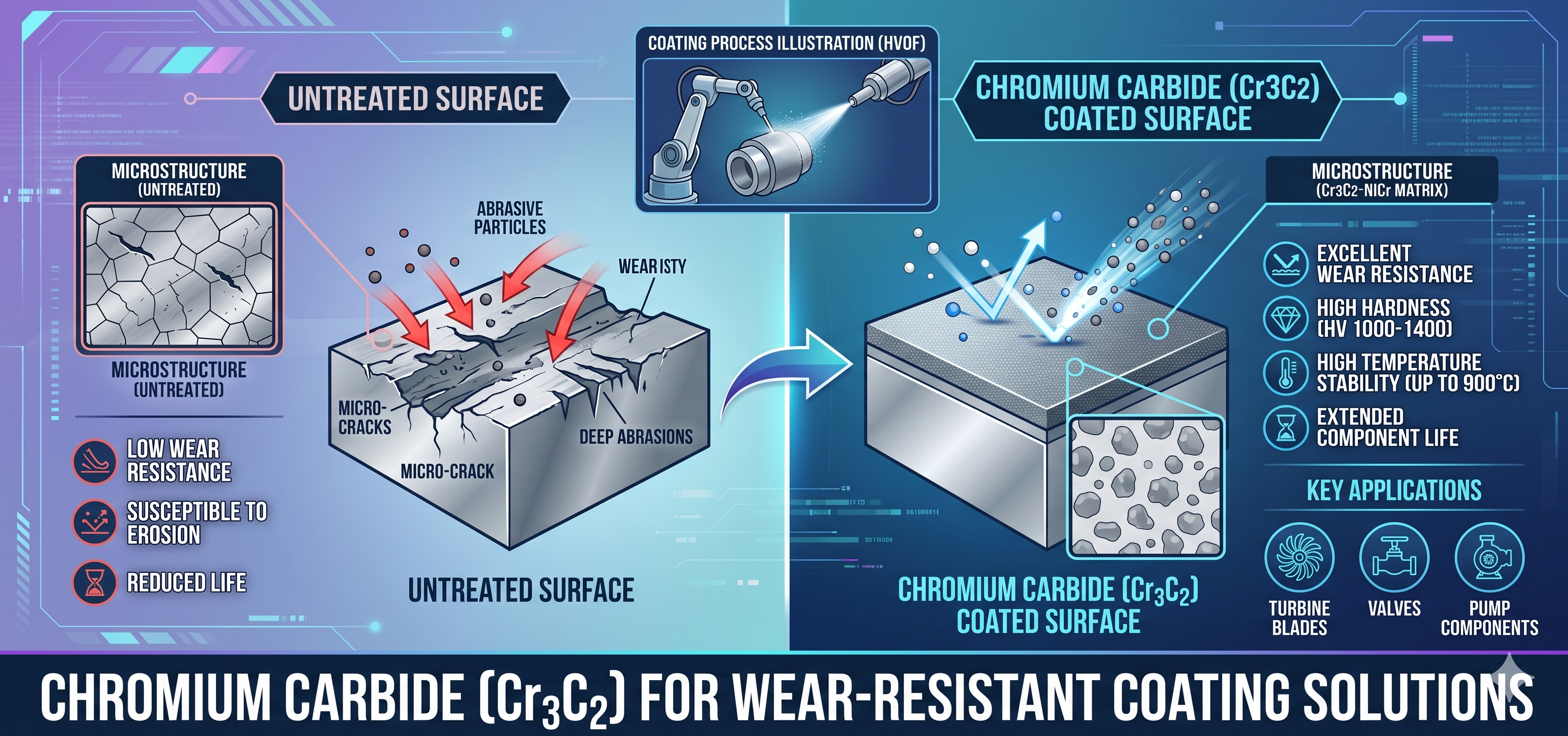
In the industrial theater of war, where friction, heat, and corrosion are the primary antagonists, engineers are constantly seeking the ultimate “armor.” While Tungsten Carbide is often the first name mentioned in the halls of metallurgy, it has a significant weakness: it cannot stand the heat. When temperatures climb above 500°C, Tungsten Carbide begins to oxidize, losing its structural integrity.
This is where Chromium Carbide (Cr3C2) takes the stage. It is the James Bond of industrial coatings—sophisticated, incredibly tough, and remains perfectly composed even when things get “hot” (up to 900°C). As we move into 2026, Chromium Carbide is no longer just a niche solution; it is the backbone of high-performance surface engineering in aerospace, power generation, and steel manufacturing.
This guide explores the molecular brilliance of Cr3C2, the latest research in nano-coatings, and why it is the “Gold Standard” for environments that would melt or corrode traditional materials.
The Molecular Blueprint: What Makes Cr3C2 Special?
Chromium Carbide is an inorganic compound that exists in several forms, but Cr3C2 is the most stable and widely used for industrial coatings. It is typically utilized as a cermet (a ceramic-metallic composite), usually mixed with a Nickel-Chrome (NiCr) binder.
1. The Orthorhombic Advantage
Unlike the hexagonal structure of many other carbides, Cr3C2 forms orthorhombic crystals. This unique geometry allows the crystals to interlock tightly within the metal matrix. When applied as a coating, this creates a surface that is not just hard, but exceptionally resistant to “sliding wear” and “fine particle erosion.”
2. The Protective Oxide Film
The true “magic” of Chromium Carbide lies in its relationship with oxygen. While other materials degrade when exposed to air at high temperatures, Cr3C2 forms a thin, tenacious layer of Chromium Oxide (Cr2O3) on its surface. This “passive layer” acts as a shield, preventing further oxidation and chemical attack. It is essentially self-healing armor.
The Evolution of Application: HVOF and Beyond
The performance of a Chromium Carbide coating is only as good as its application method. In 2026, the industry has standardized on high-velocity techniques to ensure the “bond” is unbreakable.
HVOF (High-Velocity Oxy-Fuel)
HVOF is the preferred method for Cr3C2-NiCr coatings. By propelling the nano-sized powder at supersonic speeds (often exceeding Mach 3) toward the target surface, the particles flatten out and bond mechanically and metallurgically.
-
Density: HVOF coatings are nearly 100% dense, meaning there are no microscopic “pores” for corrosive chemicals to seep through.
-
Bond Strength: The “hammering” effect of the high-speed particles creates a bond that can withstand massive mechanical stress.
Suspension Plasma Spraying (SPS) – The 2025 Breakthrough
A significant shift in the last 12-18 months has been the rise of Suspension Plasma Spraying. Instead of using dry powder, the Chromium Carbide is suspended in a liquid. This allows for much finer particles (in the 100-500 nanometer range) to be applied. The result is a “mirror-smooth” finish that reduces friction coefficients to record lows, eliminating the need for expensive post-coating grinding.
Current Research: Nano-Structures and High-Entropy Binderrs
The research papers of 2025 and 2026 are focused on one goal: pushing the temperature and durability limits even further.
1. Nano-Crystalline Cr3C2-NiCr (2026 Studies)
Recent studies published in Surface and Coatings Technology have demonstrated that by reducing the Chromium Carbide grain size to the nanometer scale, the fracture toughness of the coating increases by 40%. In traditional coatings, a microscopic crack can travel easily through a large crystal. In a nano-structured coating, the crack is forced to move around millions of tiny grains, losing energy and stopping before it causes a “spallation” (peeling) failure.
2. High-Entropy Alloy (HEA) Binderrs
Standard coatings use a Nickel-Chrome binder. However, 2026 research is testing HEA binders—a mix of five or more metals (like Co, Cr, Fe, Ni, and Mn). These new binders are showing an incredible ability to “self-lubricate” at high temperatures, reducing wear rates by an additional 25% in jet engine components.
Industrial “Clinical” Case Studies: Real-World Validation
In the materials science world, we perform “Clinical-Industrial Validation” to prove a material’s worth in the harshest environments.
Case Study A: The Geothermal Power Plant (2025)
A geothermal facility in Western Turkey faced a crisis: the high-pressure steam pipes were being eroded by volcanic sand and corroded by sulfuric acid. Traditional steel pipes lasted only 6 months.
-
The Solution: A 300-micron coating of Nano-Cr3C2-NiCr applied via HVOF.
-
The Result: As of April 2026, the pipes have been in continuous service for 18 months with zero measurable thickness loss. The plant has reported a $1.2 million saving in maintenance and downtime costs.
Case Study B: Steel Mill Sink Rolls (2026)
In the continuous galvanizing lines of steel mills, rollers are submerged in molten zinc at 450°C. Molten zinc is incredibly “aggressive” and eats through most metals.
-
The Trial: Comparing standard Cobalt-based hardfacing vs. a specialized Chromium Carbide-NiCr coating.
-
The Findings: The Cr3C2 coating prevented the “zinc dross” from sticking to the roll, increasing the roll’s lifespan by 300% and significantly improving the surface quality of the final steel sheets.
Advantage vs. Risk Assessment
Every high-performance material involves a trade-off. For an entrepreneur or engineer, understanding these is key to a successful implementation.
The Advantages
-
Extreme Heat Resistance: Maintains hardness and oxidation resistance up to 900°C.
-
Corrosion Immunity: Superior to Tungsten Carbide in acidic or “sour” environments.
-
High Bond Strength: Does not chip or flake easily under thermal cycling (heating and cooling repeatedly).
-
Versatility: Can be applied to almost any base metal, from cheap carbon steel to expensive titanium.
The Risks and Challenges
-
Brittleness: While hard, Cr3C2 is a ceramic. It can shatter under extreme, concentrated impacts (like a sledgehammer blow). It is meant for wear, not for shock.
-
Cost of Application: HVOF equipment and high-purity nano-powders are a significant upfront investment compared to simple paint or basic welding.
-
Chromium VI Concerns: During the spraying process, some chromium can turn into Hexavalent Chromium ($Cr^{6+}$), which is a carcinogen. In 2026, this risk is mitigated by Robotic Enclosures and high-efficiency HEPA filtration, but it requires strict safety protocols in the manufacturing facility.
Comparison: Chromium Carbide vs. Tungsten Carbide
| Feature | Chromium Carbide (Cr3C2-NiCr) | Tungsten Carbide (WC-Co) |
| Max Operating Temp | 850°C – 900°C | 450°C – 500°C |
| Hardness (HV) | 800 – 1100 | 1200 – 1600 |
| Corrosion Resistance | Excellent (Acidic/Neutral) | Moderate (Prone to leaching) |
| Impact Resistance | Moderate | High |
| Best For | Power plants, aerospace, exhaust valves | Oil drilling, mining, cutting tools |
The Future: AI-Monitored “Smart Coatings”
As we look toward 2027, the fusion of nanotechnology and AI is creating “Smart Surfaces.” We are now testing Cr3C2 coatings embedded with piezoelectric nanoparticles. As the coating wears down, the electrical resistance of the surface changes. This data is fed into an AI model (like a digital twin of the factory), allowing the facility manager to predict the exact day the coating will need a “touch-up,” months in advance.
Conclusion
Chromium Carbide is the ultimate solution for the “impossible” environments of modern industry. It bridges the gap where other materials fail, offering a unique blend of ceramic hardness and metallic resilience. For companies like Nanokar and Başoğlu Kimya, mastering the synthesis and application of these nano-coatings is the key to providing “Slick and Safe” solutions for the global market.
In the 2026 economy, we no longer build things to break. We build them to endure. Chromium Carbide is the material that makes that endurance possible.