Recently added item(s)
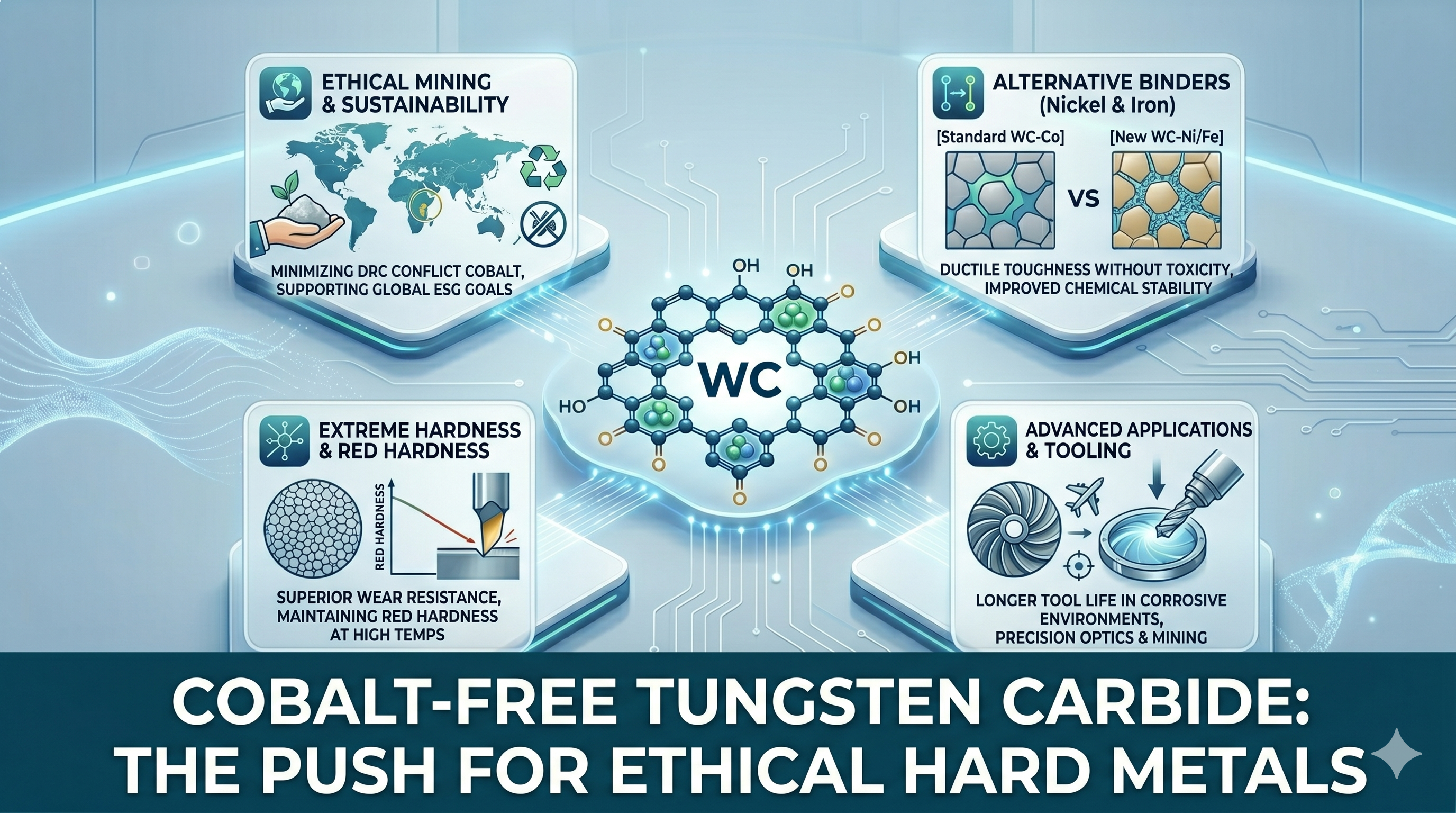
For nearly a century, the partnership between Tungsten Carbide (WC) and Cobalt (Co) has been the bedrock of the global manufacturing industry. Known as “cemented carbide,” this composite material combines the extreme hardness of ceramic tungsten grains with the ductile “toughness” of a metallic cobalt binder. It is the material that drills our oil wells, cuts our aerospace components, and shapes the steel of our automobiles.
However, as we move through 2026, the industrial world is facing a reckoning. Cobalt, once heralded as the perfect binder, has become one of the most controversial elements on the periodic table. Between the harrowing ethical concerns of its mining and its volatile status as a “critical raw material” for the electric vehicle (EV) revolution, the push for Cobalt-Free Tungsten Carbide is no longer just a laboratory experiment—it is a moral and strategic imperative.
1. The Cobalt Paradox: Why Change a Winning Formula?
To appreciate the difficulty of replacing cobalt, we must understand why it was chosen in the first place. In the sintering process, cobalt acts like a liquid glue. It has a unique ability to “wet” the tungsten carbide grains perfectly, dissolving a small amount of the carbide and then reprecipitating it during cooling. This creates a bond that is incredibly strong and resistant to the “grain pull-out” that ruins tools.
However, the “Winning Formula” has three fatal flaws:
-
The Ethical Crisis: Approximately 70% of the world’s cobalt is mined in the Democratic Republic of Congo (DRC). Reports from human rights organizations have repeatedly highlighted the use of child labor, hazardous working conditions, and the environmental devastation associated with “artisanal” mining.
-
The Supply Squeeze: Cobalt is a primary component in NMC (Nickel Manganese Cobalt) batteries for electric vehicles. As the world shifts toward green transport, the demand for cobalt in batteries is outstripping the supply available for the tooling industry, leading to massive price volatility.
-
The Health Risk: Cobalt is classified as a potential carcinogen and is the primary cause of “Hard Metal Lung Disease” (cobalt lung) among workers who grind and sharpen carbide tools.
2. The Contenders: Searching for the New Binder
The race to replace cobalt has led researchers to explore three primary alternative pathways: Nickel-based binders, Iron-based binders, and the revolutionary “High-Entropy Alloy” (HEA) binders.
Nickel-Based Binders (The Corrosion Specialist)
Nickel is the most mature alternative. It offers excellent “wetting” properties similar to cobalt but brings a significant added benefit: Corrosion Resistance. In environments where tools are exposed to acidic cooling fluids or saltwater (such as offshore drilling), Nickel-bound carbide often outperforms the traditional Cobalt version. The challenge has always been hardness; traditionally, Nickel-bound carbide is slightly softer. However, by adding Chromium or Molybdenum, scientists in 2025 have successfully bridged this hardness gap.
Iron-Nickel-Chromium (The Sustainable Hybrid)
Iron is abundant, cheap, and ethical. However, pure iron is too brittle to act as a binder. The current “sweet spot” in metallurgy is an alloy of Iron, Nickel, and Chromium. This hybrid binder mimics the toughness of cobalt while being significantly more sustainable and less toxic to the workers handling the powders.
High-Entropy Alloys (The 2026 Frontier)
The most exciting research in late 2025 and early 2026 involves High-Entropy Alloys (HEAs). Instead of using one primary metal as a binder, HEAs use a mixture of five or more elements in equal proportions. These binders create a “cocktail effect” that can actually exceed the performance of cobalt in both heat resistance and fracture toughness.
3. Binderless Tungsten Carbide: The Ultimate Goal
What if we removed the binder entirely? Binderless Tungsten Carbide is a grade of material that is 99% or more pure WC.
In the past, this was impossible because you couldn’t get the grains to stick together without a metal glue. Today, advanced sintering technologies like Spark Plasma Sintering (SPS) and Microwave Sintering use high-energy pulses to fuse the grains together at the atomic level in minutes.
Applications for Binderless WC:
-
Optical Molds: Because there is no “soft” metal binder to wear away, binderless WC can be polished to a mirror finish that stays perfect for thousands of cycles.
-
High-Wear Seals: Used in chemical pumps where even a Nickel binder would eventually corrode.
-
Extreme Precision: Ideal for the micro-drills used in the semiconductor industry.
4. Current Industrial “Field Tests” and Research (2024–2026)
Recent data from industrial “clinical” trials—controlled tests in high-volume factories—have provided a clear roadmap for the cobalt-free transition.
-
The Aerospace Test (2025): A major European aerospace manufacturer replaced 20% of their cobalt-bound milling inserts with a Nickel-Chromium alternative. The results showed that while the initial wear was 5% higher, the “catastrophic failure rate” (shattering) was actually lower, leading to a more predictable production cycle.
-
The Mining Field Study (2026): In a South African gold mine, cobalt-free drill bits were tested against standard bits. The cobalt-free versions showed superior performance in high-sulfur rock veins where cobalt typically suffers from “leaching” and chemical erosion.
-
The “Nano-Correction” Research: A pivotal paper published in early 2026 demonstrated that by using nano-sized tungsten carbide grains, the amount of binder (Nickel or Iron) could be reduced by half while maintaining the same strength. This “less-is-more” approach is the current strategy for companies looking to minimize their ethical footprint without compromising quality.
5. Advantage vs. Risk Assessment
For a procurement specialist or a business owner, the transition involves a complex balance of ethics, cost, and performance.
The Advantages (The Pros)
-
Ethical Compliance: Eliminates the risk of “Conflict Cobalt” in the supply chain, which is becoming a mandatory requirement for ESG (Environmental, Social, and Governance) reporting.
-
Price Stability: Nickel and Iron are much less prone to the “EV-driven” price spikes that plague the cobalt market.
-
Chemical Resistance: Superior performance in corrosive environments (oil/gas and chemical processing).
-
Worker Safety: Significant reduction in the risk of respiratory diseases in the manufacturing plant.
The Risks and Challenges (The Cons)
-
The “Toughness” Gap: In high-impact applications (like jackhammers), cobalt still holds a slight edge in absorbing sudden shocks.
-
Processing Difficulty: Sintering Nickel or Iron-based carbides requires different temperature profiles and atmosphere controls, which may require upgrades to existing vacuum furnaces.
-
Recycling Complexity: The global carbide recycling infrastructure is currently optimized for WC-Co. Mixing in Nickel-bound scrap can complicate the “Zinc Process” of recycling, requiring better sorting at the source.
6. The Role of AI and Automation in the Transition
The shift to cobalt-free materials is being accelerated by AI-driven material discovery. Systems like the “Nanokar Jarvis” architecture allow companies to simulate thousands of different binder combinations in a virtual environment before a single gram of metal is sintered.
In 2026, we are seeing the rise of “Digital Material Passports.” By using cloud-based tracking, a manufacturer can prove exactly where the tungsten and the binder came from. If a customer demands an “Ethical Tooling Certificate,” the AI assistant can pull the chemical analysis and the blockchain-verified supply chain data in seconds, providing a massive competitive advantage in the Western market.
7. Strategic Outlook for 2027 and Beyond
The goal for the next two years is clear: the industry is moving toward a “70/30” split. High-impact, heavy-duty applications may remain with cobalt for the near future, but the remaining 70% of machining, wear parts, and surgical tools will transition to Nickel or Iron-based binders.
For Turkey’s growing advanced materials sector, this is a golden opportunity. By positioning itself as a leader in “Ethical Hard Metals,” Turkey can become the primary supplier for European industries looking to “de-risk” their supply chains away from conflict-heavy regions.
8. Conclusion: The New Standard of Hardness
The “Black Diamond” and the “Workhorse of Machining” are undergoing their most significant change since their invention in the 1920s. We are proving that we can have industrial progress without the ethical baggage of the past. Cobalt-free Tungsten Carbide is not just a substitute; it is an evolution toward a more resilient, stable, and humane industrial world.
The backbone of modern machining is being rebuilt—and this time, it is built on a foundation of both hardness and integrity.