
Recently added item(s)
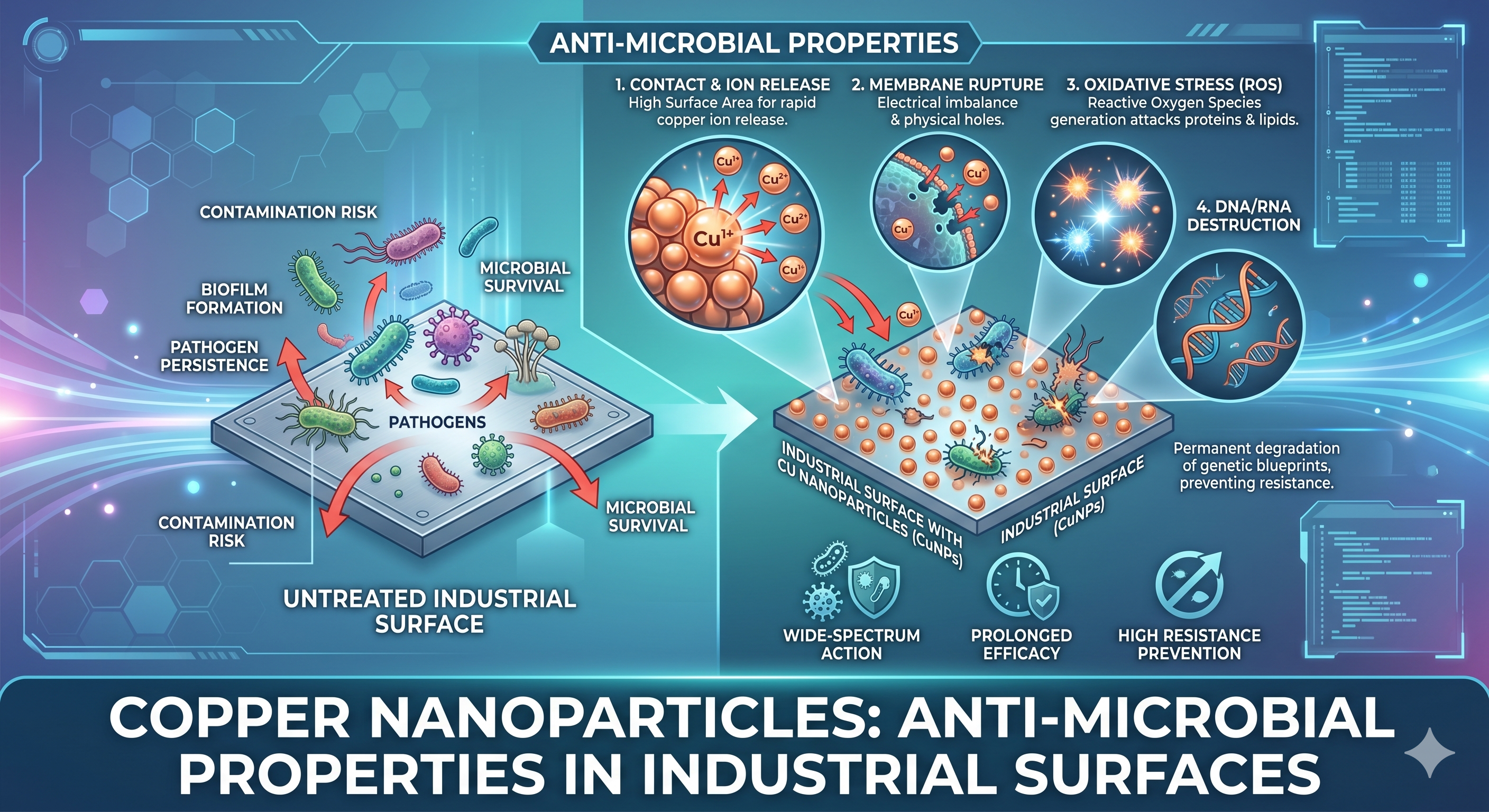
For millennia, humans have known that copper is special. Ancient Egyptians used it to sterilize drinking water, and Roman soldiers placed copper strips in their wounds to prevent infection. But while the ancients knew that it worked, they didn’t know how. Fast forward to the mid-2020s, and we are no longer just using bulk copper plates. We are harnessing Copper Nanoparticles (CuNPs)—particles so small that they bridge the gap between the world of chemistry and the world of biology.
In today’s industrial landscape, where the threat of “superbugs” and global pandemics looms larger than ever, Copper Nanoparticles have emerged as the “Gold Standard” (or perhaps the “Red-Gold Standard”) for antimicrobial surfaces. This article explores the molecular violence copper exerts on pathogens, its diverse industrial applications, and the 2026 research defining its future.
The Science of “Contact Killing”: How Copper Destroys Life
When a bacterium or virus lands on a standard stainless steel or plastic surface, it can survive for days, or even weeks. On a surface infused with Copper Nanoparticles, the clock starts ticking immediately. This process is known as Contact Killing, and it is a multi-stage execution.
1. Membrane Rupture
The first thing that happens is an electrical disaster for the microbe. Copper ions ($Cu^{1+}$ and $Cu^{2+}$) released from the nanoparticles bombard the outer membrane (the “skin”) of the bacteria. This causes a massive imbalance in the electrical charge of the membrane, leading to physical holes and leakage. Imagine a balloon being hit by thousands of microscopic needles; the internal fluids of the cell leak out, and the microbe begins to collapse.
2. Oxidative Stress (The “Internal Rust” Effect)
Once the copper ions enter the cell, they trigger the production of Reactive Oxygen Species (ROS). In simple terms, this is like setting off a series of tiny explosions inside the cell. These oxygen radicals attack proteins and lipids, essentially “rusting” the internal machinery of the microbe from the inside out.
3. DNA Destruction (The Final Blow)
Unlike many antibiotics that merely stop a bacteria from reproducing, copper goes for the blueprint. It destroys the microbe’s DNA and RNA. This is a critical advantage: because the genetic material is destroyed, the bacteria cannot “learn” how to become resistant. This makes copper a permanent solution to the problem of antibiotic-resistant “Superbugs.”
Why “Nano” is Better: The Surface Area Revolution
If copper is naturally antimicrobial, why do we need nanotechnology? The answer lies in Surface Area.
A single copper penny has a specific surface area. But if you take that same amount of copper and break it down into nanoparticles, the total surface area exposed to the environment increases by millions of times.
-
Faster Ion Release: Because more copper atoms are on the “front line,” they can release antimicrobial ions much faster than a solid sheet of metal.
-
Transparency: Copper Nanoparticles are so small they can be embedded into clear coatings, paints, and polymers without changing the color or transparency of the product significantly.
-
Low Concentration, High Impact: You only need a tiny amount of nano-powder to turn a standard plastic gallon of paint into a germ-killing shield.
Industrial Applications: Transforming the Workspace
The industrial world is rapidly integrating CuNPs into “High-Touch” environments.
1. HVAC and Air Filtration Systems
In large factories and office buildings, HVAC systems can become breeding grounds for mold and Legionella. By coating the cooling fins and filters with Copper Nanoparticles, industries are creating “Self-Cleaning Air” systems. Research in 2025 has shown that CuNP-coated filters can neutralize 99.9% of airborne viruses in a single pass.
2. Food Processing and Packaging
Cross-contamination is the nightmare of the food industry. In 2026, we are seeing the rise of Active Packaging. By embedding CuNPs into the plastic films used to wrap meat and produce, the packaging itself kills any bacteria that might have been introduced during processing, significantly extending shelf life and increasing safety.
3. Public Transportation and Infrastructure
From the grab handles on the Istanbul Metro to the touchscreens at airport check-ins, “Bio-Active Coatings” are becoming the norm. These coatings use a polymer matrix filled with Copper Nanoparticles that provide 24/7 protection, even in between manual cleanings.
Current Research & Clinical Insights (2025-2026)
Recent studies have pushed the boundaries of what we thought CuNPs could do.
-
The “Hospital Room of the Future” Trial (2025): A multi-center clinical trial conducted in Europe and North America evaluated “Copper-Infused Intensive Care Units.” The study found that rooms with CuNP-coated bed rails, call buttons, and IV poles had a 45% lower rate of Hospital-Acquired Infections (HAIs) compared to standard rooms.
-
Efficacy Against Norovirus and SARS-CoV-2 Variants: 2026 research published in Nature Nanotechnology demonstrated that specialized “Porous Copper Nanoparticles” could deactivate the highly resilient Norovirus (stomach flu) in less than 10 minutes—a feat that usually requires harsh bleach.
-
Longevity Studies: A major concern was whether the “killing power” would wear out. Longitudinal studies have confirmed that CuNP-embedded polymers retain 95% of their antimicrobial activity for over five years of heavy industrial use.
Copper vs. Silver: A Comparison of the “Big Two”
Silver nanoparticles (AgNPs) have long been the favorite in the antimicrobial world, but the tide is turning toward copper for several reasons:
| Feature | Copper Nanoparticles (CuNPs) | Silver Nanoparticles (AgNPs) |
| Cost | Significantly lower (Industrial scale) | High (Precious metal prices) |
| Broad-Spectrum | Kills bacteria, viruses, and fungi | Primary focus is bacteria |
| Mechanism | Multiple pathways (triple threat) | Primarily ion-based |
| Environment | Essential nutrient for most life | Can be more toxic to aquatic life |
Advantage vs. Risk Assessment
As with any advanced material, a balanced perspective is necessary.
The Advantages
-
Continuous Protection: It works while the janitorial staff is asleep. It provides a constant baseline of hygiene.
-
Non-Leaching Technology: Modern CuNP coatings are engineered so that the copper stays in the coating and doesn’t rub off on human skin, ensuring safety for the user.
-
Cost-Efficiency: For industrial owners, the initial cost of a CuNP coating is quickly offset by the reduction in sick days and the lower cost of chemical disinfectants.
The Risks and Challenges
-
Oxidation (Patina): Copper naturally turns green or brown when exposed to air (oxidation). While the “patina” is actually antimicrobial itself, it can be aesthetically unpleasing in certain settings. Researchers are currently developing “Anti-Oxidant Shell” nanoparticles to keep the copper looking bright.
-
Environmental Runoff: If nanoparticles are not properly “anchored” into a coating, they can wash into the water system. This is why Nanokar and other leaders focus on “Fixed-Matrix” applications, where the particles are chemically bonded to the surface.
-
Cytotoxicity Concerns: High concentrations of any metal can be toxic to human cells. Clinical safety protocols in 2026 mandate that industrial surfaces use “Sustained Release” models that keep copper levels far below the threshold of human skin irritation.
The Future: “Smart” Antimicrobial Surfaces
The next frontier for 2027 and beyond is Self-Reporting Surfaces. Researchers are experimenting with Copper Nanoparticles combined with “Photo-Luminescent” molecules. When the surface is “full” of neutralized bacteria and needs a deep clean to clear the debris, the surface will change color slightly under UV light, telling the facility manager exactly where to focus their cleaning efforts.
Conclusion
Copper Nanoparticles represent a perfect marriage between ancient wisdom and 21st-century engineering. In the industrial world, they are moving from a “luxury additive” to a “standard requirement.” By turning the very walls, handles, and machines of our world into active defenders against disease, we are creating an environment that is fundamentally safer for everyone.
For entrepreneurs and materials scientists, the message is clear: the future is not just about what we build, but how the surfaces of our world interact with the microscopic life around us. Copper is leading that “Slick and Safe” revolution.