
Recently added item(s)
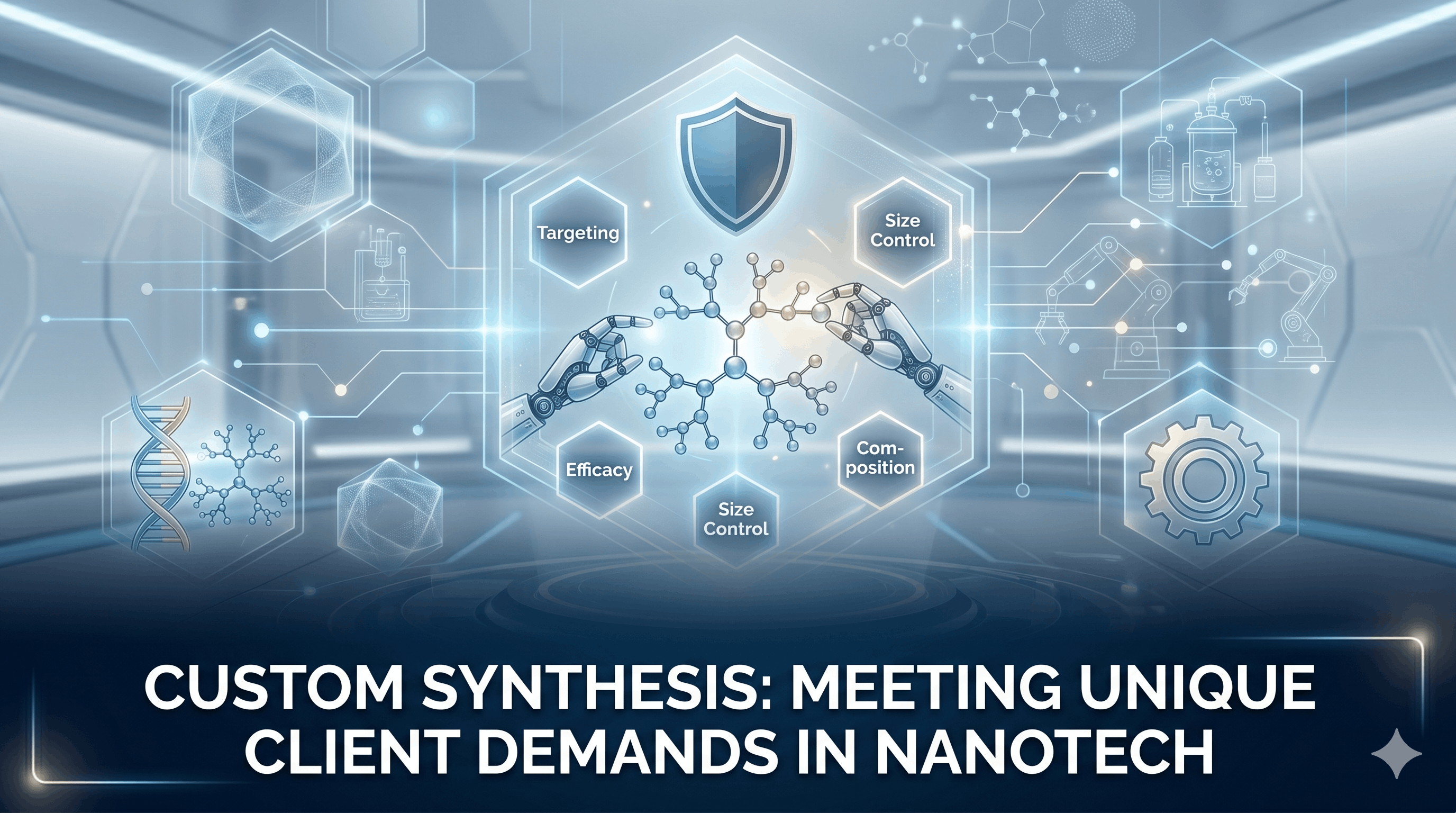
Nanotechnology, the science of manipulating matter at an atomic and molecular scale, has long ceased to be just a theoretical field. It is now a powerful reality driving innovation across almost every sector of modern industry. From small-scale manufacturing in agriculture and medicine to large-scale production in automobiles and environmental management, nanotechnology has modernized nearly every facet of our world [2.1.2]. However, the core of this revolution lies not just in using nanomaterials, but in using the right nanomaterials. This is where Custom Synthesis becomes the indispensable backbone of advanced nanotechnological application.
Traditional manufacturing often focuses on standardized, mass-produced materials. But in the realm of the ultra-small, standard solutions rarely meet the highly specific, unique demands of pioneering industries. Custom synthesis allows companies to move beyond “off-the-shelf” materials, enabling them to design and acquire nanomaterials tailored with precision to their exact morphological, physical, and functional needs [2.1.1]. Whether it’s optimizing drug delivery efficiency to >95% using specialized ionizable cationic lipids like ALC0315 [2.1.1], or creating self-assembling photoactive semiconductors for next-gen energy panels [2.1.1], custom synthesis bridges the gap between scientific ambition and practical reality.
The Rise of the Tailored Nano-Landscape
As the nanotechnology market approaches a projected USD 220.8 Billion by 2031, growing at a rapid CAGR of 13.21% [2.1.1], the need for specialization is skyrocketing. This market growth is segmented by type (nanomaterials, nanocomposites, nanodevices) and manufacturing process, where bottom-up approaches (creating complex nanostructures from molecules/atoms) hold nearly 60% of the share [2.1.1, 2.2.2]. This prevalence highlights the shift from merely grinding down materials to intelligently building them.
Custom synthesis in nanotechnology is the advanced engineering practice of designing and fabricating these complex nanostructures. It is the process of building materials from the ground up—atom by atom, molecule by molecule—to have specific features tailored to a unique application [2.2.2]. It allows scientists to control multiple critical parameters that define how a material performs:
-
Morphology: Customizing shape to create nanowires, nanorods, nanospheres, nanoribbons, nanocubes, nanoflowers, or nanotubes [2.2.1]. The shape of a nanoparticle affects everything from its surface area-to-volume ratio to its optical properties and how it interacts with biological systems.
-
Dimension: Precise control over particle measurements, often down to the nanometer scale, for example up to 200 nm for certain metal nanoparticles [2.2.1].
-
Composition: Mixing different elements to create nanometals, nanometal oxides, semiconductors, polymeric nanomaterials, or advanced nanocomposites [2.2.1].
-
Surface Functionality: “Dressing” the nanoparticle with specific functional groups, biomolecules, polymers, or coatings (like silica or carbon) [2.2.1]. This is crucial for enabling the particle to selectively bind to target cells in medicine or to stabilize it against aggregation [2.3.1, 2.2.1].
-
Properties: Tuning the optical density, absorbance, or scattering characteristics across the visible and infrared range by altering morphology and composition [2.2.1].
Medicine as the Primary Driver: Precison Therapeutics and Vaccines
The single largest end-user of nanotechnology is the pharmaceutical industry, which dominated with a 36.05% market share in 2025 [2.1.1]. The surge in mRNA-lipid nanoparticle demand for next-generation vaccines is a powerful testament to the necessity of custom synthesis [2.1.1]. Lipid nanoparticles, once a niche pandemic solution, have now become the foundational backbone for precision medicine, shifting from cyclical demand to a structural market requirement [2.1.1]. Customization allows contract drug manufacturers to steadily add capacity for these sophisticated formulations [2.1.1].
Drug Delivery and Controlled Release
Custom synthesized nanomaterials, particularly nanoparticles, are revolutionizing how diseases are treated by acting as precise delivery systems [2.3.1]. In classical drug administration, poor bioavailability and aqueous solubility often limit the absorption of hydrophobic drugs [2.3.1]. Custom engineered nanoparticles can extend the shelf lives of food products, but their most critical role is improving intracellular delivery [2.3.1].
By engineering specific surface properties, custom nanoparticles can selectively target diseased cells (like tumors) while avoiding healthy tissues [2.3.1]. This approach can significantly increase drug efficacy while simultaneously reducing severe side effects [2.3.1]. Furthermore, these tailored carriers can be designed for controlled release, allowing a sustained delivery of cargo over time, rather than a single toxic spike [2.3.1].
Overcoming Biological Barriers
The potential of nanomedicine lies in its ability to navigate the body’s complex defense systems [2.4.1]. Custom synthesis is essential for developing nanoparticle-based strategies (such as liposomes or nanospheres) to overcome major obstacles like:
-
The Blood-Brain Barrier (BBB): This tight seal restricts large or hydrophilic molecules from entering the brain, a major hindrance to treating central nervous system (CNS) disorders [2.4.1].
-
Intravenous Barriers: Drugs must overcome hurdles in circulation, where phagocytic immune cells primarily remove nanomedicines [2.4.1, 2.6.1]. Customizing the nanoparticle’s “stealth” coating can prolong circulation time [2.4.1].
-
Tumor Vasculature: Delivering therapeutics into solid tumors is incredibly challenging due to heterogeneous vasculature, high tumor cell density, and dense stroma containing collagen [2.4.1]. Custom nanoparticles can be designed to exploit the leaky tumor microvasculature while navigating the dense tumor interstitial space [2.4.1].
From Energy to Electronics: Beyond the Biological Realm
While medicine dominates, the impact of custom synthesized nanomaterials ripples through other high-value sectors:
-
Energy and Sustainability: Customization enables advanced materials for energy storage, a sector set to grow at 15.6% CAGR through 2031 [2.1.1]. Projects use synthetic DNA to self-assemble photoactive semiconductors for next-generation panels, while aerogel panels like Slentite meet stricter thermal codes and cut wall thickness [2.1.1].
-
Nanocomposites and High-Value Structures: Aerospace industries use responsive nanocomposites, while nanotools stay niche but high-value [2.1.1].
-
Nanodevices and Quantum Dots: Customization allows the transition from materials to integrated functions, such as smart diagnostic tools and display upgrades using quantum-dot devices, validating premium pricing in this growing market segment [2.1.1].
Advantage-Risk Assessment of Custom Nano-Synthesis
While custom synthesis offers unparalleled opportunities, it comes with a complex landscape of advantages and risks that define its development path.
Advantages (The Case for Customization)
-
Precision and Enhanced Performance: Materials are designed for a singular purpose, offering superior functionality compared to standardized materials, such as optimized electrical conductivity, higher surface area-to-volume ratio, or tuned optical densities [2.3.1, 2.2.1].
-
Unique Targetability in Medicine: Customized surfaces and coatings (like PEGylation) enable nanoparticles to selectively bind to disease markers, bypassing healthy tissues and biological barriers [2.4.1, 2.3.1].
-
Intellectual Property and Competitiveness: Custom processes allow the creation of unique, patentable materials, providing a strong competitive edge in the high-stakes high-tech economy.
-
Enabling Future Technologies: Customization is the essential step for moving from fundamental science (e.g., studying band gaps or thermal conductivity) to practical aspects, such as translating new fab processes or optimizing devices to exceed industrial state-of-the-art [2.5.1].
Risks and Challenges (The Barriers to Adoption)
-
High Development Costs: Creating custom polymers or particles involves expensive raw materials (like medical-grade pure monomers), advanced equipment, and specialized expertise, which can deter small businesses [2.4.2].
-
Scalability Issues: Precision in a lab is easier to achieve than reproducibility on a commercial scale [2.4.2]. Scaling up often leads to variability in quality, consistency, and efficiency, resulting in performance issues [2.4.2].
-
Technical Complexity: Precise customization (like synthesizing stimuli-responsive polymers) requires intricate techniques and long development cycles [2.4.2]. The multi-component 3D constructs of nanoparticles necessitate detailed orthogonal analysis methods for reproducibility [2.4.1].
-
Regulatory Hurdles: Safety evaluation methods for regulatory purposes lag behind scientific development [2.6.1]. Biocompatible polymers for drug delivery must pass rigorous FDA or EMA evaluations [2.4.2]. Characterization of immune toxicities is particularly challenging as phagocytic immune cells are the primary route for removing nanomedicines [2.4.1, 2.6.1].
-
Environmental and Supply Chain Concerns: There are persistent concerns regarding high energy consumption, toxic solvents, and raw material supply volatility, especially due to geopolitical tensions for specialized monomers or catalysts [2.4.2, 2.4.1].
Conclusion: Custom Synthesis as the Essential Future
Custom synthesis is not a fleeting trend; it is the structural mechanism underpinning the stable growth of the nanotechnology industry [2.1.1]. From tailoring lipid nanoparticles for next-gen vaccines that secure >95% delivery efficiency to designing self-assembling semiconductors for sustainable energy solutions, custom synthesis meets unique client demands that standardized materials cannot address [2.1.1]. It is the pathway to premium pricing for nanodevices and nanocomposites, enabling commercial roll-outs of smart diagnostics and aerospace systems [2.1.1].
Despite the substantial challenges—ranging from high development costs and scalability issues to complex regulatory landscapes—momentum remains structural rather than cyclical [2.4.2, 2.1.1]. The future will belong to those who can master the technical complexity of orthogonal analysis, advanced characterization, and the reproducible manufacturing processes needed to achieve consistent custom nano-solutions [2.4.1, 2.4.2]. By bridging the academic-industry knowledge gap and addressing the risks, custom synthesis will continue to define the frontier of unique nanotech innovations.