
Recently added item(s)
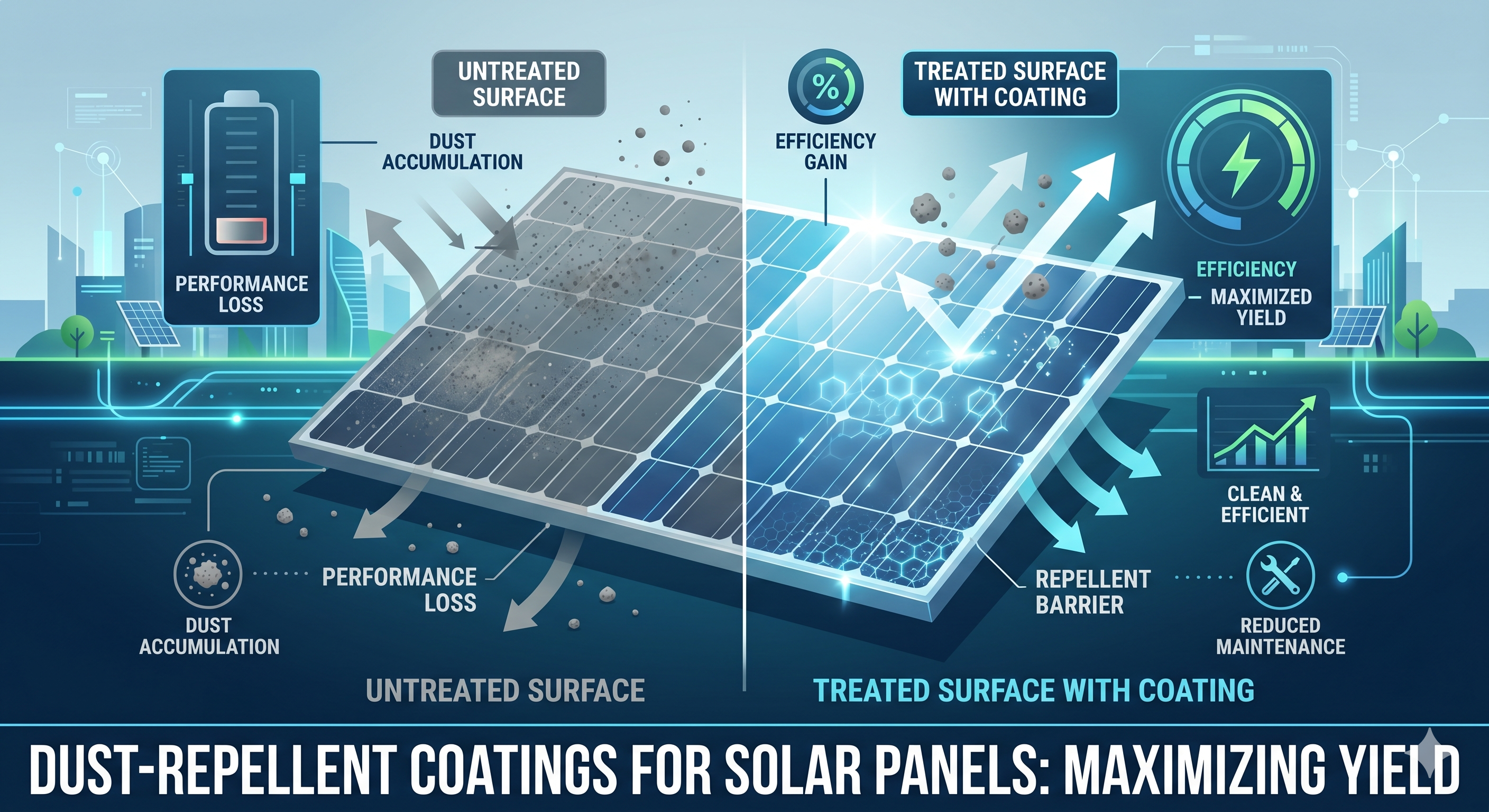
The global transition toward renewable energy is in full swing, and solar power stands at the forefront of this revolution. We are covering deserts, rooftops, and vast fields with photovoltaic (PV) panels, turning sunlight directly into electricity. But there is a silent, microscopic enemy threatening the efficiency of this green army: dust.
In the solar industry, this phenomenon is known as “soiling.” While it sounds innocuous, the accumulation of dust, pollen, sand, and bird droppings on solar panels can drastically reduce their power output. To combat this, materials science has introduced a powerful ally: dust-repellent (anti-soiling) coatings.
This blog explores the science behind these innovative coatings, the results of recent “clinical” field studies, the economic advantages, and the potential risks associated with their adoption.
The Invisible Enemy: How Soiling Impacts Solar Yield
Solar panels work by allowing photons (light particles) to enter the solar cell, knocking electrons loose to create a flow of electricity. Anything that blocks that light reduces the power generated.
A layer of dust might seem insignificant, but its impact is multiplicative across a large solar farm. Research has shown that in high-dust regions, such as the Middle East, North Africa, or desert areas in the southwestern United States, soiling can reduce a panel’s efficiency by 15% to 30% in just a few weeks if left uncleaned. In extreme cases, complete neglect can lead to yield losses exceeding 50%.
Furthermore, dust is rarely distributed evenly. Uneven accumulation creates “hot spots.” A shaded or dirty cell in a series acts as a resistor, heating up because it cannot pass the current generated by the clean cells. This not only causes immediate power loss but can permanently damage the panel, shortening its lifespan.
Traditional solution is manual cleaning. However, cleaning solar farms, especially in remote desert areas, is expensive, water-intensive (a scarce resource in deserts), and risks abrasive damage to the panels. This is why dust-repellent coatings have shifted from a scientific curiosity to an industrial necessity.
The Science of Repulsion: How These Coatings Work
There isn’t a single type of anti-soiling coating; rather, there are two primary scientific approaches based on surface energy and chemistry: Hydrophobic and Hydrophilic.
1. Hydrophobic (Water-Fearing) Coatings: The “Lotus Effect”
Imagine water beading up beautifully on a freshly waxed car. This is hydrophobicity. These coatings create a “nanostructured” surface with very low surface energy.
In nature, this is best exemplified by the Lotus leaf. Under a microscope, the leaf isn’t smooth; it’s covered in microscopic pillars coated in waxy nanocrystals. Water cannot wet the surface; instead, it rests on the tips of these pillars, forming near-perfect spheres. Because the water cannot grip the surface, gravity causes it to roll off at the slightest tilt.
Crucially, as these water beads roll, they act like tiny vacuum cleaners, picking up dust and dirt particles along the way. This is known as the self-cleaning effect. In regions with occasional morning dew or light rain, hydrophobic coatings are incredibly effective.
2. Hydrophilic (Water-Loving) Coatings and photocatalysis
While it sounds counterintuitive, water-loving surfaces can also repel dust. These coatings often utilize Titanium Dioxide ($TiO_2$) or silicon-based nanoparticles.
A hydrophilic surface has high surface energy, causing water to flatten and spread into a thin, continuous film rather than beading up. When it rains (or panels are rinsed), this sheeting action washes away dust very evenly, preventing water spots that can cause shading.
The real magic of hydrophilic coatings often lies in photocatalysis, typically achieved with $TiO_2$. When exposed to ultraviolet (UV) light from the sun, the $TiO_2$ acts as a catalyst, triggering a chemical reaction that breaks down organic matter on the panel’s surface (like pollen, bird droppings, or diesel soot). Once the organic binders are destroyed, the remaining inorganic dust cannot stick and is easily washed away by wind or light rain.
Inside the Lab and Out in the Field: Recent Research and “Clinical Studies”
While engineering laboratories can create miraculous materials, the PV industry demands evidence from the real world. In engineering terms, these are our “clinical studies”—rigorous field trials where coated panels are compared to uncoated controls for years.
The Graphene Innovation
Recent breakthroughs are incorporating graphene into coatings. A study published in a leading energy journal highlighted a graphene-based nano-coating that is both super-hydrophobic and highly conductive. The conductivity helps dissipate static charge, which is a major reason why fine desert dust adheres to glass panels. The study reported a maintenance of over 95% of the panel’s initial efficiency after six months in a harsh, simulated desert environment, compared to a control panel which dropped below 70%.
Durability Trials
The Achilles’ heel of early coatings was durability. Sun, wind-driven sand, and cleaning brushes stripped the coatings within a year. Modern research focuses on “ruggedizing” these nanoscale surfaces. State-of-the-art studies are now proving that mineral-based, inorganic hydrophilic coatings (like those using nano-silica) can chemically bond with the glass surface, providing anti-soiling benefits for 10 to 15 years. A recent trial in Dubai demonstrated that coated panels required 70% less water for cleaning while maintaining a 6% higher average annual yield compared to daily-cleaned panels.
Combating Electrostatic Adhesion
Dust sticks partly because of electrostatic forces. New research into materials science has produced anti-static, dust-repellent coatings. These coatings don’t just rely on water; they actively prevent dust from forming a static bond with the panel in the first place. This is critical for arid regions where it rarely rains. Field studies in desert environments indicate that anti-static coatings alone can reduce the rate of soiling by 40% to 50%.
The Bottom Line: Advantage–Risk Evaluation
Choosing to coat solar panels involves balancing significant benefits against potential drawbacks.
Advantages (The Yield Maximizers)
-
Increased Energy Yield: This is the primary driver. By maintaining cleanliness, coatings ensure panels operate closer to their rated capacity. A modest 5% annual increase in yield can translate to millions of dollars in revenue over the lifespan of a large solar utility.
-
Reduced O&M Costs: Operations and Maintenance (O&M) are significant expenses. Coatings drastically reduce the frequency of manual cleaning required.
-
Water Conservation: As water becomes scarcer, using it to clean panels is ecologically and economically undesirable. Self-cleaning coatings minimize or eliminate the need for water in maintenance.
-
Panel Longevity: By preventing hotspots and abrasive damage from frequent cleaning, coatings can extend the functional lifespan of PV modules.
-
Improved ROI: While there is an upfront cost, the combination of increased yield and lower maintenance costs leads to a better return on investment and a shorter payback period for the project.
Risks and Challenges
-
Initial Capital Expenditure: High-quality coatings, especially when professionally applied, add significant cost to the initial construction of a solar farm.
-
Durability and Degredation: No coating lasts forever. If a coating degrades unevenly, it might cause partial shading or hotspots, the very problems it was meant to solve. UV radiation and sand abrasion can strip coatings faster than anticipated.
-
Spectral Mismatch: Some coatings can slightly alter the light spectrum passing through to the cell. While designed to be anti-reflective (increasing light capture), a poorly formulated coating could accidentally block certain wavelengths, slightly reducing efficiency in clean conditions.
-
Environmental Concerns: The synthesis and application of certain nanomaterials must be managed carefully. Materials like fluoro-compounds (used in some hydrophobic coatings) are persistent in the environment. The industry is shifting toward more benign mineral-based solutions (like silica and $TiO_2$) to mitigate this risk.
-
Performance Variability: A coating that works perfectly on a humid, pollen-filled rooftop in Germany may fail completely in a dry, sandy desert in Oman. The solution must be region-specific.
Conclusion
Dust-repellent coatings represent a critical leap forward for the solar industry. They transform the maintenance of solar assets from a reactive, labor-intensive model to a passive, engineered solution. By closing the gap between potential solar capacity and actual performance, these advanced coatings ensure we get every possible watt of clean energy from the sun.
As research continues to increase the durability and decrease the cost of nanostructured and photocatalytic coatings, they will evolve from an “optional upgrade” to a standard, non-negotiable component of all solar panel installations worldwide, keeping the shimmer of clean energy maximization alive.